



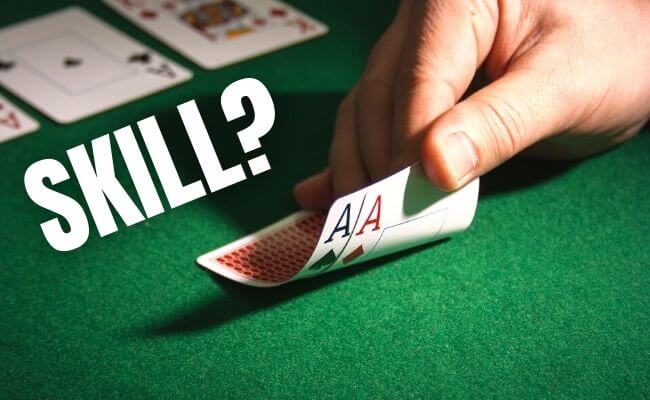
Here’s something interesting to try out – go around and ask different people whether poker is luck or skill. You’ll be really surprised at how the answers split fast, usually along whether the person has ever tried playing seriously.
Results over time don’t look random once enough hands are played. That gap between one hand and ten thousand hands is where most of this argument builds up. You won’t be able to tell if any of the sides is fully wrong. This has led the debate to go on for years and years with no clear answer in sight.
What actually decides a hand?
A single hand of poker leans hard on luck. Two players push their money in with the same math, and the better cards win more often than not. No amount of skill changes what card comes off the deck next. That’s the part casual players notice most, especially anyone learning through a poker app where hands move fast and one bad beat feels like proof the whole game is rigged toward chance. Slow the sample size down, though, and the picture starts moving. Play a thousand hands instead of ten, and the better decisions start pulling weight that the cards alone can’t explain.
The legal fight over skill vs. luck
If you think that the general discussion is limited to the public alone, here’s something interesting to know. The courts have too argued about this for decades. A 2012 federal case in New York ruled that poker leans on skill enough to avoid federal gambling statutes. The ruling was overturned on appeal two years later on a technicality, which really left the skill question unanswered.
States still handle it differently. Some carve out exceptions for poker specifically. Others consider it something similar to slots and call it a day. Nevada and New Jersey treat it as its own category entirely, separate from the rest of the casino floor.
Why variance fools people
People watching from outside see one big win and start crediting it to luck. Results that can be trusted are derived from long-term data, but in the casino world, not many people care about that.
Short-term results in poker swing wildly even among players with a real skill gap between them. A weaker player can beat a stronger one across a single session, a single tournament, sometimes a whole weekend. That’s purely because the deck ran their way.
What professionals actually do differently
Pro-level players don’t struggle against variance — they’re just built to survive it. Bankroll management keeps one bad stretch from wiping someone out before the skill edge has time to show up in the numbers.
Analyzing betting patterns, tuning as per an opponent’s tendencies, knowing when a fold saves more money than a call would win — none of that touches the cards themselves. But all of it changes how much money moves in a player’s direction over time.
Where luck genuinely takes over
The argument around what defines luck versus what defines skill is not as simple as it seems when it’s poker-specific. Poker sits closer to the blurry middle than most games people call skill-based. A single hand is mostly luck. A single tournament still carries a heavy dose of it. One elimination hand can end a great player’s night regardless of how well everything before it went. Skill shows up as a statistical lean, but that’s not a guarantee at all. This is why the debate never fully resolves either way.
The content side of the debate
Go to any social media feed that serves poker fans, and you’ll see endless poker strategy content. The loudest opinions on luck versus skill now come from online creators who learn in pieces and from various resources. They are not really good players themselves.
This content might be useful in some way, but the actual math takes a backseat. Imagine a 60-second video that oversimplifies a decision that took a real player years to learn. That makes hard choices look obvious. Viewers walk away thinking they understood the hand when they just watched someone in a well-edited video or maybe a text post.
Where that leaves the average player
Most people playing poker on a weekend aren’t going to see enough hands for skill to fully separate from luck, and that’s fine. The game still rewards better decisions, even in small doses, even if a single night doesn’t prove it either way.
If you are chasing consistency over years, not sessions, then you are in the group where the skill argument stops being theoretical and starts showing up in a bank account. For everyone else, the honest answer is that both sides of the debate are describing the same game, just at different points on the timeline.