



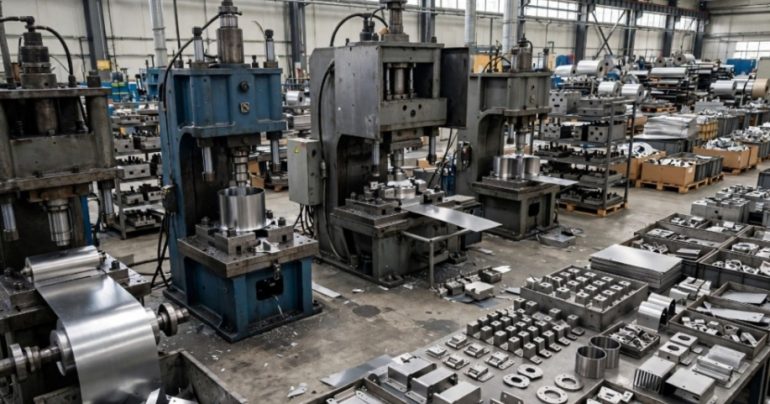
Metal pressing companies provide specialist manufacturing services that shape sheet metal into precise components using presses, dies and tooling. The process can involve cutting, bending, drawing, forming, embossing, piercing and other operations depending on the required component.
For businesses looking for metal pressing companies, understanding the available processes is important when selecting a suitable manufacturing partner. Professional metal pressing can support consistent production, repeatable results and efficient manufacturing for a wide range of components.
How Does Metal Pressing Work
Metal pressing uses a punch and die to apply controlled force to sheet metal. The material is positioned within the tooling before the press forms or cuts it into the required shape.
The exact process depends on the design and production requirements. Some components can be produced through a single operation, while more complex parts may require several stages. This makes metal pressing suitable for both straightforward components and more detailed metal forms.
Metal Stamping for Precision Components
Metal stamping is a key service offered by metal pressing companies. It uses custom tooling to create specific shapes from sheet metal, strips or coils.
Depending on the tooling and component design, stamping can include operations such as:
- Cutting and blanking
- Bending and forming
- Piercing and punching
- Embossing and coining
- Flanging and hemming
- Reducing and stretching
Progressive stamping can also combine several operations within a continuous production process, which can help improve production efficiency for higher-volume requirements.
Deep Drawing and Metal Forming
Deep drawing is another important metal forming process. It creates three-dimensional components by drawing sheet metal into a die using a punch.
This process is particularly useful for components that require depth and a seamless formed structure. It can be used for products such as containers, housings, dished ends and other engineered components.
The choice between deep drawing and another forming method depends on factors such as component design, material, production volume and tooling requirements.
Progress Pressing for Larger Production Runs
Progress pressing is designed for manufacturing complex components through a series of stages. Each section of the tooling performs a particular operation as the material moves through the press.
This approach can reduce the need for separate handling between operations and is often suitable for repeated production of consistent components. For businesses with ongoing manufacturing needs, progressive pressing can efficiently produce large quantities of formed metal parts.
Metal Blanking and Fly Pressing
Metal blanking involves cutting a predetermined shape from sheet metal or coil. The resulting blank can then be used in further manufacturing processes such as stamping, deep drawing, spinning or fabrication.
Fly pressing is another traditional metalworking method used to form and shape components. The suitability of each process depends on the required shape, quantity, material and production specification.
Experienced metal pressing companies can assess these requirements and identify the appropriate manufacturing method for a particular application.
Tool Making and Custom Pressing
Tooling strongly influences the quality and repeatability of pressed components. Custom punches, dies and other tooling are developed around the required component design.
Winward Engineering provides in-house tool making alongside its metal pressing services. Its technical capabilities include CNC machining and experienced toolmaking, allowing tooling requirements to be considered as part of the wider manufacturing process.
This integrated approach can be useful when a project requires both component production and dedicated tooling.
Materials Used in Metal Pressing
The material selected for a pressed component depends on its required properties and intended application. Metal pressing can be suitable for a range of ductile metals, including aluminium, low-carbon steel and soft copper.
More demanding materials, including stainless steel, Inconel and titanium, can also be used for suitable applications. When selecting a forming process, consider the material, thickness, and component design.
Industries Using Metal Pressed Components
Metal pressing has applications across many manufacturing sectors because it can produce formed components for different products and assemblies. Winward Engineering states that it serves industries including automotive, architecture and general engineering.
Pressed components can also be incorporated into wider manufacturing processes, including welding, fabrication and product assembly. This makes metal pressing relevant to businesses requiring individual components as well as more complete manufacturing solutions.
Choosing the Right Metal Pressing Companies
When comparing metal pressing companies, businesses should consider their manufacturing capabilities, tooling support, quality standards and production capacity. Key factors include:
- Manufacturing capabilities: Check whether the company can meet your component and production requirements.
- Tooling and quality: In-house tool making and suitable quality processes can support consistent results.
- Experience: Winward Engineering has provided metal spinning and pressing services since 1946, alongside related manufacturing services.
- Project requirements: Discussing component design, material selection, tooling and production volume early can help identify the right manufacturing process.
Conclusion
Professional metal pressing companies provide a range of metal-forming solutions for businesses that need accurate, repeatable components. From stamping and deep drawing to progressive pressing, blanking, and fly pressing, different techniques can be selected based on the component and production requirements.
Winward Engineering combines metal pressing with tooling, fabrication, finishing and other manufacturing services, providing an integrated approach for businesses requiring pressed metal components.