



Action fans know the ritual well: exams are looming, but so is the new trailer drop, the franchise rewatch, or the late-night gaming session.
For students, screens aren’t just entertainment anymore. They’re where homework happens, where revision videos live, and where every distraction is one tab away.
Parents feel the tension too. Every hour on a device looks the same from across the room, whether it’s a franchise marathon or a genuine study session.
So the real question isn’t whether students should be on screens. It’s what they’re doing on them.
The Screen Time Myth
For years, the go-to parenting advice was simple: limit screen time, full stop. Recent research complicates that picture.
A 2026 prospective study of medical students, published in the peer-reviewed journal Cureus, tracked screen use over four weeks and split it into two categories: academic and non-academic.
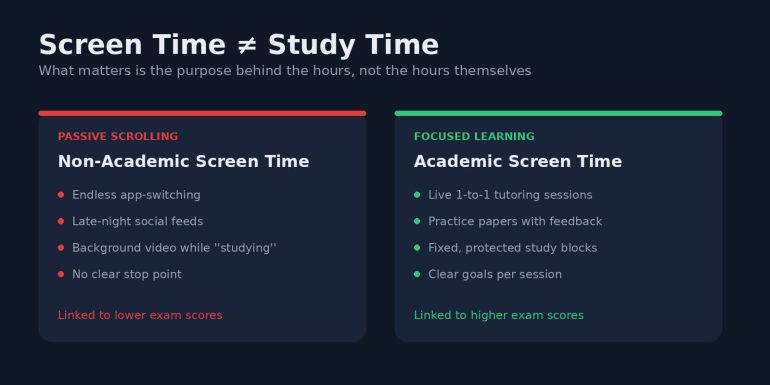
The finding: academic screen time correlated positively with exam marks, while non-academic use was strongly and negatively correlated with the same scores.
Interestingly, total screen time on its own wasn’t the deciding factor. The purpose was.
Two students can log the exact same number of hours on their phones and end up with very different report cards, depending on what those hours were spent on.
That single distinction, academic versus non-academic use, turns out to matter more than any hard cutoff on total hours.
Not all screen time is equal. Purpose matters more than hours logged.
Why This Matters More for GCC Students Right Now
Students across the Gulf are juggling more curricula and more competing demands than ever: IGCSE, A-Level, IB and AP timelines that leave little room for error.
Alongside that, they have genuinely full digital lives: gaming, streaming, group chats, YouTube.
Cut screens out entirely and you lose real study tools along with the distractions. Leave screens unstructured and non-academic use tends to creep in and take over.
The families who navigate this well aren’t the ones banning screens outright. They’re the ones building structure around them, usually with three things:
- A fixed homework window that starts and ends at the same time each day.
- A dedicated space for focused study, separate from the couch or the bed.
- A specialist who can make the “academic” hours actually count instead of just filling time.
That’s part of why one-to-one online tutoring has grown so fast in the region. Platforms like Tuitional have built their model around this idea, matching each student with a single specialist tutor for their exact board and subject, running live sessions instead of pre-recorded content, and sending parents session notes so progress is visible rather than assumed.
It’s a good example of screen time being redirected toward something with a measurable return: better grades, not just more hours logged.
The session itself still happens on a screen. The difference is that every minute of it is accounted for: a tutor asking questions, checking working, and catching confusion before it turns into a bad exam result.
What Unstructured Screen Time Actually Costs
It’s easy to underestimate how much drift happens inside a single “study session.”
A student opens a revision video, a notification pulls their attention for thirty seconds, and that thirty seconds becomes five minutes of scrolling before they even notice.
Multiply that across a two-hour homework block and the actual academic screen time can end up far lower than the hours logged suggest.
This is exactly the gap the Cureus researchers were pointing at: not screen time as a single number, but the ratio between focused and unfocused use inside it.
Closing that gap doesn’t require more willpower. It usually just requires a session with an actual start, a fixed end, and someone on the other end keeping it on track.
Practical Ways to Rebalance the Week
A few small shifts go a long way, whether you’re a parent or a student:
- Separate “input” screen time from “output” screen time. Watching a documentary is passive input. Solving practice problems with feedback is active output. Output is what moves grades.
- Protect the hour before bed. Late-night scrolling, even academic content, disrupts sleep quality and quietly undermines next-day focus.
- Batch entertainment instead of grazing. A planned movie night is a reward. An hour of aimless app-switching between homework tabs is friction.
- Make study sessions genuinely interactive. A live, one-to-one session keeps a tutor able to catch confusion in real time, closer to the “academic” end of that Cureus study’s spectrum.
- Review the week honestly. Once a week, look back at how the screen hours actually split between input and output. The number is often more useful than any app-blocking tool.
Signs the Balance Has Tipped
Most students don’t notice the shift from focused to unfocused screen time until grades already reflect it. A few early warning signs are worth watching for.
- Homework consistently takes far longer than the work itself should warrant.
- The device is still in hand well after the planned study block has ended.
- Revision “sessions” involve more re-reading than active recall or practice questions.
- Sleep keeps getting pushed later, even on school nights.
- Grades in a specific subject dip even though the student insists they “studied a lot.”
None of these are cause for panic on their own. But two or three showing up together are usually a sign that screen time has quietly drifted from academic to non-academic, the exact shift the Cureus researchers linked to lower marks.
Catching it early is far easier than reversing months of habit right before exam season.
A quick fix that works for a lot of families: sit down together once a week and just ask what the biggest homework block actually produced. If the honest answer is “not much,” that’s the moment to add structure, not more hours.
The Bottom Line
Nobody’s suggesting students trade their favorite franchises for flashcards.
The evidence points to a more forgiving, more practical truth: it’s not the screen that’s the problem, it’s what’s happening on it.
The same device that plays the next big action release can also run a focused, live tutoring session an hour later. Both are valid uses of screen time. Only one of them shows up on a report card.
Structure the recreational hours, make the academic hours count, and the two can comfortably coexist. Action marathons included.