



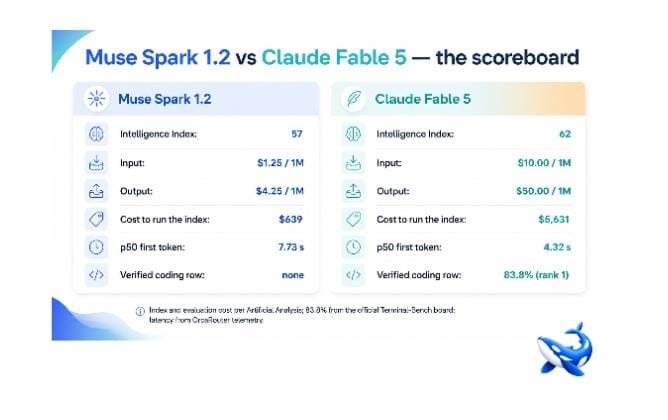
One number settles this comparison faster than any benchmark chart: Artificial Analysis publishes what it costs to run its Intelligence Index on each model it tracks — same tasks, same conditions, billed at list price — and Claude Fable 5 comes to $5,630.52 against $639.27 for Muse Spark 1.2. Same evaluation, an 8.8× difference in the bill, for a five-point difference in the score. We ran the same matchup with a different emphasis in our detailed matchup.
That ratio is the whole argument, and everything below is an attempt to say honestly when it favours which model.
The rate cards
- Claude Fable 5 — $10.00 per million input tokens, $50.00 per million output
- Muse Spark 1.2 — $1.25 per million input, $4.25 per million output, $0.15 cached input
That’s 8× on input and 11.8× on output. Cached input widens the gap further for anything that re-sends a stable context, which describes most repository-oriented coding work.
For a concrete monthly figure, take 50 million input and 10 million output tokens:
- Claude Fable 5 — $500 + $500 = $1,000
- Muse Spark 1.2 — $62.50 + $42.50 = $105
- Muse Spark 1.2 with most input cached — roughly $50
Nobody chooses a model on rate card alone, but a 10× to 20× spread changes what question you’re asking. It stops being “which is better” and becomes “what is the five-point gap worth on my workload, and how often do I actually need it.”
Where Fable 5 earns it
Three places, clearly.
Raw capability on hard problems. 62 versus 57 on Artificial Analysis’ live Intelligence Index is not enormous, but index points get harder to buy near the top. Fable 5 currently sits second on that board; Muse Spark 1.2 is #12 of 185.
Independently verified coding results. This is the sharpest distinction and it rarely makes it into comparisons. On the official Terminal-Bench 2.1 leaderboard, Claude Code paired with Claude Fable 5 holds the top row at 83.8% ± 1.2%, at a run cost of $552.67. Terminus 2 with Fable 5 is third at 80.4%. Muse Spark 1.2 has no entry on that board at all — its 82.9% is Meta’s own vendor-run figure, produced in Meta’s harness with each rival paired to its own agent product, and never reproduced externally. Under Vals AI’s neutral common harness, Muse Spark 1.2 ranks #14 of 50 on the same benchmark.
So the headline “82.9 versus 83.8, basically a tie” is not a comparison anyone should make. One number is audited and one isn’t.
Speed. OrcaRouter’s seven-day production telemetry puts Claude Fable 5 at p50 4.32 seconds to first token and Muse Spark 1.2 at 7.73 seconds. The premium model is also the more responsive one, which is not how these trade-offs usually run.
Where Muse Spark 1.2 wins outright
Cost per unit of work, not just per token. Artificial Analysis’ cost-per-index-task figure is $0.40 for Muse Spark 1.2. Vals AI, on its common harness, measured $0.69 per test — the cheapest of anything in its top five, while ranking 5th of 45 overall at 71.88%. Being both near the top and cheapest in the bracket is a genuinely strong position.
Structured professional work. Vals’ per-domain ranks are the most under-reported thing about this model: #1 of 44 on Finance Agent (v2), #1 of 136 on TaxEval v2, #1 of 31 on Harvey’s Legal Agent Benchmark, #2 of 80 on MedScribe, #9 of 79 on SWE-bench. If your work looks like “read a large pile of documents and produce a defensible structured answer,” the cheaper model is currently first in class on three separate independent benchmarks.
Volume. At an 8-to-12× price difference, there are entire product features that are viable on one model and not the other. That’s not a marginal advantage; it’s a different set of things you can build.
Context. Both hold roughly a million tokens — 1,048,576 for Muse Spark 1.2 against 1,000,000 for Claude Fable 5. The difference is that filling that window costs $1.31 on one model and $10.00 on the other.
The honest caveats on both sides
Muse Spark 1.2 is verbose. Artificial Analysis measured it burning 95 million output tokens to complete the index against a roughly 70-million tier median. Reasoning tokens bill as output, so a naive per-token price comparison understates its real cost — though even after that correction the gap remains close to 9×.
It is also new, at four weeks old, from a lab shipping three versions in four months, and it was co-trained with its own agent — which means some of its measured strength may not transfer to your harness.
Fable 5’s caveat is simpler: at $50 per million output tokens, it is very easy to build something you cannot afford to run at scale. Teams routinely discover this after the prototype works.
How most teams should actually resolve it
Not by choosing. By tiering.
The economics here are almost a textbook case for routing: run the cheap model first, escalate to the expensive one on the cases where the cheap one is uncertain, fails a validation check, or touches something high-stakes. On a workload where 85% of requests are routine, that structure gets you most of Fable 5’s quality at something close to Muse Spark 1.2’s bill.
Making that practical requires both models behind one interface. OrcaRouter carries both — along with 200-plus others — on a single OpenAI-compatible key, at 0% markup, with each provider’s list price passed straight through and automatic failover if one has a bad afternoon. The escalation rule becomes configuration rather than an integration project, and you can measure the real quality gap on your own tasks before deciding how much of your traffic deserves the premium model.
The takeaway
Claude Fable 5 is the better model and has the audited coding result to prove it; Muse Spark 1.2 is five index points behind and costs roughly a ninth as much to do the same work. Neither of those facts is in dispute, so the real question is what fraction of your traffic genuinely needs the top of the board. For most teams that fraction is small, and the sensible architecture is both models on one key with a rule that decides between them — not a six-week evaluation to crown a single winner.
Sourcing note: Muse Spark 1.2’s 82.9% Terminal-Bench figure is Meta’s own vendor-run result and has not been independently reproduced. Index scores, evaluation costs and token counts are from Artificial Analysis; the 83.8% and 80.4% rows are from the official Terminal-Bench 2.1 leaderboard; per-test cost and domain ranks from Vals AI; pricing and p50 first-token latency from OrcaRouter, which passes provider list prices through at 0% markup. All checked August 7, 2026.