

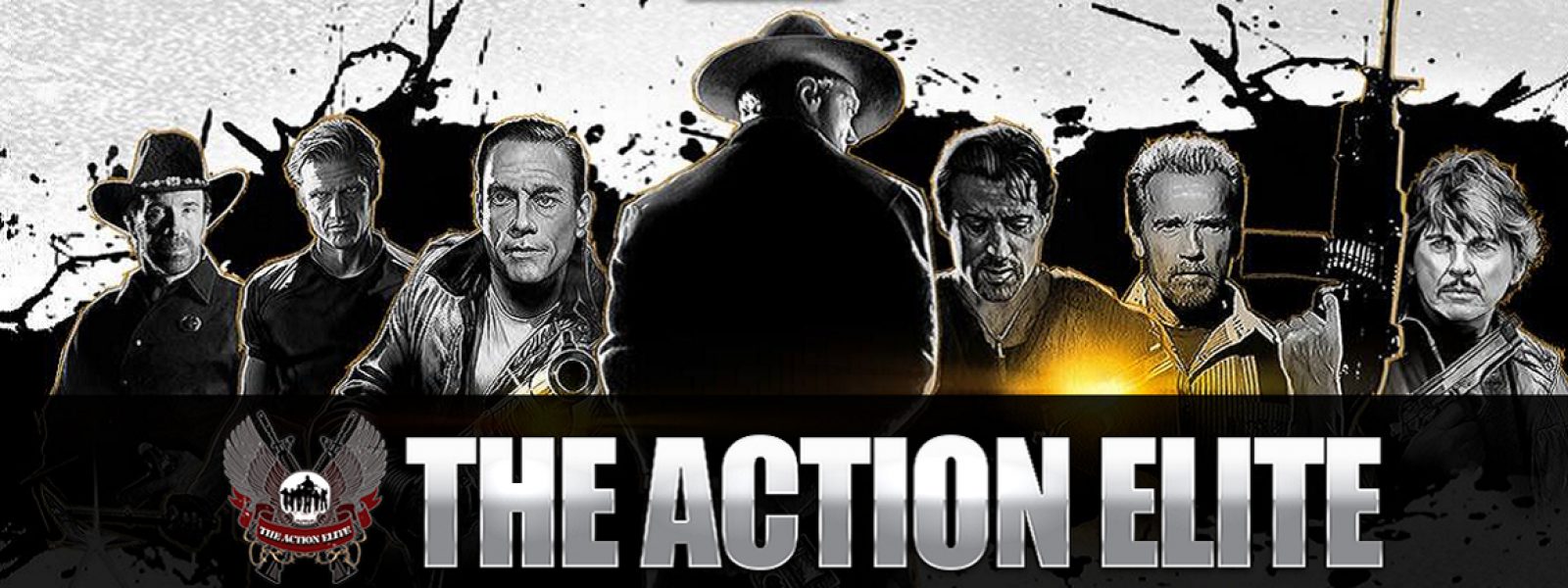


Something familiar is happening in the world of action cinema. Browse through Netflix or Prime Video’s latest offerings in 2025, and you’ll notice a distinct aesthetic creeping back into frame: neon-soaked nights, brutal hand-to-hand combat, practical stunts that make you wince, and villains who chew scenery with theatrical relish. The modern action film is having a love affair with the late 80s and early 90s, but this isn’t simple nostalgia – it’s a full-blown renaissance.
The 80s-90s Aesthetic Returns
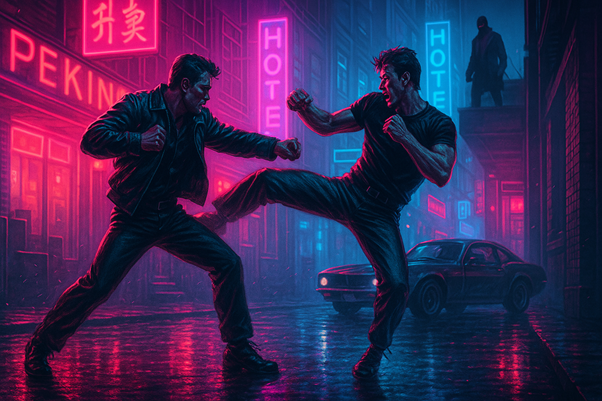
The visual language of VHS-era action films has made an unmistakable comeback. Neon purples and blues wash over rain-slicked streets, fog machines work overtime in dingy warehouses, and the colour grading favours harsh contrasts that recall the limitations – and accidental artistry – of older film stock. Directors are deliberately choosing the grimy, tactile atmosphere of classic action cinema over the sanitised, digitally-perfect Marvel aesthetic that dominated the 2010s.
These films embrace chambered locations: dark alleyways, underground nightclubs, multi-storey car parks, and industrial estates. There’s a sense of geography and physicality that CGI-heavy blockbusters often lack. The camera lingers on practical details – the clang of metal, the shatter of glass, the spray of sparks from grinding metal. It’s a “dirty” aesthetic in the best possible way, one that grounds the action in something that feels real, even when the choreography reaches superhuman levels.
Practical Stunts and the Hunger for Real Action
Perhaps the most significant shift has been the return to practical stunt work. After years of wire-removal, motion capture, and digital doubles, audiences have developed a keen eye for what’s real and what isn’t. The modern action renaissance prioritises the “feeling” of impact – you can sense the weight behind every punch, the momentum of every fall, the danger in every car flip.
Stunt schools are experiencing a resurgence, and coordinators trained in Hong Kong-style action and Gun-Fu are in high demand. The deliberately unstabilised camera work, popularised by the Bourne films but refined by later entries, makes viewers feel every blow. There’s a rawness to it, a visceral quality that no amount of CGI enhancement can replicate. When an actor – or their stunt double – genuinely crashes through a table, you feel it in your bones.
From John Wick to Extraction: The Modern Action Blueprint
If we’re discussing the revival of sophisticated action choreography, we must acknowledge John Wick as the catalyst. When the first film arrived in 2014, it did something revolutionary: it treated action scenes like dance sequences, with extended takes, clear geography, and genuine consequences. Keanu Reeves trained extensively in judo, Brazilian jiu-jitsu, and tactical firearms, and the camera respected that effort by pulling back and letting us see it.
The Wick films reintroduced the concept of “gun-fu” – balletic violence where firearms become extensions of the body, blending martial arts with tactical shooting. Every reload matters, every magazine has a finite number of rounds, and the protagonist actually gets tired. It’s a level of detail that was standard in Hong Kong action cinema but had been largely abandoned by Hollywood.
Netflix and Prime Video quickly recognised the appeal. Extraction (2020) featured a 12-minute “oner” that, whilst composed of several stitched takes, demonstrated the same commitment to spatial coherence and physical authenticity. The Night Comes for Us, Headshot, and Triple Threat all drew heavily from the Indonesian action school established by The Raid, where bone-crunching realism meets impossibly creative fight choreography.
The Raid’s influence cannot be overstated. Gareth Evans and his team, working with pencak silat practitioners, created action sequences that felt genuinely dangerous. Characters fought in tight corridors, on staircases, in claustrophobic rooms – environments that forced creativity and showcased genuine skill. Modern streaming action has adopted this philosophy wholesale.
New Streaming Hits: Retro Elements in Contemporary Packages
Examining recent releases reveals how thoroughly these retro elements have been integrated. Films like The Union, Ballerina, and Havoc demonstrate clear aesthetic and structural debts to their 80s and 90s predecessors. They favour practical locations over green screens, prioritise stunt work over digital effects, and structure their narratives around set-pieces rather than dialogue.
Streaming services have become the natural home for these genre experiments. Unlike theatrical releases, which require broad appeal to justify their budgets, streaming platforms can take calculated risks on mid-budget action films targeted at specific audiences. The economics are different: a film doesn’t need to make back its budget in a single opening weekend. It just needs to keep subscribers engaged and attract new ones through word-of-mouth and algorithmic recommendations.
This has created space for action directors to experiment with tone, pacing, and style in ways that the traditional studio system wouldn’t permit. The result is a flowering of different approaches to action cinema, all unified by their rejection of the polished, CGI-dependent blockbuster model.
The Return of Archetypal Villains
Alongside the shift in visual style and action choreography, we’re seeing a return to a particular type of antagonist. The villains in these new action films aren’t the cold, calculating masterminds of the Jason Bourne era. They’re theatrical, charismatic, visually distinctive characters who deliver pafos-laden monologues and genuinely seem to enjoy being evil.
Think of the colourful rogues’ gallery from the Roger Moore Bond films, or the scene-stealing antagonists of 80s action cinema like Hans Gruber or Bennett from Commando. Modern streaming action is bringing back villains with personality – characters who dress distinctively, have memorable quirks, and provide genuine entertainment value beyond simply being obstacles for the hero.
There’s a hunger amongst audiences for “big” characters again. After years of morally grey antiheroes and sympathetic antagonists, viewers are ready to embrace villains who are simply, gloriously villainous. It’s part of the same rejection of gritty realism that’s driving the broader aesthetic shift – sometimes you just want to see a charismatic baddie get what’s coming to them.
Viewing Habits and Digital Consumption of Action
The way audiences consume action in 2025 has fundamentally changed. Modern viewers, particularly younger demographics, have been conditioned by short-form content to expect immediate gratification. The structure of contemporary action films reflects this: minimal preamble, conflict established within minutes, and a relentless pace that rarely pauses for breath.
This shift towards compressed, high-intensity entertainment isn’t limited to film. The same audience gravitating towards these action films is simultaneously engaging with mobile gaming, short-form video content, and various forms of quick-access digital entertainment. The common thread is low barrier to entry and immediate engagement – whether it’s a 90-minute action film that delivers fights within the first five minutes, a mobile game you can play during your commute, or even accessible platforms like top Irish 5 euro deposit casinos that offer instant entertainment with minimal commitment. It’s all part of a broader cultural shift towards immediacy and intensity in our leisure time.
Action films have adapted to this reality. The three-act structure remains, but it’s compressed. Backstory is delivered through action rather than exposition. Character development happens between punches. It’s economical storytelling that respects the viewer’s time whilst delivering maximum thrills.
How Nostalgia Shapes New Hits
The psychology behind this retro renaissance is fascinating. For older viewers, there’s genuine nostalgia – a desire to recapture the feeling of watching Die Hard or Hard Target for the first time. But for younger audiences who weren’t alive during the VHS era, these aesthetic choices don’t register as nostalgia. They’re simply a visual and narrative language that feels fresh compared to the dominant style of the past decade.
Young directors raised on these films are now old enough to make their own, and they’re bringing that passion to bear. They understand what made those films work – the tactile reality, the clear geography, the sense of danger – and they’re applying modern production values to execute those ideas more effectively than ever before.
It’s worth noting that whilst the aesthetic is retro, the execution is thoroughly contemporary. Modern action films benefit from superior camera technology, better safety protocols, more sophisticated editing techniques, and a deeper understanding of what makes action choreography readable and exciting. They’re taking the soul of 80s action and giving it a 2025 polish.
Problems and Prospects of the Retro Renaissance
No trend is without its pitfalls. The primary risk is that the market becomes oversaturated with films chasing the same aesthetic without understanding what made it work in the first place. Neon lighting and practical stunts aren’t magical ingredients – they’re tools that must be deployed thoughtfully.
There’s also a danger of the “retro” label becoming a crutch, an excuse for lazy plotting or thin characterisation. The best 80s action films balanced their bombast with genuine craft. They had clear themes, memorable characters, and emotional stakes beneath the explosions. Modern films borrowing their aesthetic must also inherit their substance.
Looking forward, the genre has room to evolve. We’re already seeing experiments that blend this action style with cyberpunk aesthetics, creating neon-soaked near-futures where the action is both retro and futuristic. There’s potential for darker, more realistic takes that maintain the practical stunt work but ground the stories in genuine consequences and moral complexity.
The real test will be whether the industry can move beyond simple imitation and use these rediscovered techniques to create something genuinely new. The best possible outcome isn’t an endless stream of 80s pastiches, but rather a new generation of action films that synthesise the best elements of multiple eras into something distinctive and exciting.
Next Generation Movies with Old Aura
The contemporary action renaissance represents more than simple nostalgia. It’s a correction – a return to principles that made action cinema thrilling in the first place. Practical stunts create genuine tension. Clear choreography allows audiences to appreciate the skill involved. Theatrical villains provide entertainment value. Gritty aesthetics ground the fantastical in something tangible.
Streaming platforms have provided the economic model and creative freedom for this revival to flourish. They’ve recognised that mid-budget action films, made with passion and craft, can find devoted audiences without needing to be all things to all people.
As we move through 2025 and beyond, the action genre appears healthier than it has in years. Directors have rediscovered that you don’t need a £200 million budget and a universe of interconnected films to create thrilling action. Sometimes all you need is a committed stunt team, a talented choreographer, some atmospheric lighting, and a genuine respect for the craft of action filmmaking.
The 80s and 90s action films worked because they understood something fundamental: action cinema at its best is physical, visceral, and immediate. Modern filmmakers are taking that lesson to heart, and audiences are responding enthusiastically. The future of action looks bright – and perhaps just a bit neon.