



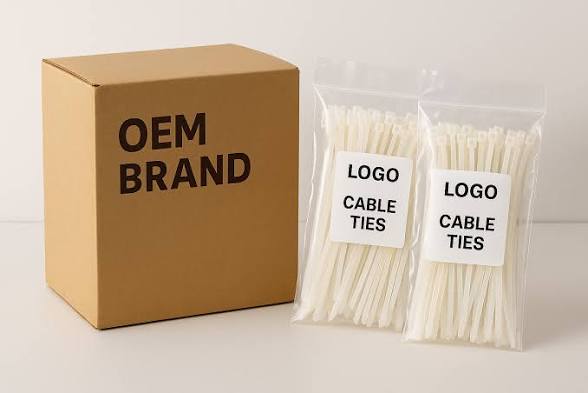
Cable ties are a simple product, so it is hard to stand out when you sell someone else’s. That is why a growing number of distributors, tool brands and electrical wholesalers now sell cable ties under their own name.
OEM and private-label production lets you control the product, the packaging and the margin. This guide explains what you can customise, how the process works and what to agree with a manufacturer before you start.
OEM vs. Private Label: What Is the Difference?
The two terms are often used interchangeably, but there is a useful distinction:
- Private label: you take the manufacturer’s standard product and sell it under your brand, with your packaging and labelling.
- OEM: the manufacturer produces to your specification. That can mean a custom colour, printed text, a particular material grade or a non-standard size.
Most brands start with private label, since it is faster and simpler. They move into OEM once they know which products sell.
What You Can Customise
Almost every visible part of a cable tie can be tailored to your brand or your customers’ needs:
- Printing: your logo, brand name, part numbers or warning text printed directly on the tie.
- Colour: brand colours or colour-coding sets for specific trades and industries.
- Material: standard nylon 66, UV-stabilised black for outdoor use, heat-stabilised grades, or stainless steel 304/316.
- Size and strength: lengths, widths and tensile ratings chosen to fit your range gaps.
- Packaging: branded bags, header cards, retail boxes, barcodes and multi-language labels.
Choosing the Right Manufacturing Partner
Private-label production depends on the partner behind it. When a problem shows up, it will show up with your name on the product. Look for a manufacturer that has made cable ties for many years, holds quality certifications for cable tie production specifically, and already supplies other brands.
Export experience matters as much as moulding skill. An established cable tie exporter already knows the labelling, documentation and packing requirements of different markets, from RoHS declarations for Europe to carton markings for North America. That knowledge saves new brands weeks of back-and-forth and protects them from compliance mistakes.
How the OEM Process Works
A typical private-label or OEM project runs through five stages:
- Brief: you share the product range, specs, quantities and target markets.
- Artwork and quote: you send logo files and packaging designs, and the manufacturer confirms feasibility, MOQ and pricing.
- Pre-production samples: printed or coloured samples are made for you to approve.
- Mass production: the approved sample becomes the standard for the full run.
- Inspection and shipping: the finished goods are checked against the sample and shipped.
With an experienced factory, the whole cycle from confirmed order to shipped container can take as little as 15 to 30 days.
What MOQs Should You Expect?
Many buyers assume custom work means huge minimums. That is not always true. Typical factory MOQs are around 10,000 pieces per item for nylon ties and about 5,000 for stainless steel, and some manufacturers apply the same minimums to custom and printed orders.
That makes it realistic to launch a small branded range, test it with your customers and scale up the sizes that sell. Buyers who order branded cable ties from Difvan, for example, get the same MOQ and lead time as the standard range, so a first private-label order carries very little extra risk.
Mistakes to Avoid
- Skipping the printed sample: always approve a physical sample with your real artwork before mass production.
- Launching too many SKUs: start with your five to ten best-selling sizes, not the full catalogue.
- Ignoring market rules: make sure labels, declarations and certificates match each country you sell into.
- No written spec: record material, tensile rating, colour and packaging in the purchase order so every repeat order matches.
Final Thoughts
Private-label cable ties turn a commodity line into a brand asset. Customers who find your name on the tie in their hand come back to you, not to the next supplier on a price list. With the right manufacturing partner, the barrier to entry is lower than most distributors think. A focused first order can put your own range on the shelf within weeks.