



Here is a statistic that surprises people outside the exhibitions industry: roughly two thirds of the world’s leading trade fairs take place on German soil. It is a dominance with deep roots, from medieval market privileges to postwar industrial policy, and it has a practical consequence for anyone whose job involves standing at a booth: sooner or later, your calendar becomes a German geography lesson. The professionals who do this well have stopped thinking in terms of individual fairs and started thinking in circuits, because the skills and the logistics transfer from one fair city to the next. The cities themselves, though, have personalities, and knowing them changes how you plan.
The map, city by city
Frankfurt is the international gateway and the generalist: Ambiente for consumer goods, ISH and Light + Building for the building trades, Automechanika for the automotive aftermarket, and the Book Fair, which is a category of one. Its exhibition grounds sit in the middle of the city, fifteen minutes from the largest airport in the country, which is why so many circuits start here whether or not Frankfurt is on the itinerary.
Düsseldorf is the specialist heavyweight. MEDICA is the largest medical trade fair in the world, boot the largest watersports show, and K, held every three years, is the global plastics industry’s single essential date. The city holds one logistical trump card no other German fair city can match: Messe Düsseldorf sits practically next door to its own international airport, a ten-minute ride apart, which makes it the only major fairground in the country where flying in on the morning of a meeting is a plan rather than a gamble.
Cologne, twenty-five minutes down the Rhine, brings Anuga, the world’s biggest food fair, gamescom, Europe’s biggest games event, and the imm furniture show, in halls that face the cathedral across the river. Munich answers with bauma, which is simply the largest trade fair on earth, plus electronica and ISPO. Hannover’s fairground is the biggest by area anywhere, home to the Hannover Messe industrial show and the IAA Transportation truck fair. Berlin rounds out the map with ITB for travel, IFA for consumer electronics and ILA for aerospace.
Fly in once, then stay on the ground
The classic mistake on a multi-fair trip is treating each city as its own fly-in, with all the airport friction that implies, multiplied. Veterans do it differently: one long-haul flight into a hub, then ground legs between fair cities. Germany’s intercity trains make this genuinely pleasant when you are travelling alone with a carry-on; Frankfurt Airport to Düsseldorf’s main station is around an hour and a half on the high-speed line, city centre to city centre, and you can work the whole way.
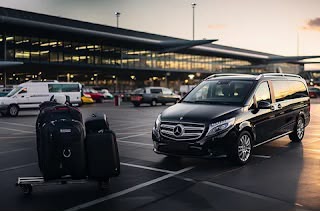
The calculation changes the moment you are not travelling light. Add a colleague, a pair of sample cases and a roll-up banner, and the platform changes, luggage racks and station escalators of a rail journey stop being charming. This is where the road wins on total door-to-door effort: a fixed-price transfer from Frankfurt Airport to Düsseldorf loads at the arrivals kerb and unloads at your hotel, with the fare agreed before you flew and no decisions required in between. On a circuit, that predictability compounds: every leg you pre-book is a leg you no longer think about.
Should you ever fly between fair cities? On the long diagonals, occasionally: Munich to Hamburg, or Berlin to Cologne, can justify a domestic hop when the schedule is brutal. Along the Rhine corridor, never. Frankfurt, Cologne and Düsseldorf sit so close together that by the time you had checked a bag and cleared security, the car you did not take would have been pulling up at the Messe. The corridor is the circuit’s great gift; use the ground.
Reading the calendar
The circuit has seasons, and the seasons have quirks. January and February belong to Frankfurt, with Heimtextil and Ambiente back to back; spring scatters the action between Munich, Cologne and Hannover; September stacks giants dangerously close together across several cities; and October is the Book Fair, when Frankfurt briefly stops being a business city and becomes a literary one. Then there are the cycles, because many of the biggest shows do not run every year: Automechanika and Light + Building take the even years, ISH the odd ones, K arrives every third year and drupa makes the printing world wait even longer. The practical consequence is that a circuit which worked beautifully this year may simply not exist next year. Build each season’s plan outward from the actual fair dates rather than copying last year’s itinerary and hoping.
The hotel arbitrage nobody tells first-timers about
German fair cities are close enough together that hotel demand in one spills into its neighbours, and you can play this in both directions. During gamescom or Anuga, Cologne’s rates go vertical while Düsseldorf’s, twenty-five minutes away, merely climb; seasoned exhibitors book Düsseldorf and commute against the flow. The same trick works between Frankfurt and Mainz or Wiesbaden during Ambiente week, and in reverse when Düsseldorf’s own giants are on and Cologne suddenly has the sane prices. The commute costs you half an hour; the arbitrage frequently pays for it many times over, and the breakfast queues are shorter.
The ground game at the fairground
Every Messe shares the same rhythm: a morning surge in, a six o’clock flood out, and a taxi rank that cannot absorb either. The fix is the same everywhere too, and an entire ecosystem now exists to sell it: flat-rate, pre-booked rides between airport, hotel and fairground, from English-first operators on the international side to German-market specialists such as fr-transfer.de on the domestic one. In Düsseldorf, DüsseldorfRide’s Messe Düsseldorf transfer service is built around exactly the MEDICA-week pain points: a fixed morning slot from the hotel, a named entrance for the evening pickup, and a price that ignores the demand spike outside. Whatever operator you choose in whichever city, the principle is the thing: decide your rides when you book your stand, not when you land.
Freight, samples and the fine print
Two circuit-specific warnings from the school of hard knocks. First, if you are bringing samples or stand materials from outside the EU, look up the ATA Carnet system before you fly; it is the paperwork that lets professional equipment cross borders without paying duty, and the fair cities’ customs offices know it well, but it must be arranged at home in advance. Second, respect the stand-build days. Every hall opens for construction before the fair does, and the exhibitors who arrive on build day rather than opening morning are the ones whose graphics are straight and whose demo actually runs. Plan the circuit backwards from those dates, not from the glossy opening ceremonies.
Thinking in circuits
Seen from above, the German fair year is a single machine: Düsseldorf and Cologne trading crowds along the Rhine, Frankfurt pulsing every few weeks, Munich and Hannover and Berlin taking their turns. Once you stop treating each fair as an expedition and start treating the country as one connected venue with six front doors, the whole thing gets cheaper, calmer and considerably more effective. The exhibitors who look effortless in hall seven have not discovered a secret. They have just done the circuit before, and they booked the boring things first.