



Keeping a car looking new is harder than it sounds. Daily driving exposes the paint to dust, road grime, sunlight, rain, bird droppings and small stones and over months this wear starts to show. The paint loses its shine and small marks begin to appear even on cars that are washed regularly.
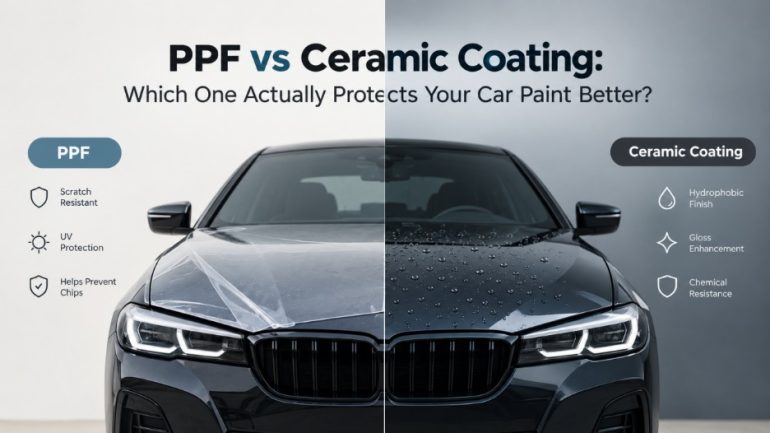
Two options usually come up when people talk about protecting car paint: paint protection film and ceramic coating. Both help keep a car looking neat and glossy, but they do this in very different ways and understanding that difference matters more than picking whichever one sounds more advanced.
So which one is actually better?
The honest answer is that it depends on what the owner wants to protect against. If the main worry is physical damage, such as stone chips and scratches from daily driving, one option clearly does more. If the goal is an easier-to-clean surface with extra shine, the other option probably makes more sense. Some owners end up choosing both and that is a fair approach too.
Here is a simple breakdown of how the two compare.
What Is Paint Protection Film?
Paint protection film, generally known as PPF, is a thin and clear film applied over the painted surfaces of a car. It acts as a protective layer sitting between the paint and everything the road throws at it.
Good-quality PPF is built to absorb the impact of small stones, road debris and light scratches before they reach the paint underneath. It can be installed across the entire car or on selected panels only, depending on the owner’s budget and how much protection they want.
The areas that usually get PPF first are the front bumper, bonnet, front guards and side mirrors, simply because these parts take the most hits from road debris. The film stays transparent, so the car’s original colour still shows through.
What Is Ceramic Coating?
Ceramic coating works differently. It is a liquid product applied directly to the paint, which then bonds with the surface as it cures. Once it sets, it forms a thin protective layer over the paint.
What ceramic coating is really known for is making water and dirt less likely to stick, which makes washing noticeably easier. It also adds gloss and offers some resistance to environmental contaminants and UV exposure.
What it cannot do, though, is absorb a strong physical impact. This is probably the biggest difference between the two products and it is worth understanding before making a decision.
Which One Protects Against Stone Chips?
This is where PPF has a clear edge.
When a stone hits the front of a moving car, the impact is often strong enough to chip the paint. Ceramic coating, being a very thin layer, is not built to stop this kind of impact.
PPF, on the other hand, exists specifically to create a physical barrier between the paint and whatever the road sends its way. That is exactly why it is used on high-impact areas like the front bumper, bonnet and front guards.
If stone chips and road debris are the main concern, PPF is generally the stronger choice.
Which One Handles Minor Scratches Better?
PPF also holds up better against certain light scratches, since the film absorbs some of the damage instead of the paint underneath.
Some newer films even come with self-healing properties. When exposed to warmth, minor surface marks can fade or disappear over time on their own.
Ceramic coating can make the surface a little harder and may resist very light marks, but it should not be treated as a substitute for PPF. It will not protect the paint from every scratch or impact and owners who expect that often end up disappointed.
Which Gives Better Gloss?
If appearance is the main priority, ceramic coating is usually the more popular pick. A good ceramic coating gives the paint a deep, glossy finish that makes the whole car look cleaner and more polished.
That said, modern PPF has come a long way too and can deliver a high-gloss finish of its own. The final look really depends on the quality of the product, the condition of the paint before application and how well the job is installed.
Owners who want strong physical protection along with a glossy finish do not have to pick one or the other. Many choose PPF on the high-impact panels and add ceramic coating over the film and the rest of the painted surfaces.
Which One Is Easier to Clean?
Ceramic coating is well known for repelling water. Water tends to bead up and roll off the surface easily and dirt and grime come off more easily during a wash too. That does not mean the car stays spotless forever, but regular cleaning does become simpler.
PPF can also be low maintenance, especially with modern films that come with hydrophobic top layers designed to repel water and dirt on their own. So rather than judging by the name of the technology, it helps to look at the actual features of the specific product being installed.
How Long Do They Last?
The lifespan of both PPF and ceramic coating comes down to a few factors: product quality, how well it was installed, weather exposure, washing habits and general upkeep.
High-quality PPF can last several years when installed properly and looked after. Ceramic coatings vary quite a bit too, with some designed for shorter-term use and professional-grade coatings offering protection for years.
Either way, following the manufacturer’s maintenance instructions matters. Even a product advertised to last for years will underperform without basic care.
What About UV Protection?
Sunlight affects car paint over time. Regular UV exposure, especially for cars left outside for long stretches, contributes to fading and oxidation.
Both PPF and ceramic coatings offer some protection here, though their core strengths differ. Ceramic coating is mainly valued for surface protection, gloss and its hydrophobic qualities, while PPF offers a thicker physical barrier that suits impact protection better.
For cars that spend a lot of time parked outdoors, both options bring something useful, depending on what the owner prioritises.
Is PPF More Expensive Than Ceramic Coating?
In most cases, yes. PPF generally costs more, partly because of the material itself and partly because of the installation process, which requires careful cutting and precise fitting around every panel.
The final cost also depends on coverage. A full-car PPF installation naturally costs more than protecting just the front section.
Ceramic coating tends to be less expensive overall, though professional coating prices still vary depending on the product used, the size of the vehicle and how much prep work is needed.
Before deciding purely on price, it helps to think about what kind of protection actually matters for the way the car is driven and parked.
What Does “PPF Coating” Actually Mean?
The term PPF coating for car comes up often in searches, usually from people looking for a way to combine physical protection with a glossy, easy-to-clean surface.
It is worth knowing that PPF and ceramic coating are separate products. PPF is a physical film installed over the paint, while ceramic coating is a liquid that bonds either to the paint directly or, in some cases, to the surface of the PPF itself.
Some installers offer ceramic coating applied over PPF, which combines the film’s physical protection with the added gloss and hydrophobic benefits of the coating. If a business advertises “PPF coating,” it is worth asking exactly what is being offered, since the term can mean different combinations depending on the installer.
Can Both Be Used Together?
Yes and for owners who want strong all-round protection, this combination often makes sense.
PPF can go on the areas that take the most physical impact, while ceramic coating covers the rest of the painted surfaces and, where compatible, sits on top of the film too. A common setup involves PPF on the front bumper, bonnet, front guards and mirrors, with ceramic coating applied across the rest of the car.
This gives a fair balance of physical protection, appearance and easier maintenance, though it is important that the products used are compatible and that the installation is done correctly by someone experienced with both.
So, Which One Should You Choose?
Choose PPF if the main concerns are:
- Stone chips
- Road debris
- Minor physical impacts
- Light scratches
- Protecting high-impact panels
- Keeping the original paint safe underneath
Choose ceramic coating if the priorities are:
- Gloss
- Water repellency
- Easier cleaning
- Protection from environmental contaminants
- Maintaining the paint’s appearance
And if both matter, combining the two is a reasonable path forward.
Where Aegis PPF Fits In
For anyone leaning towards paint protection film, Aegis PPF is worth considering. They offer a range of film options, so buyers are not stuck choosing between one fixed package. Depending on your budget and requirements, you can choose the best fit for your scenario. This flexibility makes it easier to get meaningful protection without overspending on coverage that is not needed.
Final Thoughts
PPF and ceramic coating are not really competing against each other in most situations. They solve different problems.
PPF is better suited to protecting paint from physical damage, especially stone chips and road debris. Ceramic coating is better suited to improving surface protection, gloss and water repellency.
For a car that spends a lot of time on highways, PPF on the high-impact areas makes a noticeable difference. For someone who mainly wants a glossy finish and easier washing, ceramic coating alone might be enough.
Before deciding, it helps to think about how the car is driven, where it is usually parked, how long it will be kept and how much protection actually feels necessary. The right choice is not always the most expensive one. It is the one that matches the risks the car faces every day.