


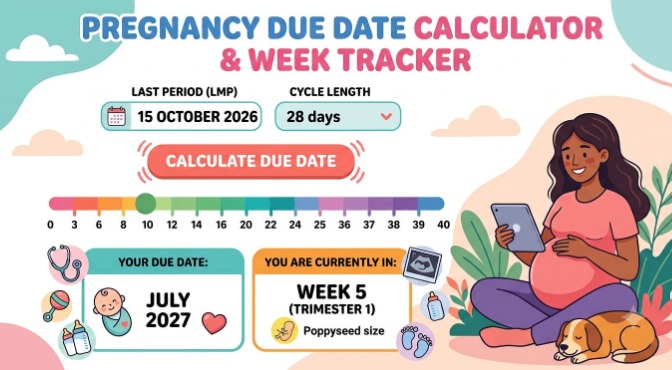
A standard pregnancy calculator works by adding 280 days (or 40 weeks) to the very first day of your last period. Because of how clinical math works, you’re actually considered about two weeks pregnant on the day you conceive!
How Does a Pregnancy Calculator Actually Work?
When you first get that positive test, the first thing on your mind is, “When will I actually meet this baby?”
While you might think your timeline starts on the night you conceived, doctors calculate things a little differently. To keep everyone on the same page, medical providers measure pregnancy starting from the beginning of your last cycle.
Naegele’s Rule: The Standard Period Math
Most online tools and your doctor’s office use a formula called Naegele’s Rule. It assumes a classic 28-day cycle with ovulation happening right around day 14.
The math looks like this:
$$\text{Due Date} = \text{First Day of Last Period} + 1 \text{ Year} – 3 \text{ Months} + 7 \text{ Days}$$
Here is a quick example:
If your last period started on May 10, you subtract 3 months (February 10) and then add 7 days. Your estimated due date would be February 17 of the following year.
Gestational Age vs. Fetal Age: Why You Get a “2-Week Head Start”
This trips up almost every first-time parent:
- Gestational Age: This is the official clock used by midwives and OB-GYNs. It starts counting from day one of your last period.
- Fetal Age: This is the baby’s actual age, measured from the moment of conception (usually two weeks after your period started).
So, when your period is a few days late and a home test shows two pink lines, you are clinically 4 weeks pregnant, even though the embryo has only been growing for about 2 weeks.
How to Calculate Your Due Date for Different Scenarios
Real bodies don’t always run on a strict 28-day schedule. Here is how to adjust the timeline based on your specific body or situation.
TYPICAL 28-DAY CYCLE TIMELINE
Day 1 Day 14 Day 28 (Missed Period)
First Day Ovulation / 4 Weeks
of Period Conception Gestational Age
Irregular, Longer, or Shorter Cycles
If your cycles are shorter or longer than 28 days which is super common, especially if you have PCOS or just stopped birth control the standard math will be a little off.
The time after ovulation is usually a steady 14 days, but the time before ovulation varies.
- 35-Day Cycles: You likely ovulate around Day 21 (instead of Day 14). Add 7 extra days to the standard due date formula.
- 22-Day Cycles: You likely ovulate earlier, around Day 8. Subtract 6 days from the standard formula.
If You Know Your Exact Conception Date
If you were tracking your basal temperature or using ovulation strips, you can figure out your due date directly from that high-fertility window:
$$\text{Due Date} = \text{Conception Date} + 266 \text{ Days (38 Weeks)}$$
IVF and Fertility Treatments
If you conceived through IVF or a frozen embryo transfer, your date is locked in down to the hour.
| Method | How to Calculate Your Due Date |
| Day 3 Embryo Transfer | Transfer Date + 263 days |
| Day 5 Embryo Transfer | Transfer Date + 261 days |
| IUI (Insemination) | Insemination Date + 266 days |
When Will a Doctor Change Your Due Date?
Your period-based date is really just an educated guess. Once you get an early ultrasound, your doctor might tweak your official timeline based on what they see on the screen.
WHEN DOCTORS UPDATE YOUR DUE DATE
Scan Timing Difference Needed to Change Date
Up to 8–9 weeks —> More than 5 days off from period date
9 to 14 weeks —> More than 7 days off from period date
16 to 22 weeks —> More than 10 days off from period date
Crown-Rump Length (CRL)
During your first trimester scan (usually between weeks 8 and 12), the ultrasound tech measures the Crown-Rump Length essentially, baby’s length from head to bottom.
In early pregnancy, embryos grow at a remarkably consistent rate, making these early scans the absolute gold standard for dating.
Medical Guidelines for Changing the Date
According to standard medical guidelines, if your early ultrasound measurement differs significantly from your period math, your care provider will officially update your due date:
- Before 9 Weeks: If the ultrasound date is off by more than 5 days, the ultrasound date takes priority.
- Weeks 9 to 14: If the ultrasound date is off by more than 7 days, the ultrasound date wins out.
Pregnancy Timeline: Key Milestones to Watch For
Once you have an estimated date, your 40-week journey gets broken down into three trimesters.
First Trimester (Weeks 1–12): The Foundation
- Weeks 1–4: Implantation happens, and pregnancy hormones (hCG) start ramping up.
- Weeks 5–8: The neural tube closes, and an early heartbeat can usually be detected on an ultrasound by week 6 or 7.
- Weeks 9–12: Tiny fingers and toes form. Miscarriage risk drops significantly as you near the end of week 12.
Second Trimester (Weeks 13–27): The Golden Weeks
- Weeks 13–16: Energy often returns as morning sickness fades.
- Weeks 17–20: You’ll start feeling early flutters (quickening). You’ll also have your mid-pregnancy anatomy scan around week 20.
- Weeks 21–27: Baby can hear your voice, and lung structures are developing rapidly.
Third Trimester (Weeks 28–40): The Home Stretch
- Weeks 28–32: Rapid weight gain and brain development.
- Weeks 33–36: Baby drops lower into your pelvis to get into position.
- Weeks 37–40: Reaching 39 weeks is officially considered full-term!
Conclusion
An online pregnancy calculator is a fantastic first tool to help you visualize your timeline and prepare for the exciting months ahead. Whether you calculated your due date using your last period, an ovulation tracking date, or an embryo transfer, keep in mind that your estimated due date is a flexible benchmark rather than a strict deadline.
As your pregnancy progresses, your midwife or OB-GYN will guide you through each milestone, using routine scans and prenatal checkups to ensure both you and your baby stay healthy every step of the way.