



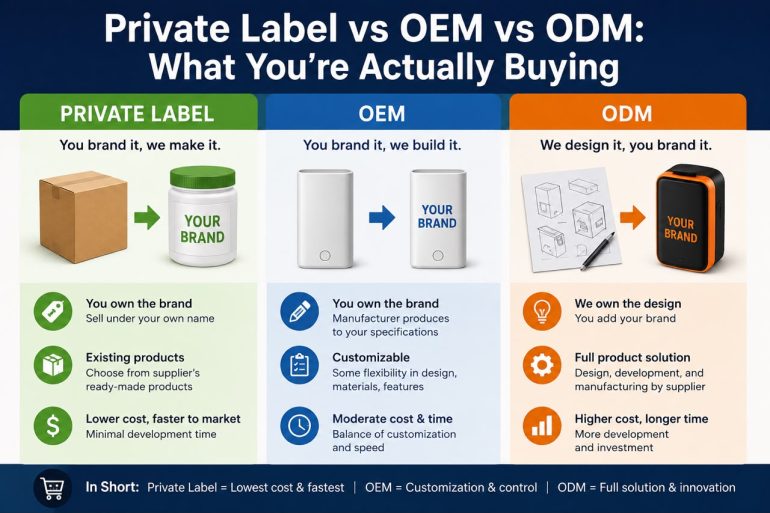
Three acronyms get used interchangeably in sourcing conversations, and the confusion is expensive in a very specific way: people discover which arrangement they are actually in at the worst possible moment, usually when they try to change suppliers or find a competitor selling something identical to their flagship product. The distinctions are not academic. They determine who owns the design, who owns the tooling, whether you have exclusivity, and how much leverage you have when the relationship goes sideways. To keep this grounded in real terms rather than textbook definitions, we have used the publicly published service descriptions from HIFINE, a Suzhou-based filtration manufacturer, as a worked example of how these tiers are typically presented by a factory — not as a recommendation, but because a real service menu makes the boundaries between the three much easier to see than an abstract definition does.
Here is what each arrangement actually means, and what you are and are not buying in each case.
Private label: you own the brand, and nothing else
Private label is the simplest arrangement and the one most commonly mislabeled. The factory has an existing product already in production. You put your brand on it. That is the entire transaction.
What you own: your logo, your packaging design, your listing, your customer relationship.
What you don’t own: the product. The design is the factory’s. The tooling is the factory’s. The specification is the factory’s.
What that means in practice: the factory can sell the identical product to anyone else, including your direct competitor, including next week. Your differentiation is entirely on the marketing side — brand, service, positioning, price. If a competitor appears selling the same item under a different name at a lower price, you have no recourse, because nothing was ever exclusive.
When it makes sense: testing a market, filling out a catalog, entering a category where the product is genuinely commoditized, or operating at a volume too small to justify tooling. For replacement filters in standard sizes, this is often the correct answer and there is nothing second-rate about it.
The most common mistake: believing that paying for custom packaging creates any product-level exclusivity. It does not. Packaging is packaging.
OEM: you own the design, the factory builds it
OEM — original equipment manufacturer — has drifted into meaning several different things, which is part of the problem. In sourcing practice it describes an arrangement where you supply the design and the factory manufactures to it.
You bring a drawing, a CAD file, or an existing sample to reverse-engineer. The factory builds tooling to match and produces to your specification.
What you own: the design, and — if you negotiate it properly — the tooling.
What that gets you: genuine product differentiation. Your frame geometry, your dimensions, your media specification, your assembly. A competitor cannot buy the same thing because the same thing does not exist elsewhere.
What it costs you: money and time up front. Tooling has to be cut. Samples have to be iterated. Minimum order quantities exist specifically to amortize that tooling — which is why published minimums scale with mold complexity rather than sitting at a single flat number. HIFINE, as an example of how this is typically stated, publishes minimums starting around 500 to 1,000 units, scaling based on mold complexity, and describes the process as spec submission, then sample approval, then production. That three-stage shape is standard across the industry and worth recognizing when you see it.
What it also costs you: responsibility. Under OEM, design failures are yours. If your frame does not seal reliably in your housing, that is a specification problem, not a manufacturing defect, and the factory built exactly what you asked for. This is a real shift in risk that buyers moving up from private label often do not anticipate.
ODM: the factory owns the design, you get to customize it
ODM — original design manufacturer — sits between the two. The factory has developed the design. You adapt it: dimensions within a range, media grade, colors, branding, packaging.
What you own: the modifications, your brand, and typically nothing underneath.
What you get: speed and lower entry cost. You skip design development entirely and get to market on a proven product. Tooling may already exist or need only modification, which pulls both cost and lead time down substantially compared to full OEM.
What you give up: exclusivity, usually. The base design remains the factory’s and is generally available to other buyers. Some factories will grant exclusivity within a territory or a period, sometimes tied to a volume commitment. This is negotiable — but only if you raise it, and only in writing.
Where it gets confusing: ODM is often marketed as OEM, because OEM sounds more bespoke. If the factory showed you the product first and you modified it, that is ODM regardless of the label on the quotation.
The comparison at a glance
| Private Label | OEM | ODM | |
| Who designs it | Factory | You | Factory |
| Who owns the design | Factory | You | Factory |
| Tooling ownership | Factory | Negotiable — get it in writing | Usually factory |
| Exclusivity | None | Yes, by construction | Negotiable, often none |
| Typical MOQ | Lowest | Highest | Middle |
| Time to market | Fastest | Slowest | Fast |
| Who owns a design defect | Factory | You | Shared, define it |
| Ability to switch factories | Easy, product changes | Possible if you hold tooling and drawings | Difficult |
The tooling question, which is where most disputes start
If you take one thing from this piece, take this: paying for a mold does not automatically mean you own it.
This surprises people constantly. A tooling charge on an invoice reads like a purchase. In many arrangements it is closer to a contribution toward a mold the factory owns, holds, and controls. When you later want to move production, you discover the mold cannot leave.
Settle these four points in writing before tooling is cut:
- Who owns the mold once the tooling charge is paid.
- Whether it can be physically released to you or transferred to another facility, and under what conditions.
- Who owns CAD files and drawings you supplied, and whether the factory may use them for other customers.
- What happens if the factory stops production — of your item, or entirely.
Point four matters more than it sounds. A mold sitting in a factory that has gone quiet is a mold you effectively do not have, whatever the contract says. Ask where tooling is physically stored and whether you can inspect it.
Exclusivity is a clause, not a tier
A related misunderstanding: buyers assume OEM automatically means exclusivity and ODM automatically means none. Neither is quite right.
Under OEM, exclusivity is structural — the factory cannot sell your design to someone else because the design is yours. But that protection covers the specific design, not the category. A factory can build something functionally similar for another client without touching your drawings.
Under ODM, exclusivity has to be purchased, usually with a volume commitment or a territory limitation or both. Factories grant it more often than buyers expect, mainly because buyers rarely ask.
Either way, if exclusivity matters to your business model, it needs to be a written clause with a defined scope — product, territory, duration — not an assumption inherited from the acronym.
Which tier fits which stage
The useful framing is not “which is best” but “which is appropriate right now,” and most businesses move through them in sequence.
Testing a market or validating demand: private label. Low commitment, fast, and you learn whether anyone wants the thing before spending on tooling. The cost is that you cannot defend the position if it works.
Growing, with proven demand and no product differentiation yet: ODM. You get something meaningfully yours without funding a full development cycle. Negotiate exclusivity here if you can — this is the stage where its absence starts to hurt.
Established, with volume and a reason to be different: OEM. Tooling amortizes over real volume, differentiation becomes defensible, and you own an asset rather than renting access to one.
The premature jump is the expensive error. Commissioning custom tooling for a product that has not proven demand converts a variable cost into a sunk one, and sunk costs in tooling have a way of keeping companies committed to products they should have dropped.
Questions to ask before you sign anything
Regardless of tier, these should be answered in writing:
- Which arrangement is this, in your terms? Ask directly and compare the answer to what actually happened. If they showed you the product, it is not OEM.
- Who owns the tooling after the tooling charge is paid?
- Is any exclusivity included, and what is its scope and duration?
- What is the MOQ, and what drives the number? A supplier who explains that it scales with mold complexity is describing a cost structure; one who quotes a flat figure for everything is quoting a policy.
- Will samples come off the production process or be built separately? A hand-built sample proves capability, not consistency.
- Who is responsible if the product fails in the field — and does the answer change depending on whether the cause was design or manufacturing?
- What happens to my tooling and drawings if we stop working together?
The service descriptions referenced throughout this piece are published at https://hifinefilter.com/, and they are worth reading the way you should read any factory’s own materials: as a useful map of how the tiers are structured, and as a set of claims specific enough that you can check them. Getting the arrangement written down correctly is what protects you eighteen months from now, when it matters and it is too late to renegotiate.