


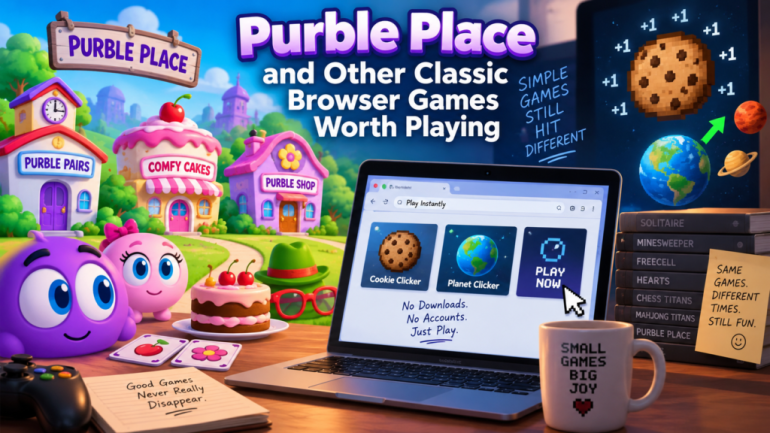
Modern games are extraordinary and exhausting in equal measure. A new release can ask for a hundred gigabytes of storage, a long patch, an account and a launcher before you have done anything at all. Some evenings that is exactly what you want. Other evenings you have twenty minutes and no appetite for setup.
That gap is where browser games live, and it explains why a category everyone assumed had died keeps quietly refusing to.
The best example is a game Microsoft deleted. It shipped free with Windows Vista in 2007, disappeared in 2012, and now survives entirely because people liked it enough to rebuild it. You can still play Purble Place online today, and a few rounds are a decent reminder of how much a game can do with almost nothing.
What Purble Place Actually Was
Purble Place was not one game. It was three, wrapped in a cartoon town where each building opened something completely different.
The schoolhouse held Purble Pairs, a memory game. Cards face down, flip two at a time, clear the board in as few turns as you can. Beginner gave you one small grid. Advanced gave you four large ones on a timer, with card art deliberately similar enough that you doubted matches you had already found.
The bakery held Comfy Cakes, which is the one most people remember. An order appears, and you steer a cake pan along a conveyor belt through the correct stations. Wrong shape, wrong batter, missed layer, and the cake goes in the bin. Three bins and the run is over. On the harder settings several cakes travel the belt at once, and the game stops being about baking and starts being about attention.
The boutique held Purble Shop, and this is the one worth the trip. The game secretly assigns colours to a character’s features and you have to deduce the combination. On the easier settings it tells you which items you got right. On Advanced it tells you only how many are correct and how many are the right colour in the wrong place. It is Mastermind in a dress-up screen, and it is a genuinely difficult logic puzzle hiding inside something built for children.
Three games, three different skills, no story, no progression, no account. You open it, you play, you close it.
Why Simple Mechanics Stay With People
There is a reason the phrase “I remember that game” attaches so often to things this small.
You learn them instantly. Every one of those three mini-games explains itself in a single screen. Nobody ever needed a tutorial for Comfy Cakes. That immediacy is rare now, and it is a large part of why these games got played by people who did not think of themselves as gamers at all.
They fit into a gap. A round takes a few minutes, which makes a browser game something you can actually finish. A modern release usually is not.
Nothing is trying to keep you. Purble Place was designed before the free-to-play era, so there is no energy meter, no daily login streak, no advert between rounds and nothing to buy. It asks for your attention and then lets you go. That is now unusual enough to feel deliberate.
The difficulty is real if you look for it. This is the part people forget. The Advanced settings in Purble Place are hard. Anyone returning to it as an adult expecting a children’s game tends to get caught out by the shop.
Simple is not the same as shallow. Chess is simple. Tetris is simple. Purble Shop is a small, well-built deduction puzzle, and it does not stop being one just because the characters have big cartoon heads.
The Wider Browser Game Graveyard
Purble Place is not an isolated case. It belongs to a whole layer of casual gaming that got wiped out in two separate events.
The first was Windows 8 in 2012, which removed the built-in Games folder entirely. Solitaire, Minesweeper, FreeCell, Hearts, Chess Titans, Mahjong Titans and Purble Place all went at once. Solitaire and Minesweeper eventually returned as Microsoft Store downloads, though the new Solitaire arrived with adverts and an optional subscription to remove them. Purble Place never came back in any form.
The second was Flash. Adobe ended support at the end of 2020, and with it went an enormous library of small games that had defined casual play for a generation of browser users. Some were preserved by volunteer archive projects, others were rebuilt in HTML5, and a great many simply stopped existing.
What survived did so through people rather than publishers. That is worth sitting with. The games still playable today are the ones somebody cared enough to rebuild, which is a decent filter for quality on its own. It is the same argument that fuels every Bring This Back piece about a film or franchise left to rot in a rights holder’s vault.
How Browser Games Changed: The Rise of the Clicker
Something interesting happened after Flash died. Browser gaming did not disappear, it shifted, and the genre that came to define the new era was the idle clicker.
The template is usually traced to Cookie Clicker, released in 2013 by the French programmer Julien Thiennot, who works under the name Orteil. It started as a joke about pointless repetition and accidentally invented a whole category. The core idea is deceptively simple. You click to earn a currency. You spend that currency on machines that earn it for you. Eventually you stop clicking entirely and watch a number grow.
The reason it works is not the clicking. It is the shape of the curve. Each new machine costs more than the last but produces disproportionately more, so your income outruns the prices and the wait between purchases gets shorter as you go. Progress accelerates instead of slowing down, and that feeling is genuinely satisfying in a way that is hard to explain to someone who has not sat through it.
Clickers took the one thing old browser games had, which was instant accessibility, and added the one thing they lacked, which was a long-term goal.
What a Modern Browser Clicker Looks Like
A reasonable current example is the Planet Clicker game, which is useful here mainly because its structure is small enough to describe completely.
You click a planet to generate energy. Energy buys machines. Machines generate energy without you. Earth has six upgrades, running from a campfire at 100 energy up to a factory at 250,000, and each one prints how long it takes to pay for itself. Build enough production and you can unlock Mars for a million energy, then eventually Venus for a trillion.
The part that makes it more than a counter is the multiplier. The same machine produces five times as much on Mars as it does on Earth, and twenty five times as much on Venus. So the decision is not just what to buy, it is when to stop investing in the planet you are on and move to a better one. That is a real strategic choice, built out of about six numbers.
It was originally built in Scratch, the block-based coding tool run by MIT, by a developer going by Coltroc, and it has been online since 2020. That is an odd origin for something with this much staying power, and it says a lot about how low the barrier to entry has become for this kind of design.
None of that makes it a deep game. It is a clicker. But it shows the shift clearly: the same instant access as a 2007 browser game, with a progression curve layered on top.
What Makes a Browser Game Worth Your Time
If you are going to spend an evening on something that runs in a tab, a few things separate the ones worth playing from the ones filling space between adverts.
It should start in one click. No account, no download, no email. If a page wants you to register before you play, it is not a game site, it is a mailing list.
It should be finishable, or honestly endless. Purble Place gives you a round with a clear end. A clicker gives you a curve with no end at all. Both are fine. What is not fine is a game that pretends to have an ending and then gates it.
Nothing important should sit behind payment. The whole appeal of this category is that it is free in a way modern gaming has forgotten how to be.
Watch what the page asks for. Legitimate browser games run entirely in the tab. Anything pushing an executable download, a notification prompt or a signup wall before you have played is a warning sign, not a feature.
Check whether progress saves. Older browser games generally do not save at all. Many modern ones store progress locally in your browser, which means it stays on that one device and disappears if you clear your site data or play in a private window. Neither approach is wrong, but it is worth knowing which you are dealing with before you commit three hours.
Where This Fits Alongside Modern Gaming
None of this is an argument that small browser games are better than the big ones. They are not competing. A sixty hour open world and a twenty minute logic puzzle are answering completely different questions.
What browser games do is fill the space that modern gaming has largely abandoned. There is no longer much between “install a launcher” and “watch something instead”. Purble Place, and the small games that survived alongside it, sit exactly in that gap.
There is also a preservation argument here that is easy to overlook. Purble Place was never sold, never marketed and never reviewed. It shipped free with an operating system, got deleted, and by any normal measure should have vanished completely. It did not, because enough people rebuilt it. That is the same energy that keeps forgotten films alive on boutique physical media labels, and it is worth more credit than it usually gets. Plenty of the underrated gems worth defending are exactly this kind of thing.
Final Thoughts
If you have twenty minutes and want to see what this category can do, skip the easy settings and go straight to Purble Shop on Advanced. It is a proper deduction puzzle and it will tell you more in a quarter of an hour than any amount of nostalgia will.
If you want something to leave running in a tab instead, a clicker is the better fit, and the appeal there is the curve rather than the clicking.
Either way, the point stands. A game does not need a hundred gigabytes and a launcher to be worth playing. Sometimes it just needs to load.