



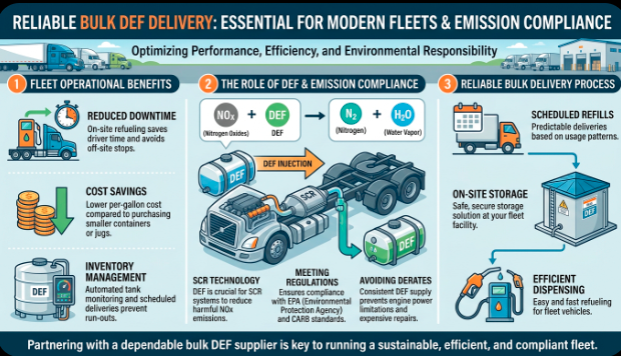
In today’s transportation and industrial landscape, emission compliance has become a central requirement rather than an optional consideration. Diesel-powered vehicles and machinery are widely used across logistics, construction, agriculture, and manufacturing, but they must meet strict environmental regulations to remain operational and legally compliant. One of the most important components supporting this compliance is Diesel Exhaust Fluid (DEF), a carefully formulated solution used in Selective Catalytic Reduction (SCR) systems to reduce harmful nitrogen oxide emissions. As demand grows for uninterrupted supply chains and operational efficiency, reliable bulk DEF delivery services have become an essential part of modern fleet management strategies.
The need for consistent DEF availability is not just a matter of convenience; it is directly tied to vehicle performance and regulatory compliance. Without DEF, many modern diesel engines are designed to reduce power or even prevent operation entirely, ensuring that emissions standards are not violated. This makes the supply of DEF a mission-critical requirement for businesses that rely on diesel-powered equipment. Bulk delivery solutions address this need by ensuring that large quantities of DEF are delivered, stored, and managed efficiently across multiple vehicles or operational sites.
Understanding Diesel Exhaust Fluid and Its Importance in Emission Control Systems
Diesel Exhaust Fluid is a non-toxic, colorless solution composed primarily of high-purity urea and deionized water. It plays a vital role in reducing harmful nitrogen oxide emissions produced during diesel combustion. When injected into the exhaust stream of a diesel engine equipped with an SCR system, DEF breaks down into ammonia, which then reacts with NOx gases in the presence of a catalyst. This chemical reaction converts harmful pollutants into harmless nitrogen and water vapor, significantly reducing environmental impact.
The effectiveness of this process depends heavily on the quality and purity of the fluid, as well as the precision of its delivery into the exhaust system. Any contamination or incorrect mixture can compromise the efficiency of emission reduction systems, leading to increased emissions and potential system malfunctions. Because of this sensitivity, businesses often rely on professionally managed supply chains that ensure DEF is stored and transported under controlled conditions.
This is where reliable bulk DEF delivery services become essential. They ensure that the fluid is delivered in sealed, contamination-free containers or directly into storage tanks at the point of use, maintaining product integrity from production to application.
The Growing Demand for Bulk DEF Supply in Industrial and Commercial Sectors
The rise in environmental regulations across global markets has significantly increased the demand for DEF. Industries that operate large fleets or heavy machinery consume DEF at a consistent rate proportional to fuel usage. As a result, small-scale container purchases are often inefficient and logistically burdensome for high-consumption operations.
Bulk DEF delivery solves this problem by providing large-volume supply solutions tailored to the needs of commercial operations. Instead of managing multiple small containers, businesses can receive DEF in bulk quantities delivered directly to on-site storage tanks. This reduces downtime, minimizes handling requirements, and ensures that vehicles remain operational without interruption.
For logistics companies, construction firms, agricultural operations, and mining activities, uninterrupted access to DEF is crucial. Even short disruptions in supply can result in reduced fleet availability, delayed operations, and financial losses. This makes reliable bulk DEF delivery services not just a convenience but a strategic necessity.
How Bulk DEF Delivery Systems Work in Practice
Bulk DEF delivery systems are designed to streamline the entire supply process from storage to dispensing. Typically, DEF is transported in specialized tanker trucks that maintain strict contamination controls. These vehicles are equipped with dedicated pumping systems that transfer DEF directly into on-site storage tanks.
These storage tanks are designed with materials that prevent contamination and protect the chemical stability of the fluid. Once delivered, DEF is stored in a controlled environment where temperature and cleanliness are maintained to preserve its quality. From there, it is dispensed directly into fleet vehicles or machinery using automated or semi-automated pumping systems.
The efficiency of this system eliminates the need for manual handling of smaller containers, reducing labor costs and minimizing the risk of contamination. It also allows businesses to monitor consumption levels more effectively, ensuring that supply is always aligned with operational demand.
In this structured supply chain, reliable bulk DEF delivery services ensure that every stage from transportation to final dispensing is executed with precision and consistency.
Key Benefits of Bulk DEF Supply for Fleet and Industrial Operations
One of the most significant advantages of bulk DEF supply is operational efficiency. Businesses with large fleets often struggle with the logistics of managing multiple DEF containers, which require storage space, handling, and frequent reordering. Bulk delivery eliminates these challenges by providing a centralized and continuous supply.
Another major benefit is cost efficiency. Purchasing DEF in bulk quantities often reduces per-unit costs compared to packaged alternatives. Additionally, reduced handling and storage requirements translate into lower labor and logistical expenses.
Consistency in product quality is another critical advantage. Bulk supply systems are designed to maintain strict quality control standards, ensuring that the DEF delivered meets ISO 22241 specifications. This reduces the risk of system malfunctions caused by contaminated or substandard fluid.
Furthermore, bulk delivery supports sustainability goals by reducing packaging waste. Fewer plastic containers and transport trips mean a smaller environmental footprint, aligning with broader corporate sustainability initiatives.
Operational Risks of Inconsistent DEF Supply
Despite its importance, DEF supply is sometimes underestimated in operational planning. A shortage of DEF can have immediate consequences for diesel-powered equipment. Many modern SCR systems are programmed to limit engine performance or prevent operation if DEF levels fall too low. This regulatory safeguard ensures compliance with emission standards but can also disrupt business operations.
Contamination is another major risk. DEF is highly sensitive to environmental exposure, and even small amounts of dirt, fuel, or other chemicals can degrade its effectiveness. Poor handling or storage practices can lead to system clogging, injector damage, or catalytic converter issues.
Inconsistent supply chains can also create inefficiencies in fleet management. If vehicles are forced to wait for DEF replenishment, productivity declines and operational schedules are affected. These risks highlight the importance of structured supply systems supported by reliable bulk DEF delivery services, which reduce the likelihood of shortages and maintain system integrity.
Storage and Handling Considerations in Bulk DEF Management
Proper storage is essential for maintaining DEF quality. The fluid must be stored in clean, sealed containers made from compatible materials that prevent chemical degradation. Exposure to extreme temperatures, especially heat, can affect the stability of the solution, while contamination from external sources can render it unusable.
Bulk storage tanks are typically designed with temperature-resistant materials and are placed in controlled environments to preserve fluid quality. Regular inspection of storage systems is also necessary to ensure that no contamination or leakage occurs.
Handling procedures must be strictly followed to maintain product integrity. Personnel involved in DEF management are usually trained to avoid cross-contamination and ensure that all equipment used in transfer and dispensing is clean and dedicated solely to DEF use.
These practices are essential for maintaining the reliability of the entire system and ensuring that reliable bulk DEF delivery services function effectively within operational environments.
The Role of Technology in Modern DEF Distribution Systems
Technology has significantly improved the efficiency and accuracy of DEF distribution. Automated monitoring systems now allow businesses to track DEF levels in real time, ensuring timely replenishment before shortages occur. These systems can be integrated with fleet management software to provide predictive alerts based on consumption patterns.
Smart dispensing systems also help reduce waste by controlling the exact amount of DEF used per vehicle. This improves efficiency and ensures compliance with emission standards without unnecessary overuse.On the logistics side, advanced routing and tracking systems allow delivery providers to optimize supply schedules and reduce transportation delays. This ensures that bulk DEF arrives on time and in optimal condition.
The integration of technology into supply chains has made reliable bulk DEF delivery services more efficient, predictable, and responsive to customer needs.
Environmental and Regulatory Impact of Bulk DEF Usage
The use of DEF is directly linked to global efforts to reduce air pollution and greenhouse gas emissions. Governments have implemented strict regulations requiring diesel engines to meet specific emission standards, and SCR systems using DEF are a key part of achieving these targets.
By enabling efficient reduction of nitrogen oxide emissions, DEF contributes to improved air quality and reduced environmental impact. Bulk delivery systems further enhance sustainability by reducing packaging waste and transportation frequency.
Industries that adopt structured DEF supply systems are better positioned to meet regulatory requirements consistently. This reduces the risk of penalties, operational disruptions, and compliance issues.
Future Trends in Bulk DEF Supply and Distribution
The future of DEF distribution is likely to be shaped by further automation, digital integration, and sustainability improvements. As industries move toward smarter operations, predictive analytics will play a larger role in determining supply needs before shortages occur.
There is also a growing focus on reducing the environmental footprint of logistics operations. This includes optimizing delivery routes, using more efficient transportation methods, and improving storage technologies to extend product shelf life.
In addition, advancements in emission control technology may influence how DEF is used and managed in the future. More efficient SCR systems could reduce consumption rates, while innovations in chemical formulation may further enhance performance.
Despite these advancements, the need for reliable bulk DEF delivery services will remain strong, especially in industries that depend heavily on diesel-powered equipment.
Conclusion: The Strategic Importance of Bulk DEF Supply Systems
Diesel Exhaust Fluid has become an indispensable component of modern diesel engine technology, enabling compliance with environmental regulations while maintaining engine performance. As industries continue to expand and environmental standards become more stringent, the importance of a stable and efficient DEF supply chain continues to grow.
Bulk delivery systems offer a practical and cost-effective solution for managing high-volume DEF requirements. They ensure consistent availability, reduce operational risks, and support long-term sustainability goals. Through controlled storage, precise delivery, and advanced monitoring systems, businesses can maintain uninterrupted operations and ensure compliance with emission standards.
Ultimately, reliable bulk DEF delivery services are not just a logistical convenience but a foundational element of modern fleet management and industrial efficiency.