



Finding an apartment in today’s rental market is difficult enough on its own. With national median asking rents consistently hovering around $1,500 to $1,800 per month across major urban centers, prospective tenants face steep competition, exhaustive background checks, and rigid lease structures.
For animal owners, the search is even more daunting. “No-pets” policies eliminate a large portion of available housing, while properties that do accept animals frequently attach steep costs: non-refundable “pet fees” ranging from $200 to $500, additional monthly “pet rent” of $25 to $75 per animal, and strict weight or breed bans.
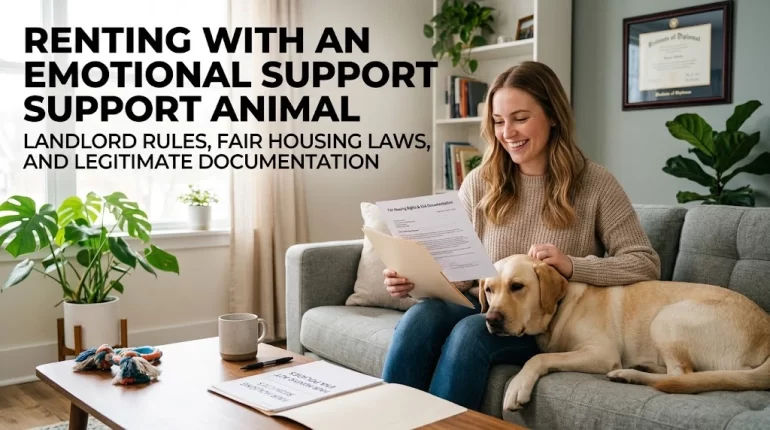
However, if you live with a diagnosed mental or emotional health condition and your companion provides therapeutic comfort, that animal may qualify as an Emotional Support Animal (ESA).
Federal housing regulations establish that an assistance animal is not a traditional pet. Because of this distinction, eligible renters have specific legal protections against discrimination, restrictive pet clauses, and arbitrary fees.
Navigating this terrain requires understanding the law, knowing your rights, and ensuring your paperwork meets strict regulatory standards.
Federal Protections: Understanding the Fair Housing Act
The foundation of assistance animal protections in residential housing is the Fair Housing Act (FHA), administered by the U.S. Department of Housing and Urban Development (HUD).
Under the FHA, housing providers are legally prohibited from discriminating against tenants or applicants based on race, color, national origin, religion, sex, familial status, or disability. Under federal guidelines, an ESA is classified not as a pet, but as an assistance animal, a broad category that includes both service animals and emotional support animals.
Mandatory “Reasonable Accommodations”
Because an ESA is not viewed as a luxury or casual pet under the law, landlords must make what the FHA defines as a reasonable accommodation.
This rule means the housing provider must adjust their usual policies, rules, and procedures to allow an individual with an emotional or psychological disability equal opportunity to use and enjoy a dwelling.
This protection grants several key exemptions for qualified renters:
- “No-Pets” Waivers: Even if an entire building strictly forbids pets, a landlord cannot enforce that policy against an approved ESA.
- No Breed or Weight Bans: If a property has a weight limit (such as banning animals over 25 pounds) or an explicit ban on specific dog breeds (such as Pit Bulls, Rottweilers, or German Shepherds), those restrictions do not apply to assistance animals. Each animal must be judged solely on individual behavior.
- Complete Pet-Fee Waivers: Landlords cannot charge upfront pet deposits, ongoing pet rent, or application fees for an ESA.
(Note: While landlords cannot charge advance pet fees, tenants remain personally liable for any legitimate physical damage the animal causes to carpets, walls, or fixtures upon move-out.)
Exceptions to the Rule: When Can a Landlord Say No?
While federal law is broad, the FHA does not cover every single residential structure in the United States. Landlords are legally exempt from providing reasonable accommodations in a few narrow scenarios:
- The “Mrs. Murphy” Exemption: Buildings with four or fewer rental units where the owner maintains a primary residence in one of the units.
- Private Single-Family Rentals: Single-family homes rented directly by the owner without the use of a real estate broker or property management firm, provided the private owner owns no more than three such single-family houses at one time.
- Direct Health and Safety Threats: If a specific animal exhibits dangerous, unprovoked aggression or creates severe, unresolvable disruptions, a landlord can legally deny or revoke accommodation after documenting the behavior.
What Landlords Can (and Cannot) Ask Under HUD Guidelines
To prevent housing providers from overstepping personal boundaries, HUD released formal guidance (Notice FHEO-2020-01) detailing exact standards for evaluating assistance animal requests. Knowing these boundaries helps protect your private health information during the leasing process.
| What Landlords ARE Allowed to Do | What Landlords ARE NOT Allowed to Do |
| Request clinical documentation if your condition is not visible or obvious. | Demand access to your full medical or psychological treatment records. |
| Verify that the healthcare provider who signed your letter holds an active, valid license. | Ask invasive questions about your specific clinical diagnosis, severity, or past treatment history. |
| Request proof of basic mandatory municipal health codes (such as up-to-date rabies vaccinations). | Require proof of specialized training, behavioral tricks, or performance tasks. |
| Deny an animal that poses a direct, objective safety threat to neighbors or maintenance staff. | Insist on using proprietary, complex housing forms that exceed standard HUD requirements. |
Under federal rules, ESAs do not require task-specific training. While Psychiatric Service Dogs (PSDs) must be individually trained to perform active disability-mitigating duties under the Americans with Disabilities Act (ADA), an ESA’s primary therapeutic role is providing stabilizing comfort through presence.
A housing manager asking to see what “tasks” your support animal does is applying service dog criteria incorrectly to an ESA.
The Paperwork: What Constitutes Valid ESA Documentation?
The single most common reason accommodation requests hit roadblocks is invalid, fraudulent, or non-compliant paperwork.
With millions of Americans experiencing conditions like major depression, generalized anxiety disorder, and chronic post-traumatic stress, the demand for telehealth evaluations has grown rapidly. Unfortunately, that growth has also fueled deceptive marketing online.
Essential Components of a Valid Letter
A legally defensible ESA letter is a clinical recommendation written by a qualified healthcare professional. It is not an arbitrary online registry certificate.
To satisfy HUD and property review standards, the letter must include:
- Professional Credentials: The practitioner’s full name, clinical license type (LCSW, LMFT, LPC, PsyD, MD, or NP), license number, state of jurisdiction, and date of issuance.
- Letterhead & Verification Details: The official clinic or practice letterhead, contact email, and active telephone number so property management can confirm validity.
- Established Relationship & Findings: A clear, concise statement confirming that you have a mental or emotional impairment that substantially limits one or more major life activities, and that the presence of the animal alleviates one or more identified symptoms.
Avoiding “Instant Registration” Scams
A quick search for assistance animals brings up hundreds of sites offering instant registrations, downloadable badges, plastic cards, and lifetime registry listings for a one-time fee.
HUD’s official guidance states plainly that web-based certificates, ID cards, and registrations purchased online are not, by themselves, sufficient to establish that an individual has a disability-related need for an assistance animal.
Real estate boards, tenant screening agencies, and private landlords routinely reject these certificates on sight. To protect your rights and your lease, obtaining a legit ESA letter online requires a genuine, one-on-one consultation with a licensed professional who evaluates your clinical background rather than simply selling a piece of novelty paper.
Step-by-Step: How to Request Reasonable Accommodation
Handling the request professionally and methodically prevents friction with your property manager. If you know how to get an ESA letter through reliable resources, you are already secure even when you haven’t started to apply for ESA letter. Here are the steps you should follow:
1. Secure Your Documentation in Advance
Do not wait until a lease violation notice appears on your door to gather paperwork. Securing your clinical evaluation ahead of time establishes your status as a responsible, proactive tenant. Modern telehealth options make it straightforward to consult with state-licensed practitioners and obtain an ESA letter securely from home without multi-month waiting lists.
2. Submit a Clear, Written Request
Send an email or formal letter to the leasing office or landlord stating:
“I am requesting a reasonable accommodation under the Fair Housing Act for an emotional support animal to assist with a health-related condition. Attached is supporting documentation from my licensed healthcare provider.”
Keep communications courteous, matter-of-fact, and documented in writing for your records.
3. Allow Standard Processing Time
Landlords are allowed reasonable time to review the documentation and verify provider credentials. While state regulations vary slightly, standard HUD guidance suggests that housing providers should process and respond to reasonable accommodation requests promptly, typically within 7 to 10 business days.
Tenant Responsibilities and Addressing Landlord Disputes
Having an approved ESA gives you legal protections, but it does not absolve you of standard tenant responsibilities.
The Tenant’s Ongoing Obligations
- Hygiene and Cleanliness: The animal must be housebroken and cleaned up after immediately in common areas.
- Noise and Disruption: An animal that barks incessantly for hours or damages hallway carpets can face legitimate behavioral complaints. Chronic, unresolved nuisances can jeopardize your accommodation.
- Local Ordinances: Your animal must still follow local city regulations, such as county rabies vaccine mandates and local leash ordinances outside the private apartment.
What to Do If Your Landlord Denies Your Request
If your landlord denies an accommodation despite compliant paperwork, consider these corrective steps:
- Ask for the Specific Reason in Writing: Inquire whether the issue is missing license verification, an invalid clinic contact number, or confusion regarding the animal’s classification.
- Provide Official Reference Material: Share HUD’s published guidelines (Notice FHEO-2020-01), specifically referencing Section III regarding telehealth assessments and documentation criteria.
- Escalate to HUD: If the landlord operates an eligible multi-family property and refuses compliance, you have the right to file an administrative complaint with the HUD Office of Fair Housing and Equal Opportunity (FHEO) or contact a local non-profit tenant legal aid organization.
Approaching the process with accurate information, legitimate paperwork, and open communication ensures both you and your assistance animal remain safely and securely housed.