



Guest contribution. The author writes about metabolic and peptide research. This article is editorial commentary, not medical advice.
Put the three most-discussed weight-loss molecules side by side and the comparison looks like a simple ladder: semaglutide works, tirzepatide works better, retatrutide works best. The trial averages invite exactly that reading — roughly 15%, roughly 21%, roughly 28% to 30%.
The ladder is not wrong, but it is built out of comparisons that were never made in the same room. Only one of the three pairings has ever been tested head-to-head, in a single trial, in the same population, on the same protocol. Understanding which comparison is real and which is arithmetic is the difference between knowing the field and repeating its marketing.
One receptor, two receptors, three
The differences start with what each molecule binds to.
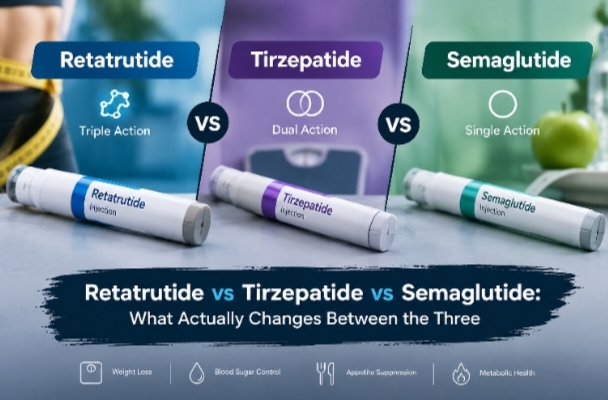
Semaglutide is a GLP-1 receptor agonist. Single target. It slows gastric emptying, increases satiety signalling and reduces appetite — the mechanism that defined the entire class and made injectable obesity treatment a mass-market category.
Tirzepatide is a dual agonist: GIP and GLP-1. The addition of GIP agonism is the generally accepted explanation for the step up in average weight loss, though the precise contribution of the GIP arm is still argued over. For years the GIP receptor was considered a poor target for weight loss — early work suggested antagonism rather than agonism might be the useful direction, and the field spent a decade on the wrong side of that question before the clinical results settled it. The lesson is worth keeping in mind when reading confident mechanistic explanations, including the ones in this article.
Retatrutide is a triple agonist: GIP, GLP-1 and glucagon. The glucagon receptor is the novel element, and it is conceptually awkward — glucagon raises blood glucose, which is the opposite of what you want in a metabolic drug. The rationale is that glucagon agonism also raises resting energy expenditure and reduces liver fat, so the combination trades a manageable effect on glucose for an additional effect on energy balance. Whether that trade is what produces the reported results, or whether retatrutide is simply a more potent molecule overall, has not been established.
What each has proven, and in whom
Every headline number below comes from a different trial, in a different population, with a different duration and a different statistical method for handling participants who dropped out. Those differences routinely move a result by several percentage points.
Semaglutide 2.4 mg. In STEP-1, adults with overweight or obesity without diabetes lost an average of about 14.9% of body weight over 68 weeks, with roughly a third of participants losing 20% or more.
Tirzepatide 15 mg. In SURMOUNT-1, the same broad population lost an average of 20.9% over 72 weeks, with 19.5% on the 10 mg dose. A greater proportion reached the 20% and 25% thresholds than on semaglutide in its own trial.
Retatrutide 12 mg. In the Phase 2 trial reported in the New England Journal of Medicine in 2023, average weight loss reached 24.2% at 48 weeks. The Phase 3 TRIUMPH-1 trial then reported 28.3% at 80 weeks and 30.3% at 104 weeks, with 45.3% of participants losing at least 30% of body weight. In adults with type 2 diabetes, TRIUMPH-2 reported up to 20.8%; in adults with severe obesity, TRIUMPH-3 reported up to 22.6%.
Read as a ladder, that is 15% to 21% to 30%. Read properly, it is three separate experiments.
The only true head-to-head we have
The comparison that does exist is tirzepatide versus semaglutide, and it came late. SURMOUNT-5 randomised adults with obesity, without diabetes, to maximum tolerated doses of either drug for 72 weeks.
Tirzepatide produced an average weight reduction of 22.8 kg against 15.0 kg for semaglutide — roughly 20.2% versus 13.7% depending on the baseline. Tirzepatide was also more likely to produce reductions of at least 10%, 15% and 20%.
That is a genuine result, and it resolved a question the field had been answering with wishful arithmetic for three years. It also demonstrated something important for anyone reading cross-trial comparisons: when the two drugs were finally tested against each other, the gap was real. The approximate 21% versus 15% from separate trials survived contact with a randomised design. It does not follow that the approximate 30% versus 21% gap will survive the same test.
No equivalent trial exists for retatrutide. The molecule has never been randomised against tirzepatide or semaglutide in any population, at any dose, at any duration. Until one is run, “retatrutide is more effective than tirzepatide” is a hypothesis with supporting averages, not a finding.
It is also worth noting what SURMOUNT-5 did not include. It enrolled adults with obesity but without type 2 diabetes, so it says nothing about the population where the ranking matters most clinically — people whose weight and glucose are both being treated. It was open-label, which matters for a drug whose main side effects are gastrointestinal and therefore visible to both participant and investigator. A comparison of that size answers the headline question and leaves the follow-ups open.
What a fair comparison would actually need
For the retatrutide question to be settled rather than estimated, the design would need three things. A randomised allocation, so that baseline differences between groups cannot drive the result. Doses that are individually titrated to maximum tolerated, as in SURMOUNT-5, because comparing 12 mg of one drug against a submaximal dose of another flatters whichever drug was pushed further. And a duration long enough for the weight-loss curves to stop diverging — the gap between compounds tends to widen for the first year and narrow afterwards, so a 48-week comparison and a 104-week comparison of the same two drugs can tell opposite stories.
Nobody has run that trial for retatrutide, and until someone does, every comparison on the internet — including the table at the end of this article — is a summary of separate experiments.
Tolerability: the part the percentages hide
Gastrointestinal adverse events dominate the class: nausea, vomiting, diarrhoea and constipation, generally worst during dose escalation and generally improving afterwards. All three compounds show the same pattern, and all three show more of it at higher doses.
What differs — and what matters more than the averages for anyone actually using one of these drugs — is the titration schedule and the ceiling. Semaglutide escalates to 2.4 mg. Tirzepatide goes to 15 mg. Retatrutide’s trials escalated to 12 mg. The dose of retatrutide that produced 30% weight loss is a dose that a substantial minority of trial participants could not comfortably sustain, and discontinuation for tolerability is the reason most people switch products in this class.
There is also an unresolved question specific to the triple agonist. Glucagon agonism increases heart rate in a dose-dependent way in the trials reported so far, and the long-term implications of that — along with effects on bone turnover and hepatic signalling — are precisely the things a Phase 3 programme is not sized to detect. Rare and delayed harms get found by post-marketing surveillance, and there has been no market to surveil.
Approval status is the practical difference
Here the three stop being comparable at all.
Semaglutide and tirzepatide are approved medicines in major markets, with defined indications, approved doses, regulated manufacturing, batch release testing, and pharmacovigilance obligations. They are prescribed, dispensed and monitored.
Retatrutide is not approved anywhere as of September 2026. It is investigational, with a regulatory submission signalled rather than an approval granted. That single fact determines what is actually available: for the first two, a prescription and a pharmacy. For the third, a grey market.
Where people look for reta, and what they get
Because no approved version of retatrutide exists, demand for it does not flow through pharmacies. It flows through search, and the search terms reflect the gap — people looking for reta where to buy, for a retatrutide 10mg option, for a seller who ships without a prescription.
What they find is a market of research chemical suppliers selling vials of an unapproved compound under a for research use only label. The label is a legal position, not a quality statement. It tells you nothing about whether the peptide in the vial is what the label claims, whether it was sterile when it was sealed, or whether it survived shipping.
For an injectable, three things are worth checking before anything else. Batch-specific, third-party certificates of analysis — not a generic certificate reused across batches, and not a purity figure quoted without the underlying chromatogram and mass spectrometry data. Sterility and endotoxin testing, which is where cheap suppliers cut first and where the consequences are worst. And cold-chain handling, because a peptide that spent a week at ambient temperature is not the product that was tested.
Suppliers that publish batch documentation openly, compound by compound, set the standard — Dragon Pharma’s retatrutide range is one example of a catalogue that lists documentation alongside the compound rather than on request. Treat the absence of that documentation as the answer to your question, and note that concentration and fill matter too: a 10 mg vial and a 5 mg vial of nominally the same peptide are not interchangeable once concentration and handling are accounted for.
None of which makes self-administering an investigational drug a sensible plan. It makes the difference between a documented vial and an undocumented one the difference between a calculated risk and an uncalculated one.
Side by side
| Criterion | Semaglutide | Tirzepatide | Retatrutide |
|---|---|---|---|
| Receptors | GLP-1 | GIP + GLP-1 | GIP + GLP-1 + glucagon |
| Approximate average weight loss in its own trial | ~14.9% (STEP-1, 68 weeks) | 20.9% at 15 mg (SURMOUNT-1, 72 weeks) | 28.3% at 80 weeks; 30.3% at 104 weeks (TRIUMPH-1) |
| Head-to-head evidence | Yes — lost to tirzepatide in SURMOUNT-5 | Yes — beat semaglutide in SURMOUNT-5 | None |
| Regulatory status | Approved | Approved | Not approved (September 2026) |
| Where it is obtained | Prescription | Prescription | Grey market research chemical |
The bottom line
Semaglutide and tirzepatide are medicines with a documented comparison between them: tirzepatide won, by a margin that was smaller than the cross-trial arithmetic had suggested but clear enough to change prescribing.
Retatrutide is, on the current evidence, probably the most effective of the three. It is also the one with no head-to-head data, no approval, no approved dose and no regulated supply chain — and its average results come from supervised trial participants, not from people self-administering an unverified vial. The comparison table above is honest; the ladder it appears to form is not, yet.
References
- Wilding JPH, et al. Once-Weekly Semaglutide in Adults with Overweight or Obesity (STEP-1). New England Journal of Medicine. 2021;384(11):989–1002.
- Jastreboff AM, et al. Tirzepatide Once Weekly for the Treatment of Obesity (SURMOUNT-1). New England Journal of Medicine. 2022;387(3):205–216.
- Aronne LJ, et al. Tirzepatide as Compared with Semaglutide for the Treatment of Obesity (SURMOUNT-5). New England Journal of Medicine. 2025.
- Jastreboff AM, et al. Triple–Hormone-Receptor Agonist Retatrutide for Obesity — A Phase 2 Trial. New England Journal of Medicine. 2023;389(6):514–526.
- Eli Lilly and Company. TRIUMPH-1, TRIUMPH-2 and TRIUMPH-3 Phase 3 results. Company announcements, 2026.
- US Food and Drug Administration. Approval status and adverse event reporting for GLP-1 and dual/triple agonist products. 2026.