



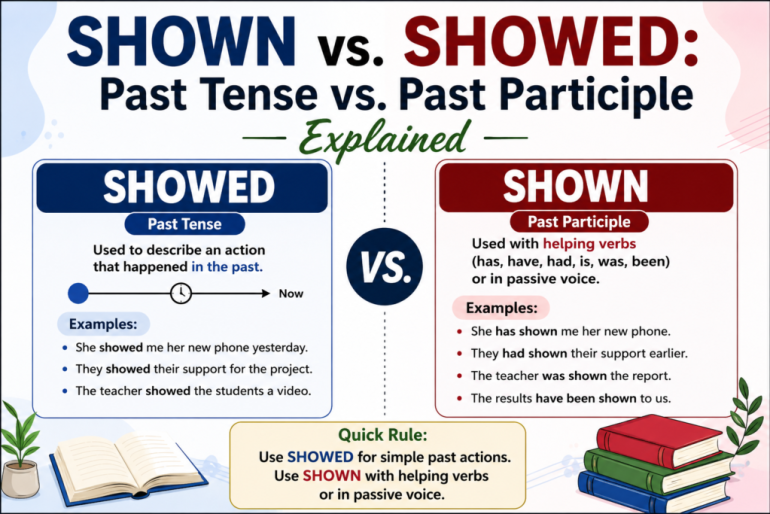
English has many irregular verbs that can be confusing, especially when their past tense and past participle forms look different. One common example is the verb “show.” Many learners wonder whether they should say “showed” or “shown.”
The short answer is simple:
- Showed is the simple past tense of “show.”
- Shown is the past participle of “show.”
Although both words come from the same verb, they are used differently in sentences. Understanding this difference will help you write and speak English more naturally.
In this guide, we will explain shown vs. showed, how each word works, common mistakes, and plenty of examples to make the difference easy to remember.
What Is the Difference Between Showed and Shown?
When to Use “Showed”
Use showed as the simple past form of “show.”
The simple past describes an action that started and finished in the past. It does not normally require a helping verb.
For example:
Tom showed me his new car.
The action of showing happened in the past.
Here are more examples:
- Maria showed us her vacation photos.
- The teacher showed the students a new example.
- He showed me how to use the computer.
- They showed their support for the project.
- Sarah showed her friends the new apartment.
- The guide showed us around the museum.
For more simple and practical English grammar explanations, mygrammora.com provides helpful guides for learners. In each sentence, showed describes a completed past action.
Use showed as the simple past form of “show.”
The simple past describes an action that started and finished in the past. It does not normally require a helping verb.
For example:
Tom showed me his new car.
The action of showing happened in the past.
Here are more examples:
- Maria showed us her vacation photos.
- The teacher showed the students a new example.
- He showed me how to use the computer.
- They showed their support for the project.
- Sarah showed her friends the new apartment.
- The guide showed us around the museum.
In each sentence, showed describes a completed past action.
Showed in Questions
You can also use showed when forming questions about a past action, although “did” takes the base form “show” after it.
Correct:
Did she show you the picture?
Incorrect:
Did she showed you the picture?
The reason is that did already marks the sentence as past tense. Therefore, the main verb returns to its base form.
When to Use “Shown”
Shown is the past participle of “show.” It is generally used with helping verbs.
One of the most common structures is the present perfect:
She has shown me the results.
You can also use “shown” with the past perfect:
She had shown me the results before the meeting.
And with the future perfect:
She will have shown everyone the results by tomorrow.
“Shown” is also frequently used in passive constructions:
The results were shown to the audience.
The movie was shown at the theater.
Examples of Shown
Here are some examples:
- He has shown great improvement.
- They have shown excellent teamwork.
- She had shown me the document earlier.
- The experiment has shown promising results.
- The picture was shown on television.
- The new product has been shown to customers.
- The report has shown a significant change.
Notice that “shown” works together with another verb rather than functioning as an ordinary simple past verb.
Showed vs. Shown in the Perfect Tenses
A helpful way to understand the difference is to look at perfect tenses.
Present Perfect
Use has/have + shown.
She has shown us the new design.
They have shown considerable improvement.
Do not say:
She has showed us the new design.
The correct form is:
She has shown us the new design.
Past Perfect
Use had + shown.
He had shown me the letter before I left.
The action of showing happened before another past action.
Future Perfect
Use will have + shown.
By Friday, the company will have shown the new product to investors.
This describes an action that will be completed before a particular future time.
Showed vs. Shown in Passive Voice
“Shown” is also common in passive voice.
For example:
The painting was shown at the exhibition.
Here, the painting receives the action rather than performing it.
Another example:
The documentary was shown on television last night.
In these sentences, shown follows a form of “be.”
You can also see:
The results were shown to the students.
The new technology has been shown to be effective.
These constructions require the past participle shown, not showed.
Is “Showed” Ever Used as a Past Participle?
In modern standard English, shown is the usual past participle of “show.”
However, showed can sometimes appear as a past participle, particularly in older, dialectal, or less common usage. For everyday modern English, learners should generally use shown when a past participle is required.
For example, standard English prefers:
She has shown us the way.
rather than:
She has showed us the way.
Therefore, if you are writing an essay, blog post, professional email, academic assignment, or other formal English text, shown is usually the safest choice after a perfect auxiliary.
Common Mistakes With Showed and Shown
Understanding a few common mistakes can make the rule easier to remember.
Mistake 1: Using “Showed” After Has or Have
Incorrect:
He has showed me the results.
Correct:
He has shown me the results.
After has or have, use the past participle shown.
Mistake 2: Using “Shown” as Simple Past
Incorrect:
Yesterday, she shown me her new house.
Correct:
Yesterday, she showed me her new house.
When there is no helping verb and you are describing a completed past action, use showed.
Mistake 3: Using “Showed” After Had
Incorrect:
They had showed us the documents.
Correct:
They had shown us the documents.
The structure is:
had + past participle
Therefore:
had shown
Mistake 4: Using “Showed” After “Was” in Passive Voice
Incorrect:
The movie was showed last night.
Correct:
The movie was shown last night.
In passive voice, use:
was/were + shown
Easy Trick to Remember Showed vs. Shown
A simple memory trick is to ask yourself:
“Is there a helping verb?”
If you are describing a straightforward action in the past, use showed.
She showed me the picture.
If you have a helping verb such as has, have, had, was, were, or been, you will often need shown.
She has shown me the picture.
She had shown me the picture.
The picture was shown to me.
This is not a rule for every possible construction, but it is an excellent starting point for English learners.
Showed vs. Shown: Quick Comparison
| Form | Grammar | Example |
| Show | Present | I show my work. |
| Showed | Simple past | I showed my work. |
| Shown | Past participle | I have shown my work. |
The key difference is that showed can stand alone as the past-tense verb, while shown normally works with a helping verb.
More Examples in Everyday English
Let’s look at some natural examples.
Simple past:
James showed me his new website yesterday.
Present perfect:
James has shown me his new website.
Past perfect:
James had shown me his website before the meeting.
Passive voice:
James’s website was shown to the clients.
Here, the meaning is related, but the grammar changes depending on the tense and voice.
Another set of examples:
The teacher showed us a video yesterday.
The teacher has shown us several videos this week.
The teacher had shown us the video before the test.
The video was shown to the class.
These examples demonstrate why choosing between showed and shown depends on the sentence structure.
Why Is “Show” Confusing?
The verb “show” is an irregular verb because its forms do not follow the regular -ed pattern in the same way as verbs such as “walk” or “play.”
For regular verbs:
walk → walked → walked
But “show” follows:
show → showed → shown
This difference can make the verb confusing for English learners.
The good news is that once you memorize the three forms and understand when each is used, the distinction becomes much easier.
Showed or Shown: Which One Should You Use?
Use showed when you are using the simple past tense:
She showed me her artwork.
Use shown when you need the past participle, especially after helping verbs:
She has shown me her artwork.
She had shown me her artwork.
Use shown in passive constructions:
Her artwork was shown at the gallery.
The easiest formula to remember is:
Past action = showed
Past participle = shown
Final Thoughts
The difference between shown and showed is mainly a matter of grammar. Both words come from the verb show, but they perform different jobs in a sentence.
Showed is the simple past form:
He showed me the answer.
Shown is the past participle:
He has shown me the answer.
Once you recognize whether your sentence is using the simple past, a perfect tense, or passive voice, choosing the correct word becomes much easier.
If you are unsure, look for helping verbs such as has, have, had, was, were, or been. In many common constructions, these signal that you need the past participle shown.
Remember:
Show → showed → shown
Learning these three forms will help you avoid one of the most common mistakes involving this useful English verb and make your writing sound more natural and grammatically correct.