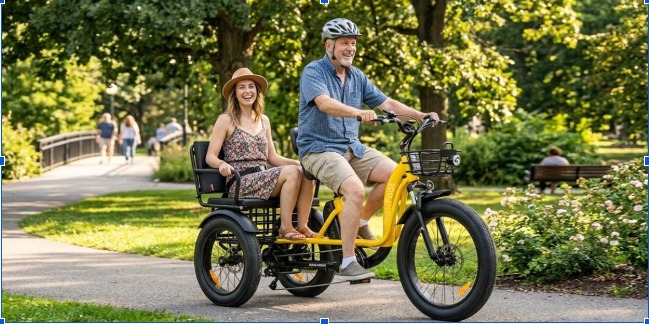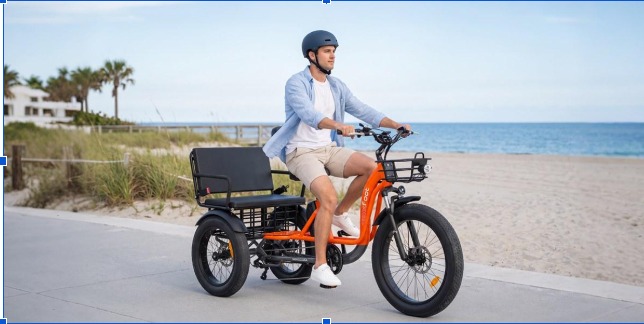
Introduction
The regret is common enough to be a genre of online review: someone buys a capable electric bike, loves it for a month, and then discovers the limit. A spouse wants to come along. A grandchild asks for a ride. A friend visits for the weekend. The bike, brilliant as it is, seats one.
At that point the choice is not “which e-bike” but “which platform.” Two wheels buy you agility, light weight, and easy storage. Three wheels buy you standing stability, payload, and — critically — somewhere safe for a second human being to sit. That is the actual trade-off, and it deserves a clearer analysis than “trikes are for people who can’t balance.”
This guide compares a standard single-rider e-bike with a purpose-built electric tricycle with passenger seat, and explains why the differences run much deeper than one extra wheel.
Passenger Safety, Balance, and Structural Stability
The tempting shortcut is to adapt the bike you already own. It is also the most dangerous option on the table.
Why bolt-on rear seats fail. Rear pegs, unrated cushion pads, and generic child seats attached to a bicycle rack introduce three problems at once:
- The rack is typically rated for 25 to 55 lbs of static cargo, not a moving 150 lb adult
- The passenger’s mass sits high and far behind the rear axle, which lightens the front wheel and makes steering vague
- A passenger with no footrests dangles their legs near a spinning wheel and shifts their weight unpredictably
On two wheels, all of that has to be corrected by the rider’s balance, continuously. One unexpected lean at low speed — exactly when a passenger is climbing on — and the whole assembly goes over.
Three-wheel static equilibrium. A trike does not need forward motion to stay upright. That single property changes the passenger experience completely. A 150 lb-plus adult can settle onto the rear seat, adjust a jacket, or reach for a bag while the vehicle stands still and level. Nothing depends on the rider’s arms and legs holding the machine up.
Integrated restraint points. A factory-built passenger area gives a companion something the aftermarket cannot: a backrest that stops rearward slide under acceleration, armrests or handgrips that give the hands a fixed job, and footrests that lock the legs safely away from the wheels. These are structural parts welded and bolted into the frame’s load path, not accessories hanging off a seat post.
Motor Torque, Differential, and Frame Certification for 2 Adults
A second adult roughly doubles the load the drivetrain must move, and drivetrains are sized for a design load.
Why solo bike motors struggle. A 500W-class hub motor tuned for one rider spends most of its life in an efficient middle range. Add another 160 to 200 lbs and it operates near stall far more often — especially from standing starts and on gradients. Stall is where a motor draws maximum current and converts most of it to heat rather than motion. Sustained, that heat degrades magnets, windings, and controller components. The bike does not fail dramatically; it just gets slower, hotter, and shorter-ranged over a couple of seasons.
Sizing for two. A dual-rider platform starts from a bigger baseline. The MaxFoot MF-33 is a representative example: a rear-drive 750W brushless geared motor with a 1400W peak and about 85Nm of torque, fed by a 25A waterproof controller. The peak figure matters more than the nominal one here — it is the headroom that absorbs a two-adult launch without the motor running at its thermal ceiling.
The differential is the structural difference. Many entry trikes drive a single rear wheel, which torque-steers under load, or weld both rear wheels to one rigid axle, which forces the inner wheel to skid through every turn. A mechanical rear differential splits torque between the two rear wheels and lets them rotate at independent speeds while cornering. With a passenger’s mass sitting over that axle, keeping both 20″ x 4.0″ rear tires planted and rolling is what stops a loaded turn from feeling twitchy.
Frame and battery certification. Two adults load a frame in torsion, not just compression. Look for a build that treats front and rear as different engineering problems — the MF-33 pairs a 6061 aluminium-alloy front frame with a 7A19 aluminium-alloy rear frame, and rates the whole vehicle at 500 lbs of payload for up to three riders and passengers. On the electrical side, a 48V 20Ah pack using Samsung 21700 cells and certified to UL-2271 signals that the battery system, not merely the cells, has been tested. Anyone shortlisting a heavy duty electric tricycle for 2 adults should be comparing those three numbers — payload rating, frame alloys, and battery certification — before comparing colours. Manufacturer trike collections usually publish all three in one table.
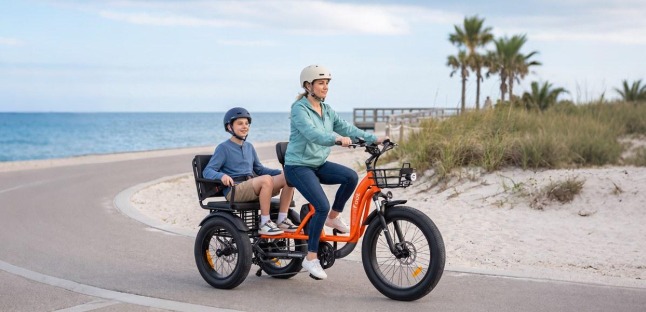
Real-World Usability: Shared Commutes vs. Solo Trips
Specifications settle the safety question. Daily life settles the ownership question.
One platform, several jobs. The rear area of a passenger trike is not locked to one use. On a Saturday it carries a second adult to brunch. On Sunday it takes two children to the park. On Monday, with the seat area used as a deck, it swallows a full grocery run, a folded camp chair, or a couple of hardware store boxes. A solo e-bike needs panniers, a trailer, or a second vehicle to do the same work.
Parking and dismounting with two on board. This is where three wheels quietly win. Pull up, engage the handlebar parking lock, and the vehicle simply stays put while your passenger stands and steps out. There is no balancing act at the kerb, no searching for a wall to lean against, and no lifting the machine into a rack. For anyone with a shoulder, knee, or back that objects to wrestling a 70 lb bike, that difference compounds every single trip.
What you give up. Honesty helps: a trike is wider, heavier, and harder to store than an e-bike. It will not thread a narrow bike-lane gap, and it needs a garage bay rather than a hallway hook. If you ride alone, ride far, and store indoors up a flight of stairs, two wheels remain the better tool.
Conclusion
The comparison is not really solo versus passenger performance. It is a question about who is coming with you. A single-rider e-bike optimises for one person’s speed and convenience; a 2 seater electric tricycle for adults optimises for shared trips, heavier loads, and stability that never depends on the rider’s balance.
Buy for the ride you actually take most often. If a companion is part of it — a partner, a parent, a grandchild, or a week’s shopping — start with the passenger requirements and let payload, differential, and braking narrow the field. Brands like MaxFoot list capacity and drivetrain data openly, which makes an honest side-by-side comparison possible before you ever book a test ride.