



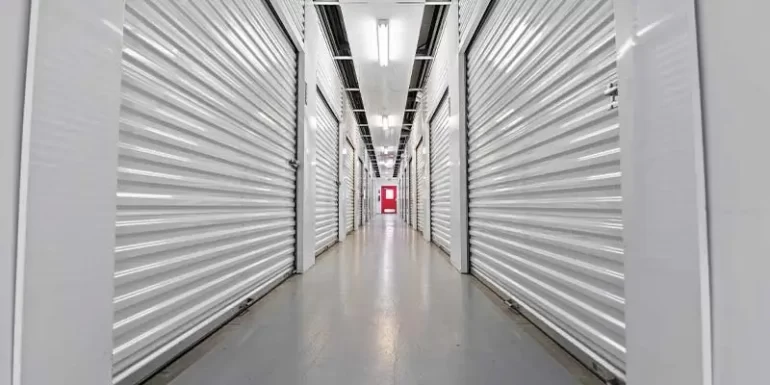
Somewhere in the last twenty years the self-storage facility quietly became one of action cinema’s most reliable settings. Not the warehouse — the warehouse has been with us since the seventies. The storage facility specifically: the roll-up doors, the strip lighting, the endless identical corridors.
Once you notice it you cannot stop noticing it.
Why it works cinematically
The appeal is structural. A storage facility gives a director several things at once that are otherwise expensive to arrange.
Corridors that repeat. Identical hallways create instant disorientation for both character and audience. You cannot tell where anyone is, which means a pursuit can be extended almost indefinitely without the geography becoming boring, because the geography was never legible in the first place.
Doors that make noise. A roll-up shutter is loud, slow, and impossible to open discreetly. That is a gift to a director. Every entrance becomes an announcement.
Sightlines that fail. Units are opaque. Anything could be behind any door. The tension is built into the architecture.
Legitimate reasons to be there at 3am. Most facilities offer 24-hour access, which removes the need to explain why anyone is present.
Compare it to a warehouse, which is a single large volume. In a warehouse everyone can see everyone. In a storage facility nobody can see anyone, and the fight is a series of ambushes rather than a single engagement.
The tropes, ranked
The unit that contains the past. Character opens a unit they have not visited in years. Inside: boxes, a covered object, evidence of a former life. This is exposition delivered visually and it works every time, which is why it appears roughly annually.
The unit that contains an arsenal. Roll-up door goes up, camera pushes in, wall of weapons. The audience understands the character’s entire history in three seconds. Efficient, if unsubtle.
The chase through the corridors. See above. Reliable, cheap to shoot, endlessly extendable.
The auction. Abandoned unit sold at auction, buyer finds something they should not have. This one crossed over from reality television and has become its own micro-genre.
The meeting that goes wrong. Two parties, one unit, a transaction. Someone is lying. The confined space means nobody can back away, which forces the scene to escalate.
Where it gets it wrong
Two things filmmakers consistently misrepresent.
Access control. In practice a facility has gates, keypads, individual unit alarms and comprehensive camera coverage. The idea that anyone can wander in at night and roam freely is fiction. Real facilities log every entry against a code.
The lighting. Every corridor in every film is dim, flickering, and sodium-lit. Actual facilities are lit to a standard that makes them slightly boring. Insurance requires it.
Neither of these will change, because the fiction is more useful than the fact.
The domestic reality is duller and stranger
What makes the trope interesting is how far it sits from the actual function of the buildings.
The genuine contents of storage units are overwhelmingly mundane and slightly sad: the possessions of people between homes, the estates of people who have died, the equipment of businesses that ran out of office space, the furniture of divorces. In London especially, where flats are small and moves frequent, the units are mostly full of ordinary life in suspension.
Firms handling removal and storage london requires as a combined service will tell you the single most common reason for a unit is a gap — the sale fell through, the tenancy ended early, the renovation overran. The unit is a waiting room for objects.
Which is arguably more interesting than an arsenal, though harder to shoot.
The films worth revisiting
If you want the trope done well, three suggestions.
The first act of any heist film that uses a facility as a staging ground tends to be its best sequence, because the location does the work of establishing competence — a well-organised unit tells you the character plans.
Thrillers that use the facility as the ending rather than the middle usually fumble it. The location is good at tension and bad at resolution; there is nowhere for a climax to expand into.
And the ones that use a single unit as a chamber piece — two characters, one door, no cutting away — are the ones that hold up. Turns out the corridors were never the interesting part. The interesting part was always the door being closed.
One prediction
Expect the trope to migrate towards climate-controlled facilities and away from the drive-up type. Purely because the newer buildings are internal, multi-storey, and lift-served, which adds a vertical axis to a chase that used to be entirely flat.
Somebody is going to shoot a very good sequence in a goods lift within the next three years.