



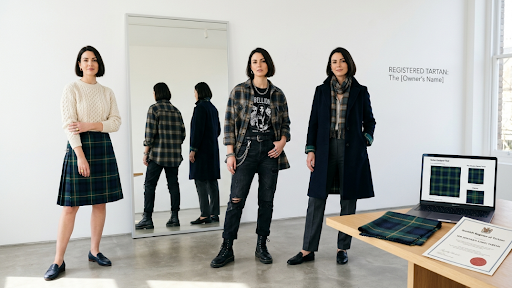
Tartan never really leaves; it just rotates through the culture wearing different names. One season it’s dark academia, the next it’s punk revival, then heritage-core, then whatever the algorithm decides to call plaid skirts in October. Designers from the couture houses to the high street return to it constantly for one structural reason: tartan is the rare pattern that signals both rebellion and establishment, depending entirely on how it’s worn. The same grid that says private school in one styling says 1977 in another.
But there’s a version of the tartan moment that fashion coverage almost never mentions, and it’s the most interesting one: you don’t have to wear anyone else’s. Tartan is not, technically, a fixed library of historic patterns. It’s a design format — a mathematical structure anyone can compose in — and the official register of tartans adds hundreds of brand-new patterns every year. With a free custom tartan designer now handling the weaving mathematics in the browser, the most exclusive move in pattern right now isn’t sourcing a rare vintage sett. It’s wearing one that didn’t exist last season because you hadn’t designed it yet.
The Fashion Logic of an Original Sett
Consider what actually makes a pattern desirable in fashion terms: scarcity, story, and coherence. An original tartan maxes all three in a way no purchased pattern can.
Scarcity is absolute rather than relative. A rare vintage tartan is rare; a registered original is unique — one pattern, one owner, recorded in a public register with the designer’s name attached. In an era when the same viral pieces appear on every feed within a week, a fabric that cannot be duplicated by anyone, anywhere, is a different category of flex entirely — the quiet kind.
Story is built in rather than borrowed. Every band in a designed tartan can carry an assigned meaning — a place, a person, a year — and those meanings are published with the pattern’s official record. Personal style writing loves to talk about clothes that “say something”; a designed tartan literally has its statement on file.
Coherence is the sleeper benefit. Because a tartan is defined by an exact colour specification, an original sett becomes a personal palette system: the scarf, the skirt lining, the bag ribbon, even a coordinating solid knit can all be keyed to the same registered colours. It’s a capsule wardrobe’s organising principle, woven.
How the Design Process Works (No Textile Degree Required)
The intimidating part of tartan — thread counts, symmetry, the weaving grammar — has been fully absorbed by software. The modern process runs on taste, not technique.
A design session starts from one of three doors. Type a story or a mood into an AI assistant — “north sea in November,” “cherry cola and school uniforms,” “my grandmother’s kitchen” — and it proposes three complete tartan designs in seconds, with reasoned colour logic, all fully editable. Upload a photograph — an outfit, a landscape, a film still — and the tool extracts a working palette from it, which is essentially moodboarding that outputs fabric. Or build band by band, which teaches the format fastest.
From there, the controls map neatly onto styling instincts. Wide bands are the pattern’s foundation — its base garment, so to speak — and thin four-to-eight-thread lines are the accents, the jewellery of the sett. The strongest tartans follow the same rule as the strongest outfits: two foundations, a couple of deliberate accents, and restraint everywhere else. One click re-renders the whole palette in four recognised tonal treatments — vivid Modern, brighter Ancient, softened Weathered, in-between Muted — which is effectively seeing the same design in four different colour seasons before committing. And the preview matters more than people expect: proper tools render the actual twill weave at thread-level resolution, in flat, close-up, and draped views, because a pattern that looks balanced as a graphic can lose its accent line entirely when pleated into a skirt or kilt. Checking the draped view first is the difference between designing a pattern and designing a garment.
The Styling Rules for an Original
Owning a unique pattern changes the mixing game in your favour, because you control both sides of every combination. Three rules cover most situations.
Scale contrast is non-negotiable. Pair the tartan with patterns of clearly different scale — a fine tattersall shirt under a bold sett, never two mid-sized checks fighting at the same frequency. The eye forgives loud; it punishes almost-matching.
Let one colour travel. Pull the tartan’s thinnest accent line out into a solid elsewhere in the outfit — the knit, the sock, the hair ribbon — and the whole look reads as designed rather than assembled. This is where owning the exact colour specification pays off: “the same red” is actually the same red.
Deploy the tones seasonally. The same registered sett woven in Modern tones is an autumn statement; in Weathered, it’s a spring neutral. One design, two wardrobes — a trick unavailable to anyone wearing a fixed commercial tartan.
From Screen to Actual Fabric
The step that separates this from every other digital design toy is that the output is real cloth. Scottish Kilt, an outfitter running its own mill since 2012, weaves customer designs from $35 per yard with a ten-yard minimum — roughly $350 for enough fabric to commission a skirt, a scarf run, or a serious jacket lining — and at thirty yards includes a complete made-to-measure kilt in the design at no extra cost. Cloth comes in a lighter 13oz and a traditional 16oz weight, digital colour proofs are approved before weaving begins, and a $29 sample pack exists for anyone who wants to feel the fabric before committing a wardrobe to it. Standard delivery runs six to ten weeks, which in fashion-planning terms means a sett designed in June is a finished winter piece.
For the truly committed, the design can also be registered with the Scottish Register of Tartans — the official body, £150 as of January 2026 — which places the pattern permanently in the public record under the designer’s name. It is, without much exaggeration, the only way to get your name into a two-century-old design institution for the price of a mid-range handbag.
Three Looks, One Sett
Because an original tartan is a system rather than a single garment, its styling range is best shown by wardrobe. Take one hypothetical registered design — navy and pine foundations, a four-thread gold accent — and run it through three registers.
The heritage read. Kilt or midi skirt in the 16oz Modern-tone weave, cream aran knit, the gold accent echoed in a signet ring. Nothing else patterned. This is the sett at its most institutional — private-chapel-wedding energy — and the depth of the twill does the formal work a printed check never can.
The subversive read. The same sett in Weathered tones as a boxy overshirt, worn open over a band tee, hardware jewellery picking up the grey that Weathered dyeing pulls out of navy. The pattern’s symmetry keeps it from reading as costume; the softened palette keeps it from reading as school uniform. One design, opposite politics.
The quiet-luxury read. The tartan appears only as a scarf and, invisibly, as a jacket lining — the flash of a private pattern at the cuff. This is where ownership pays its full dividend: a lining nobody can identify because it belongs to nobody else is the textbook definition of if-you-know-you-know. It’s also the register that ages best — trends will move the kilt in and out of rotation, but a private pattern deployed at scarf-and-lining scale never reads as a trend piece, because nobody else can wear the trend. Quiet luxury spent a decade chasing that quality in logos removed; an original sett achieves it in cloth added.
The exercise generalises: because the tonal treatments re-render the identical thread count in four moods, a single registered design covers more stylistic ground than most people’s entire pattern drawer — and every piece across every register is, verifiably, the same cloth. Capsule-wardrobe theory has been chasing that coherence for a decade. Tartan had the mechanism the whole time.
The Trend Beneath the Trend
Fashion’s tartan cycles will keep spinning — heritage this year, subversion the next — and the commercial patterns will keep being everywhere, which is both their charm and their limit. The deeper shift is that the format has quietly opened. What was once the output of mills and clan history is now a compositional medium available to anyone with a browser and a point of view, the way typography opened, the way photography opened.
Which reframes the whole styling question. The interesting version of “how to wear tartan this season” is no longer about picking the right historic sett from the shelf. It’s the version where, when someone at the party asks which tartan that is, the answer is a story with your name in it: mine. Designed it in an evening. The blue is the north sea; the thin red line — well, that one’s private. There is no more exclusive label than that, and it’s the only one in the room that was free to create.