



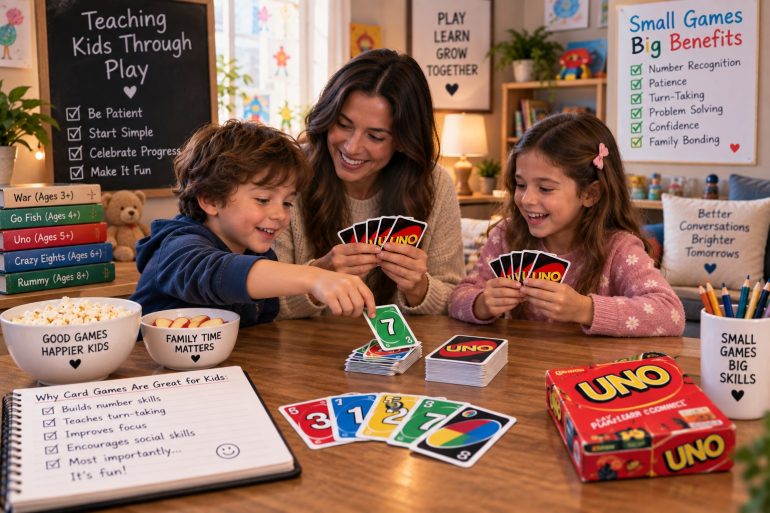
Card games often end up being one of the first structured games a child learns, well before they are old enough for more complicated board games or organized sports. Part of the appeal for parents is how much a simple deck of cards can quietly teach without ever feeling like a lesson. Kids pick up number recognition, patience, turn-taking, and even basic strategy, all while thinking they are just having fun with Mom, Dad, or a sibling.
Getting started with the right game at the right age makes a real difference in how smoothly this process goes. This guide walks through which games suit which ages, how to teach turn-taking without frustrating a young child, why Uno works so well as a first real card game, and how card games in general help build number skills along the way.
Age-Appropriate Games
Choosing a card game that matches a child’s current abilities avoids a lot of unnecessary frustration for both the kid and the parent trying to teach them. Very young children, generally around three to four years old, tend to do best with extremely simple matching games. War, which only requires comparing which of two cards is higher, works well here since it demands no strategy and very little patience to understand.
By around five or six, most kids are ready for Go Fish, which introduces a light memory element on top of basic matching. Asking for a specific card by name also helps reinforce vocabulary and clear communication in a low-pressure setting. Around this same age range, many kids are also ready to start learning Uno, especially with a bit of extra guidance on the special action cards during the first few rounds.
Older kids, roughly eight and up, can usually handle games with more strategic depth, like Rummy or Crazy Eights, which require planning several moves ahead rather than just reacting to whatever card comes up next. According to Common Sense Media’s list of age appropriate card games, matching a game’s complexity to a child’s developmental stage matters more for building genuine enjoyment than simply picking whatever game happens to be a family favorite, since a game that feels too difficult too early can turn a child off from card games altogether before they have had a real chance to enjoy them.
Teaching Turn-Taking
Turn taking sounds like a small thing, but for a lot of young kids, waiting patiently while someone else plays is genuinely one of the harder parts of learning a new card game. Building this skill gradually, rather than expecting it immediately, tends to produce much better results than getting frustrated when a young child struggles to sit still during someone else’s turn.
Starting with shorter games helps considerably, since a five minute round of War asks far less patience of a young child than a longer, more involved game would. As kids get more comfortable with the rhythm of taking turns, gradually introducing slightly longer games helps extend their patience without overwhelming them too quickly.
Giving a young child something small to do during other players’ turns, like holding their cards a certain way or watching for a specific card to appear, can help keep them engaged rather than simply waiting passively. Verbal encouragement, gently reminding them whose turn is next and praising them for waiting patiently, reinforces the behavior without making the correction feel like a scolding.
Consistency across sessions also matters more than parents sometimes expect. Playing a quick game a few times a week, rather than a longer session only once in a while, gives young children more frequent, low pressure practice at waiting their turn, which tends to build the habit faster than occasional longer sessions spread further apart. Even a five minute round squeezed in before bedtime can reinforce the same skills as a longer weekend session, as long as it happens regularly enough for the child to build genuine familiarity with the rhythm of taking turns.
According to Parents.com’s guide to teaching kids card games, turn taking through games like these gives children a low stakes way to practice patience and self control that translates well into other social situations, including classroom settings where waiting for a turn is a regular expectation throughout the school day.
Uno as a First Game
Uno occupies a nice middle ground for kids who have already gotten comfortable with something like Go Fish and are ready for a slightly more involved game. Its color coded design makes matching intuitive even before a child has fully mastered number recognition, since they can simply match colors as a starting point before layering numbers into their strategy later on.
The special action cards add an extra layer of excitement that keeps kids engaged, though it usually helps to introduce them gradually rather than all at once. Starting with just Skip and Reverse in the first few games, then adding Draw Two and the Wild cards once a child feels comfortable, tends to prevent the overwhelm that can happen when every new rule gets thrown at them simultaneously.
Kids also respond well to the built in drama of announcing “Uno” when they are down to one card. That small ritual gives young players a clear, exciting goal to work toward each round, and the mild penalty for forgetting to announce it teaches attentiveness in a way that feels like part of the fun rather than a punishment. Many parents find that kids remember this rule faster than almost any other, likely because the excitement of shouting it out loud makes it memorable in a way that quieter rules never quite manage.
If you want a simplified breakdown to walk through with your child before your first few rounds together, unopeli.fi offers simple Uno rules for kids that explain each card type clearly, which can be a handy reference while you are both still getting familiar with the full rule set.
Building Number Skills
Beyond the social benefits, card games quietly reinforce a surprising amount of early math skills without ever feeling like a formal lesson. Simply recognizing numbers on a card and matching them to another card of the same value builds number recognition well before a child encounters the same concept in a classroom setting.
Games like War introduce comparison skills, helping kids understand the concept of greater than and less than through repeated, low stakes practice. Uno adds another layer by having kids track numbers as they move through a hand of ten or so cards, subtly building comfort with sequencing and quantity as they figure out which cards to play and in what order.
According to guidance from NAEYC’s resources on using games to support early math thinking, everyday activities like card games offer some of the most effective, low pressure opportunities for young children to practice foundational math concepts, since the learning happens naturally as a side effect of play rather than through structured, deliberate instruction.
Sorting cards by color or number before a game even begins is another small habit that reinforces early categorization skills, a foundational concept that later supports more advanced math thinking around grouping and patterns. Parents who make a habit of asking their child to organize their hand a certain way before starting, rather than just diving straight into play, often find that this small extra step pays off in how quickly the child starts recognizing patterns during the actual game itself.
Final Thoughts
Card games offer parents a genuinely effective way to teach patience, number recognition, and social skills without turning any of it into a formal lesson. Starting with age appropriate games, building turn taking gradually, introducing Uno as a natural next step, and letting the number based reinforcement happen organically through regular play gives kids a strong, low pressure foundation that pays off well beyond the card table itself.
The best part is that none of this requires special materials or planning beyond a simple deck of cards and a bit of patience from the adult teaching the game. A few regular sessions together are usually all it takes for a child to move from needing constant guidance to confidently holding their own hand and calling out “Uno” with genuine excitement, and that steady progress often becomes just as rewarding for the parent teaching the game as it is for the child learning it.