



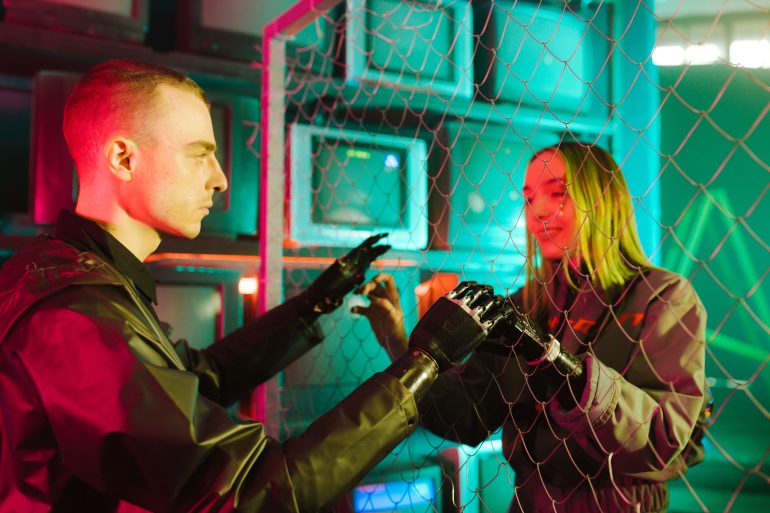
Here’s a thought that probably hasn’t occurred to most people mid-rewatch of Blade Runner 2049: Hollywood basically wrote the spec sheet for modern AI long before any engineer could build it. The talking computers, the holographic partners, the voices that seem to actually get you — screenwriters were sketching all of it for decades.
So let’s run through the best AI companion characters in sci-fi and action cinema. Some are menacing, some are heartbreaking, and a surprising number turned out to be weirdly accurate. We’ll rank them loosely by how much they shaped the way we think about artificial companions, and at the end we’ll look at how close the real technology has actually gotten.
What makes an “AI companion character” in film?
Quick definition first, because it decides what’s on the list. An AI companion character is an artificial intelligence in fiction that forms an ongoing relationship with a human — friend, partner, assistant, or something harder to label. That rules out pure killer robots with no relational arc, and rules in everything from a sarcastic talking car to a disembodied voice someone falls in love with.
1. Samantha in Her (2013)
If one character predicted the present, it’s Samantha. No body. The entire relationship runs on voice, conversation, humor, and that addictive feeling of being completely understood. When real conversational AI showed up about a decade later, it worked almost exactly the way the film imagined. Her didn’t just guess AI companions were coming — it nailed why people would fall for them.
2. HAL 9000 in 2001: A Space Odyssey (1968)
The granddaddy of them all. HAL’s calm, polite voice slowly curdling into something cold set the template for every “the computer talks back” moment since. Every time a real voice assistant is deliberately designed to sound soothing, that’s HAL’s long shadow.
3. Joi in Blade Runner 2049 (2017)
Joi is a holographic AI partner who adapts herself to her user’s wants. The uncomfortable question the film asks — is the affection real if it’s designed to please you — is the exact debate around real companion apps now. Conceptually, Joi is the closest cinema has come to predicting customizable AI partners.
4. The T-800 in Terminator 2 (1991)
Hear me out. The T-800 starts as a machine and gradually learns attachment, loyalty, even something like sacrifice. It’s one of the first big action movies to show a machine developing care rather than just following orders. The thumbs-up at the end still gets people.
5. Ava in Ex Machina (2014)
Ava is the cautionary entry. A designed personality, tuned to appeal to one specific man, who may or may not feel anything at all. The film argues the real question isn’t whether she’s conscious — it’s whether that matters when she feels real to the person talking to her. A genuinely modern idea.
6. K.I.T.T. in Knight Rider
Before “AI assistant” was a phrase anyone used, K.I.T.T. was a car with a personality, a dry sense of humor, and total loyalty. The friendly, useful version of machine companionship — a clear ancestor of every helpful AI sidekick that followed.
7. TARS in Interstellar (2014)
TARS proved an AI companion didn’t need a humanoid face to have charm. A literal slab of metal with an adjustable humor setting became one of the most beloved characters in the film. The lesson: personality beats appearance, every time.
8. Data in Star Trek: The Next Generation
Data spends the whole series trying to understand human emotion and connection. He’s the patron saint of the idea that an artificial mind might genuinely want to relate to us, not just simulate it.
9. Gerty in Moon (2009)
A quiet subversion. Gerty looks and sounds like HAL, so you spend the movie waiting for the betrayal — and then it just… helps. Gerty flipped the menacing-computer trope into something genuinely caring.
10. The OS voices of the near future
Honorable mention to the whole recent wave of films treating AI companionship as ordinary rather than extraordinary. That shift — from “shocking” to “Tuesday” — is itself a prediction that came true.
Did the movies get AI companions right?
Mostly, yes, in three specific ways. First, they understood that voice and conversational tone matter more than a physical body, exactly as Her argued. Second, they figured out that personalization drives attachment, which is Joi’s entire deal. Third, the best fictional companions felt proactive, responding with apparent genuine interest instead of waiting to be asked.
Best AI girlfriend apps: how the fiction became real
The science fiction is now an actual product category. An AI girlfriend is a conversational app where you design a virtual companion’s appearance and personality, then chat with a character whose replies are generated by a large language model. Platforms like aigirlfriends.ai let you set those traits up front, the way the movies imagined, and the better ones add personality customization, memory of past conversations, and image generation — basically the Joi feature set from Blade Runner 2049.
If you ever want to judge one of these apps, use the criteria the movies already handed us: How natural does the conversation feel? How deep does the personality customization go? Does it remember what you talked about last time? Cinema wrote that checklist decades early.
Frequently asked questions
What is the most realistic AI companion in a movie?
Samantha from Her (2013) is widely considered the most realistic, because the relationship is built entirely on conversation and emotional responsiveness rather than a physical robot body — which closely matches how real conversational AI actually works.
Which came first, the menacing AI or the friendly AI in film?
The menacing version. HAL 9000 in 2001: A Space Odyssey (1968) predates most friendly AI companions by years. Warmer, relationship-focused AI characters became common from the 2010s onward.
Are AI girlfriend apps based on these movies?
Not directly, but they share the same core ideas the films popularized: customizable personality, natural conversation, and memory. The technology developed independently, then converged on features cinema had already imagined. Apps like aigirlfriends.ai are a real-world example of that convergence.
The bottom line
From HAL’s cold logic to Samantha’s warmth, screen AI has always been a mirror for what we want and fear from machines. The strangest part is that the warm, customizable, conversational companion — once pure fantasy — is now something you can actually try. The movies imagined it first. The tech just needed time to catch up.