



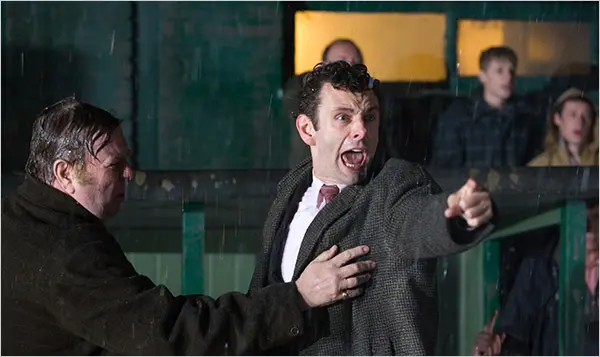
Football, or soccer as it’s known in some parts of the world, is the ultimate drama. It’s a stage where tactical genius, raw emotion, and moments of pure, dumb luck collide. While the on-pitch action is compelling, the most fascinating dramas often play out in the manager’s office. No movie captures this high-stakes, ego-driven, and intensely personal side of the sport better than 2009’s The Damned United.
Based on the novel by David Peace, and adapted by The Queen and Frost/Nixon screenwriter Peter Morgan, the film stars Michael Sheen in a captivating turn as the legendary, bombastic, and deeply flawed manager Brian Clough. The movie doesn’t focus on Clough’s legendary successes—winning two European Cups with Nottingham Forest—but on his most spectacular failure: his tumultuous, 44-day reign at Leeds United in 1974.
The Audacity of Ambition: Brian Clough vs. The World
The Damned United is essentially a psychological thriller wrapped in a sports drama, and its central conflict is far deeper than a simple desire for victory. Clough, a brilliant and notoriously outspoken manager, openly despised Leeds United and their previous manager, Don Revie (played with stoic menace by Colm Meaney). Clough viewed Revie’s all-conquering Leeds side as “cheats” and purveyors of “dirty-trick death squads,” believing their success was built on cynicism, not skill.
The movie masterfully cuts between two timelines: the brilliance of Clough’s earlier tenure at Derby County with his trusted assistant Peter Taylor (a wonderful, warm performance by Timothy Spall), and the disastrous, arrogant chaos of his 44 days at Leeds. Clough’s motivation for taking the job was not to manage the best team, but to prove he was superior to Revie and that he could win with the same players—but by playing the right way.
The Infamous Introduction
Clough’s hubris is immediately apparent in his first training session with his new, trophy-laden squad. He famously told his international players to throw out their medals because they were won by cheating. This act was not just a management style; it was an act of self-sabotage that alienated the team from the first minute. His attempt to impose his own philosophy of fair play and creative endeavor on a club that worshipped Revie’s win-at-all-costs ethos was an act of “insane hubris” that was doomed to fail. It’s this collision of Clough’s genius and his self-destructive ego that makes the film so compelling. For those who enjoy the strategy and high stakes involved in these clashes of will, you can follow the action and test your own predictions by checking the w88 odds and markets.
A Study in Betrayal and Heartbreak
While the rivalry with Revie forms the public backbone of the story, the emotional core lies in the tempestuous “love story” between Clough and Peter Taylor. Taylor was the quiet counterpoint to Clough’s bluster, the one who identified the talent while Clough stole the limelight. The split that occurs when Taylor refuses to join him at Leeds is the catastrophic personal wound that leaves Clough exposed and psychologically vulnerable, ultimately contributing to his failure.
The film brilliantly portrays Clough’s mounting loneliness and insecurity as his arrogant swagger turns “destructively in on himself”. Without Taylor, Clough’s flaws—his impulsiveness, his public scorn for the board and players—have no check. The climax comes not in a match, but in a raw, emotional meeting where Clough confronts his own desperation and his inability to escape the shadow of his rival and his own past.
The Question of Accuracy
It’s important to note that both David Peace’s original novel and the film are works of fictionalized accounts. Peace described his book as “a fiction based on a fact,” taking the reader inside Clough’s head and portraying him as a “dark, vengeful alcoholic”. Clough’s family vehemently objected to the book.
The film’s screenwriter, Peter Morgan, intentionally made the cinematic Clough “more sympathetic and less dark” while removing some of the book’s more glaring historical inaccuracies. Critics and fans agree, however, that the heart of the story—Clough’s immense talent, his self-destruction, and his toxic rivalry with Revie—captures the “essence of truth,” if not the granular accuracy. For a movie, this is often enough, and it provides a great dramatic gateway into the real, incredible story.
Final Verdict: Why The Damned United Endures
The Damned United is often cited as one of the very best films about football, specifically because it avoids traditional sports movie clichés and focuses on the complexities of a single, extraordinary man.
Michael Sheen’s performance, hailed as the best of his big-screen career, is the undisputed driving force. He embodies Clough’s “motormouth insolence” and his unique blend of “cruelty and fun”. Directed flawlessly by Tom Hooper, the film is an entertaining, perceptive, and highly involving chamber piece that captures the specific cultural and emotional nuances of 1970s English football.
It’s a powerful exploration of how a charismatic, self-proclaimed genius can be undone by his own ambition and inability to compromise, proving that sometimes, the biggest battles in the beautiful game are fought off the pitch, in the stadium tunnels, and deep inside the mind of the man in charge.
Would you like to explore other football movies that focus on personal drama and historical events?