



Most love stories in film operate within a narrow corridor of plausibility. Two people of roughly the same age find each other, struggle for a while, and then resolve things before the credits roll. The ones that sit with you longer tend to break that pattern. Age gap relationships on screen have a particular tension to them because the power between the two people is never balanced, and the films that handle this honestly are willing to let that imbalance become uncomfortable. Some of these movies function as cautionary tales. Others ask harder questions about loneliness, control, and what it means when desire overrides good sense. Here are the ones that do the best work.
The Older Woman Gets the Story
Hollywood has spent decades pairing older men with younger women and treating it as background noise. The reverse pairing got far less screen time until recently. In 2024, four films put older women with younger men at the center of their plots: The Idea of You, A Family Affair, Lonely Planet, and Babygirl. Todd Haynes’ May December from 2023 holds a 91% positive score from 325 critics on Rotten Tomatoes and an 86 out of 100 on Metacritic, which places it in “universal acclaim” territory.
The interest in dating older women on screen tracks with a growing willingness to question who gets to be desired and at what age. Babygirl grossed $64.7 million against a $20 million budget, which confirms audiences showed up. The real average age gap in American couples sits at 2.2 years, according to research on Western partnerships, a figure far smaller than what most of these films portray. That gap between fiction and reality is part of what makes these stories worth examining in the first place.
Harold and Maude (1971)
Hal Ashby’s film pairs a death-obsessed 20-year-old with a 79-year-old woman who treats living as a daily practice. The gap between Harold and Maude is not played for horror or comedy alone. It operates in a space that is genuinely tender and genuinely strange at the same time. Harold stages fake suicides. Maude steals cars and plants trees in public spaces. Their relationship works because neither of them fits anywhere else. But the film does not pretend this pairing is sustainable. Its ending carries a weight that most romantic comedies avoid entirely. The age difference here is the story, and the peril comes from loving someone whose time is almost gone.
The Graduate (1967)
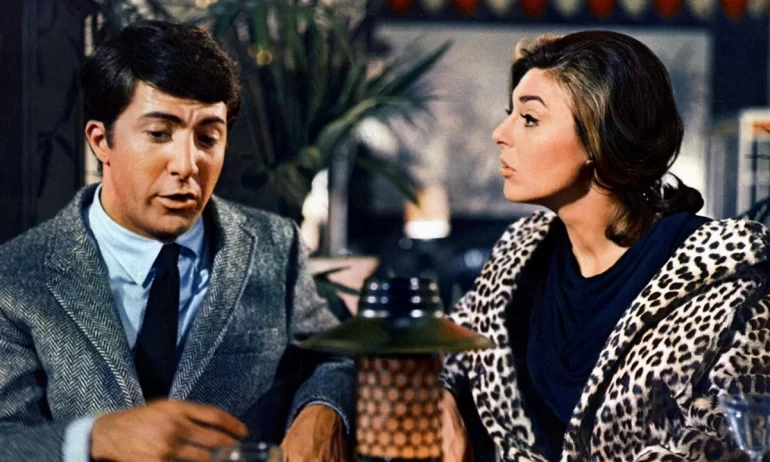
Benjamin Braddock, fresh out of college, begins sleeping with Mrs. Robinson, the wife of his father’s business partner. The film was received as a generational statement when it came out, but the relationship at its center is more unsettling than rebellious. Mrs. Robinson is bored, resentful, and exacting. Benjamin is passive, confused, and easily led. The age gap creates a space where manipulation thrives. Mike Nichols directed the affair as something that is never actually enjoyable for either party, which is what makes it such a sharp piece of filmmaking. The peril here is not social scandal. It is the slow realization that proximity to someone older and unhappy does not produce wisdom. It produces damage.
May December (2023)
Todd Haynes built this film around a case loosely inspired by the Mary Kay Letourneau story. Julianne Moore plays Gracie, a woman who began a sexual relationship with a 13-year-old boy, served time in prison, and then married him after her release. Natalie Portman plays an actress preparing to portray Gracie in a film. The structure is deceptive. What looks like a movie about the actress studying her subject becomes something more corrosive. The real peril is not the original abuse. It is how everyone around it, including the audience, consumes and repackages that abuse as a story worth telling. Charles Melton’s performance as Joe, the now-adult husband, earned widespread praise because he plays a man who has never fully understood what happened to him. The film refuses to offer resolution.
Lost in Translation (2003)
Sofia Coppola set her film in a Tokyo hotel and kept the romantic tension between Bob and Charlotte deliberately unresolved. Bill Murray was 52 during production. Scarlett Johansson was 17. The film treats the age gap with restraint, but the restraint itself becomes a kind of pressure. Bob is a fading actor stuck in a failing marriage. Charlotte is newly married and already uncertain about the life ahead of her. They find comfort in each other because neither of them can sleep and neither of them knows what to do next. The peril here is quieter. Two people who meet at the wrong time in their lives and know, without saying it, that the gap between them is too wide for anything lasting.
American Beauty (1999)
Lester Burnham’s fixation on his teenage daughter’s friend Angela is presented with a disturbing level of sympathy in the film’s first half. Kevin Spacey played Lester as a man reclaiming something lost, and the film initially invites the audience to root for his rebellion. Sam Mendes directed the fantasy sequences with a warmth that makes them seductive on purpose. The peril arrives late, when the film finally lets you see what Lester’s desire actually looks like from Angela’s side. She is scared. She is a child. The movie earns credit for arriving at that corrective, though it takes its time getting there, and the years since its release have complicated how audiences receive it.
Phantom Thread (2017)
Paul Thomas Anderson placed Reynolds Woodcock, a controlling couturier in 1950s London, opposite Alma, a younger woman who refuses to be consumed by him. The age gap matters here because it feeds directly into the power struggle between them. Reynolds expects deference. Alma offers resistance. Their relationship becomes a negotiation over who gets to define the terms. Daniel Day-Lewis and Vicky Krieps played the tension with precision, and the film’s final act suggests that the only way two people in this kind of pairing survive together is through a very strange form of mutual sabotage. The peril is not heartbreak. It is the realization that love, structured around imbalance, sometimes requires poison to function.
Why These Films Work
The best age gap films treat the gap itself as a condition that affects everything in the relationship. They do not romanticize it and they do not condemn it outright. They observe it. The discomfort a viewer feels watching Benjamin Braddock lie next to Mrs. Robinson or watching Joe in May December begin to unravel comes from the same place. These stories ask you to hold two things at once: the reality that desire does not follow reasonable patterns, and the fact that the distance in years between two people creates a form of gravity that bends the relationship in directions neither person fully controls. That is what makes them worth watching, and that is what separates them from films that use age gaps as set dressing.