



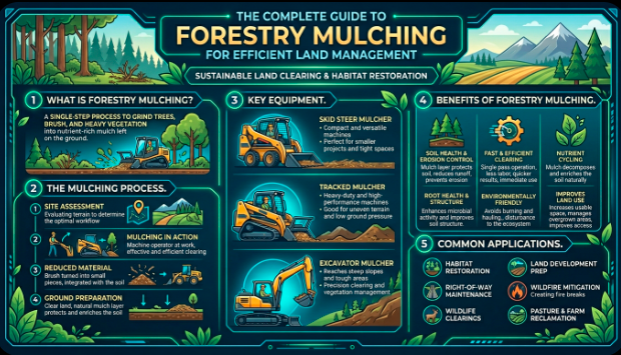
Land management has become an essential part of maintaining healthy, productive, and visually appealing properties. Whether the goal is to prepare land for construction, improve agricultural productivity, create recreational spaces, or reduce wildfire risks, proper vegetation control plays a significant role. Among the many methods available today, forestry mulching has emerged as one of the most efficient and environmentally responsible solutions. This modern land-clearing technique offers a practical way to remove unwanted vegetation while preserving soil quality and reducing environmental impact. Property owners, developers, farmers, and land managers increasingly prefer this method because it combines speed, cost-effectiveness, and sustainability into a single process. Unlike traditional land-clearing methods that often require multiple machines and extensive labor, forestry mulching uses specialized equipment designed to cut, grind, and process vegetation directly on-site.
Understanding Forestry Mulching
Forestry mulching is a land-clearing process that uses a single machine equipped with a rotary drum or cutting head to shred vegetation into fine mulch. The machinery is capable of handling small shrubs, thick brush, and even medium-sized trees depending on the equipment being used. Instead of uprooting vegetation and leaving large piles of waste behind, the material is processed directly into mulch and distributed across the cleared area. This creates a protective layer that helps stabilize soil and improve overall land conditions. The popularity of forestry mulching has grown because it simplifies what was once a complicated and expensive operation. Traditional land clearing often involves bulldozers, excavators, chainsaws, trucks, and disposal services. Each step increases costs and can significantly disturb the landscape.
Benefits of Choosing Forestry Mulching
One of the most significant advantages of forestry mulching is its ability to preserve soil integrity. Traditional clearing methods frequently disturb the soil surface, leading to erosion and nutrient loss. When vegetation is uprooted or removed entirely, the exposed soil becomes vulnerable to rain, wind, and other environmental factors. The mulch created during the process forms a protective barrier that helps retain moisture, regulate soil temperature, and reduce erosion. This natural protection supports healthier land conditions long after the clearing work is completed. Another important benefit is cost efficiency. Since the process combines cutting, grinding, and debris management into a single operation, property owners often spend less money compared to traditional clearing methods. There is no need to transport large volumes of waste material or pay for disposal services.
Environmental Advantages of Modern Land Clearing
Environmental sustainability has become a major consideration in land management decisions. Conventional clearing methods can contribute to habitat disruption, soil degradation, and air pollution when vegetation is burned. Forestry mulching provides an alternative that aligns with environmentally conscious practices. Because the vegetation is recycled into mulch, organic matter remains within the ecosystem rather than being removed or destroyed. This contributes to nutrient cycling and supports healthier soil conditions over time. The mulch layer also serves as a natural weed suppressant. By covering the soil surface, it limits sunlight exposure to weed seeds and reduces their ability to germinate. This decreases the need for chemical herbicides, which can have negative effects on surrounding ecosystems. Additionally, retaining mulch on-site helps improve water infiltration and reduces runoff during heavy rainfall.
Applications Across Different Industries
The versatility of this land-clearing method allows it to be used across a wide range of industries and property types. Agricultural operations often use it to reclaim overgrown fields, expand grazing areas, and improve access routes. Farmers benefit from the ability to clear unwanted vegetation without significantly disturbing the soil structure that supports future crop production. This balance between vegetation removal and soil preservation makes the method highly valuable in agricultural settings. Construction and development projects also rely on forestry mulching to prepare sites for new infrastructure. Before buildings, roads, or utility installations can begin, vegetation often needs to be removed efficiently and safely. The process creates a clean working environment while reducing preparation time.
Improving Property Appearance and Accessibility
Overgrown vegetation can significantly impact the appearance and functionality of a property. Dense brush, invasive plants, and unmanaged growth often create barriers that limit access and reduce visual appeal. Property owners seeking to enhance the usability of their land frequently turn to forestry mulching as a practical solution. The process opens up spaces, creates clear pathways, and improves visibility while maintaining a natural aesthetic that blends with the surrounding environment. Enhanced accessibility is especially valuable for recreational properties. Hunting areas, hiking trails, and outdoor activity spaces often require selective vegetation management to maximize their usefulness. By removing unwanted growth while preserving desirable trees and natural features, landowners can create attractive and functional landscapes.
Wildfire Prevention and Vegetation Management
One increasingly important application of forestry mulching is wildfire prevention. Excessive vegetation serves as fuel that can contribute to the rapid spread of fires. Thick underbrush, dead trees, and unmanaged plant growth increase the likelihood of severe wildfire events. By reducing these fuel loads, land managers can create defensible spaces that help slow fire progression and improve overall safety. The process is particularly effective because it removes combustible materials while leaving a protective mulch layer on the ground. This layer decomposes gradually and does not present the same fire risks associated with dense vegetation. Strategic vegetation management around structures, access roads, and natural areas can significantly reduce wildfire hazards and improve long-term land safety.
Choosing the Right Equipment and Professionals
Successful land-clearing projects depend on selecting the appropriate equipment and experienced operators. Different sites present unique challenges, including varying terrain, vegetation density, and project objectives. Professional forestry mulching contractors evaluate these factors before determining the most suitable machinery and operational approach. Their expertise helps ensure efficient results while minimizing environmental impact. Working with qualified professionals also improves safety and project outcomes. Specialized equipment requires proper training and experience to operate effectively. Contractors understand how to navigate obstacles, preserve desirable vegetation, and manage challenging conditions. Their knowledge allows property owners to achieve their land management goals without unnecessary complications or delays.
Long-Term Benefits for Landowners
The advantages of forestry mulching extend beyond immediate vegetation removal. The mulch left behind gradually decomposes, adding organic matter and nutrients to the soil. This natural process supports healthier plant growth and contributes to improved soil fertility over time. As the land recovers and stabilizes, property owners often notice enhanced vegetation quality and reduced maintenance requirements. Long-term property value may also increase when land is properly maintained and accessible. Clear, well-managed landscapes are more attractive to potential buyers, investors, and developers. Whether the objective is agricultural productivity, recreational use, conservation, or future development, maintaining land through responsible vegetation management can provide lasting economic and environmental benefits.
Conclusion
Effective land management requires solutions that balance productivity, cost efficiency, and environmental responsibility. Forestry mulching has become one of the most reliable methods for achieving these goals because it simplifies vegetation removal while preserving natural resources. By converting unwanted growth into beneficial mulch, the process reduces waste, protects soil, and improves overall land conditions. Property owners across multiple industries continue to recognize its value as a practical and sustainable approach to vegetation management. As land-use demands continue to evolve, innovative methods such as forestry mulching will play an increasingly important role in maintaining healthy and functional landscapes. From agricultural improvements and construction preparation to wildfire prevention and habitat enhancement, the benefits are extensive and long-lasting. By choosing this efficient land-clearing solution, property owners can improve the usability, appearance, and environmental quality of their land while supporting sustainable management practices for the future.