



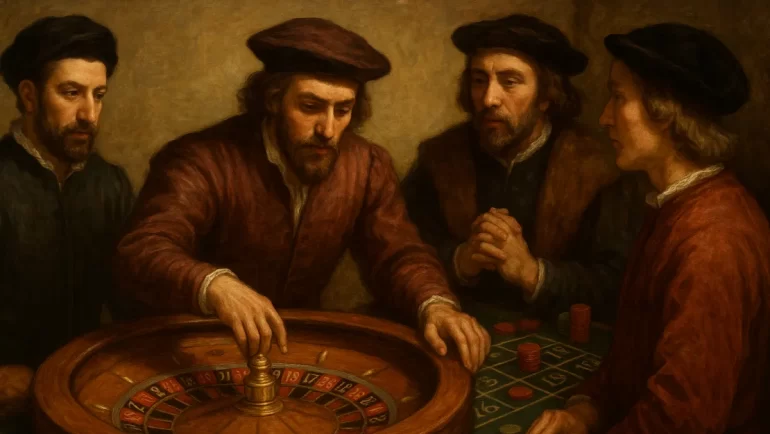
The spinning wheel of roulette is perhaps the most iconic symbol of the modern casino. Often referred to as the “King of Casino Games,” roulette has a history that is as circular and unpredictable as the movement of the ball itself. Its journey spans several centuries, involving accidental scientific discoveries, aristocratic French salons, and the frontier towns of the American West. Understanding the evolution of this game provides a unique window into how cultural shifts and technological progress have shaped the way we approach gaming and entertainment today.
The Accidental Invention of Blaise Pascal
The origins of roulette are famously tied to a quest for something entirely unrelated to gambling. In 1655, the French physicist, philosopher, and mathematician Blaise Pascal was attempting to create a perpetual motion machine. Pascal’s goal was to design a device that could continue to move indefinitely without drawing energy from an external source. While he failed in his primary objective, the resulting mechanism—a primitive, low-friction spinning wheel—became the foundation for one of the world’s most enduring games of chance.
While Pascal provided the mechanical framework, the game we recognize today was also influenced by several other leisure activities popular at the time. Historians often point to the Italian game “Biribi” and the English game “Even-Odd” as significant contributors to the rules and betting structures that were eventually integrated into the roulette wheel.
The 19th Century: The Rise of the Single Zero
As the game grew in popularity across Europe, it underwent a significant structural change in the mid-19th century. In 1843, in the German spa town of Homburg, two French brothers named Francois and Louis Blanc introduced a roulette wheel with only a single zero. At the time, the standard French wheel included both a “0” and a “00” pocket, which provided the house with a higher mathematical advantage.
The Blanc brothers’ decision to remove the double zero was a strategic move to compete with other casinos. By lowering the house edge, they made the game significantly more attractive to players, leading to a surge in popularity. When the German government later abolished gambling, the Blancs moved their operations to Monte Carlo.
Roulette’s Arrival in the New World
While the single-zero wheel was conquering Europe, the original double-zero version traveled across the Atlantic to the United States. Brought by French immigrants to New Orleans, the game moved up the Mississippi River and spread into the gambling dens of the Wild West. American casino owners, seeking a higher profit margin than their European counterparts, rejected the single-zero innovation and retained the double-zero format.
The conditions in early American gambling houses were often rugged, leading to further modifications. For a brief period, some American wheels even featured an eagle symbol as a third house pocket, though this was quickly discarded as it made the player’s odds too unfavorable. The table below illustrates the primary differences that emerged during this period of geographic divergence.
Comparison of European and American Roulette Variants
The following table outlines the structural and mathematical differences that define the two most common versions of the game played today.
| Feature | European Roulette | American Roulette |
| Total Number of Pockets | 37 | 38 |
| Zero Configuration | Single Zero (0) | Double Zero (0, 00) |
| House Edge | 2.70% | 5.26% |
| Sequence of Numbers | Random distribution | Symmetrical distribution |
| Common Location | Europe, Asia, Africa | Americas, Caribbean |
The persistence of these two distinct formats highlights how regional preferences and economic factors influenced the game’s development over the last two centuries.
The Digital Revolution and Modern Accessibility
The most significant shift in the history of roulette occurred at the end of the 20th century with the advent of the internet. The transition from physical mahogany wheels to sophisticated software allowed the game to reach a global audience of millions. Online platforms have introduced a level of diversity that was previously impossible, offering variations like multi-wheel roulette, speed roulette, and mini-roulette.
Today, the industry is defined by “Live Dealer” technology, which uses high-definition streaming to connect players with real croupiers in a studio setting. This hybrid approach combines the convenience of digital play with the tactile, social atmosphere of a traditional casino. For modern enthusiasts seeking a reliable and high-quality gaming environment, platforms like casino runa eu provide a comprehensive range of these historical variants tailored for contemporary audiences.
Embracing the Legacy of the Wheel
From its humble beginnings in a French laboratory to the high-stakes tables of Monte Carlo and the digital interfaces of the 21st century, roulette has remained a cornerstone of gaming culture. Its enduring appeal lies in its simplicity and the unique blend of mathematical precision and pure chance. Whether you prefer the lower house edge of the European wheel or the tradition of the American double-zero, you are participating in a legacy that spans over 300 years.
As technology continues to advance with virtual reality and blockchain integration, the next chapter of roulette’s history is already being written. To truly appreciate the game, one must experience the tension of the spinning ball firsthand. Explore the different variants available today and discover why this “accidental” invention continues to captivate players worldwide. Focus on responsible play and enjoy the sophisticated strategy that this historic game offers.
ALSO READ: The Most Popular Online Casino Games in the UK and Why Players Choose Them