



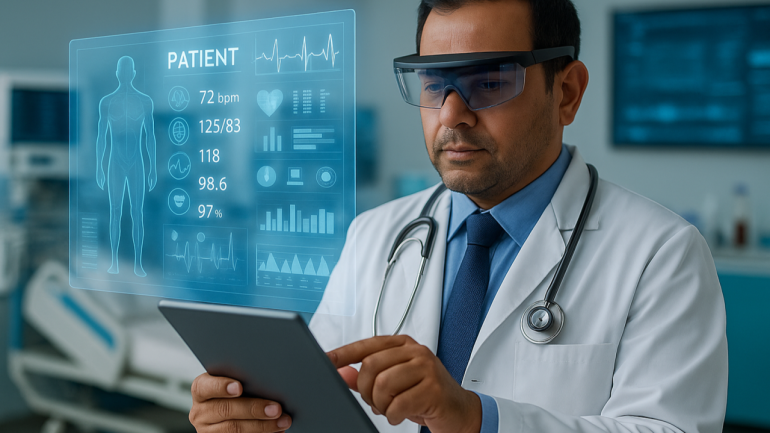
Digital health is entering a new era. Advances in artificial intelligence (AI), cloud computing, data analytics, and connected healthcare technologies are changing how patients interact with providers and how healthcare organizations deliver care. What was once considered an emerging technology is increasingly becoming part of everyday clinical and administrative workflows.
From intelligent documentation and automated medical coding to predictive analytics and personalized patient care, AI has the potential to make healthcare more efficient, accessible, and patient-centered. As adoption continues to grow, healthcare organizations that successfully integrate AI into their existing technology infrastructure will be better positioned for the future.
AI Is Changing How Healthcare Is Delivered
Healthcare generates enormous amounts of information every day, including clinical notes, laboratory results, medical histories, prescriptions, imaging reports, insurance information, and patient communications. Traditionally, much of this information has required manual processing.
AI can help healthcare organizations analyze and use this data more efficiently. Machine learning algorithms can identify patterns, natural language processing can interpret clinical documentation, and generative AI can assist healthcare professionals with tasks such as summarization and documentation.
The goal is not necessarily to replace healthcare professionals. Instead, AI can take over repetitive and time-consuming tasks, allowing physicians, nurses, and administrative staff to focus more on patients.
Smarter EHR Software
EHR Software is becoming one of the most important foundations for AI-powered healthcare. Modern electronic health record platforms can collect and organize large volumes of patient information, creating an environment where AI tools can support clinical and administrative decision-making.
AI-enabled EHR platforms may help physicians summarize patient histories, identify potentially relevant clinical information, generate documentation, and surface important information during a patient encounter.
For example, instead of spending several minutes reviewing a patient’s previous records, an AI assistant could generate a concise summary of relevant diagnoses, medications, laboratory results, and previous treatments. The physician can then review that information and make the final clinical decision.
The future of EHR Software is therefore likely to involve more intelligent automation rather than simply serving as a digital replacement for paper records.
AI-Powered EMR Systems
EMR systems are also evolving as healthcare organizations look for ways to improve clinical workflows. Traditional EMR platforms primarily focus on storing and managing patient records. AI can add another layer of intelligence to these systems.
AI-powered EMR systems could assist with:
- Clinical documentation
- Patient record summarization
- Medical coding
- Appointment management
- Clinical decision support
- Medication-related alerts
- Patient risk identification
- Administrative automation
- Revenue cycle workflows
For healthcare providers, this can reduce administrative workloads and potentially improve the overall efficiency of clinical operations.
However, AI-generated recommendations should support—not replace—professional judgment. Physicians and other qualified healthcare professionals must remain responsible for clinical decisions.
The Rise of AI Medical Scribes
One of the most visible applications of AI in healthcare is automated clinical documentation.
Physicians often spend significant amounts of time documenting patient encounters. AI medical scribe can listen to conversations between healthcare professionals and patients, convert speech into text, identify relevant clinical information, and generate structured documentation.
This can reduce the amount of time physicians spend typing notes and allow them to focus more directly on their patients.
As natural language processing technology improves, AI scribes are expected to become increasingly capable of understanding medical terminology, specialties, and clinical workflows.
Automating Healthcare Administration
AI’s impact will extend beyond clinical care. Healthcare organizations also perform thousands of administrative tasks that can potentially be automated.
For example, AI can assist with:
- Insurance verification
- Claims processing
- Medical billing
- Appointment scheduling
- Patient communications
- Prior authorization workflows
- Medical coding
- Documentation review
- Revenue cycle management
Automation can help reduce repetitive manual work and allow staff to spend more time on tasks requiring human interaction and judgment.
Transforming Medical Credentialing
Medical credentialing is another area where technology can make a significant difference. Healthcare organizations must verify a provider’s qualifications, licenses, certifications, education, and other professional information before they can practice within a particular organization or network.
Medical Credentialing companies are increasingly using digital technologies to streamline these processes. AI and automation can potentially help organizations collect information, identify missing documentation, monitor expiration dates, and reduce manual administrative work.
A more intelligent credentialing process could help healthcare organizations onboard providers faster while maintaining appropriate verification and compliance procedures.
Personalized Patient Care
AI could also make healthcare more personalized.
Instead of treating every patient according to a generalized model, AI systems can analyze individual patient information and identify patterns that may help healthcare professionals understand a patient’s specific circumstances.
Predictive analytics, for example, can analyze historical and real-time information to identify patients who may be at higher risk for certain complications. Healthcare providers can then use this information alongside their clinical expertise to determine appropriate interventions.
Personalized digital health tools may also help patients manage chronic conditions, monitor health metrics, receive reminders, and communicate with healthcare professionals.
Remote Monitoring and Virtual Healthcare
Digital health is increasingly moving beyond the traditional doctor’s office.
Wearable devices, connected medical equipment, smartphone applications, and remote patient monitoring platforms can collect health information outside clinical settings. AI can analyze this data and potentially identify significant changes that warrant attention.
For patients managing chronic conditions, this could provide healthcare professionals with a more continuous view of their health rather than relying solely on periodic appointments.
Telehealth platforms can also incorporate AI-powered tools for scheduling, documentation, patient triage, and follow-up communication.
AI and Healthcare Data
The effectiveness of AI depends heavily on data. Healthcare organizations have access to enormous amounts of information, but that data can exist across different systems and formats.
Interoperability will therefore become increasingly important.
Healthcare organizations will need systems that can securely exchange information while maintaining data quality, privacy, and regulatory compliance. EHR and EMR platforms that can integrate with other healthcare applications will be particularly important as AI becomes more deeply embedded into healthcare workflows.
The Importance of Privacy and Security
The growth of AI in healthcare also introduces significant challenges.
Healthcare data is highly sensitive, and organizations must carefully consider how patient information is collected, stored, processed, and shared. AI systems must be designed with appropriate security and privacy safeguards.
Healthcare organizations should evaluate factors such as:
- Data security
- Patient privacy
- Regulatory compliance
- Access controls
- Data quality
- AI transparency
- Human oversight
- Vendor security practices
AI should not be adopted simply because it is technologically impressive. Healthcare organizations need to ensure that AI solutions provide meaningful value while protecting patients and maintaining trust.
Human Expertise Will Remain Essential
Despite rapid technological progress, healthcare will continue to depend on human expertise.
AI can analyze information, identify patterns, automate tasks, and generate recommendations. However, healthcare professionals bring clinical experience, empathy, communication skills, ethical judgment, and an understanding of individual patient circumstances that technology cannot fully replicate.
The most successful healthcare model will likely be one in which humans and AI work together.
AI handles repetitive and data-intensive tasks, while healthcare professionals remain responsible for interpreting information, communicating with patients, and making important clinical decisions.
What Does the Future of Digital Health Look Like?
The future of digital health will likely be more connected, automated, and intelligent.
Healthcare organizations will increasingly use AI across the entire patient journey—from scheduling an appointment to documenting a visit, processing a claim, monitoring a patient’s health, and coordinating follow-up care.
EHR Software and EMR systems will evolve from passive information repositories into intelligent platforms capable of assisting healthcare professionals throughout their workflows. Meanwhile, Medical Credentialing companies and other healthcare service providers will continue adopting automation to streamline administrative processes.
The real opportunity is not simply using AI for the sake of innovation. It is using AI to solve practical healthcare problems: reducing administrative burden, improving access to information, supporting clinicians, reducing inefficiencies, and ultimately creating better experiences for patients.
Conclusion
AI is reshaping digital health at an unprecedented pace. From intelligent EHR and EMR systems to AI-powered documentation, predictive analytics, remote monitoring, and automated credentialing, the technology is changing virtually every part of the healthcare ecosystem.
The next generation of digital health will not be defined by AI alone, but by how effectively healthcare organizations combine AI with human expertise, secure data infrastructure, and patient-centered care.
Organizations that approach AI strategically—with appropriate oversight, security, and clear business and clinical objectives—can use the technology to build a healthcare system that is more efficient, connected, and responsive to the needs of both providers and patients.