



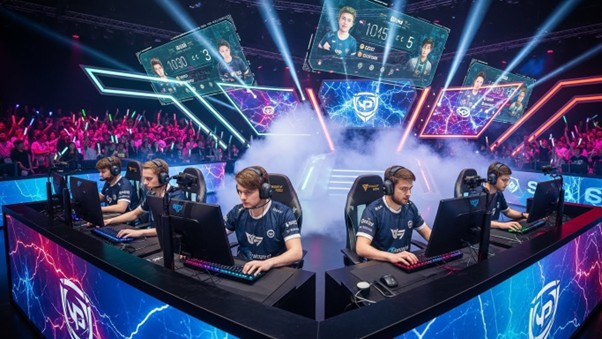
The gaming industry and esports have developed significantly in recent years, becoming a professional industry. Previously niche competitions have now become structured championships with large prize pools and fan support. They unite millions of viewers, players and brands, forming a new digital sports culture. Online leagues affect the economy, media, and even education, increasing the popularity and importance of esports. In this article, we will describe how the development of professional online leagues affects the global landscape of competitions and entertainment.
The Evolution of Professional Online Leagues
In the early stages of its development, esports was not professional. The first professional online leagues emerged in response to the growing popularity of multiplayer video games and the need for structured tournaments. Initially, these were small competitions with minimal prize pools, mostly organized by the player communities themselves. Over time, game developers and independent tournament organizers joined this process, starting to create regular leagues with clear schedules, rules, and qualification systems.
Counter-Strike, Dota 2, League of Legends, and Valorant played a major role in the development of esports. These disciplines have the largest fan bases, clear schedules, and even ranking systems. By analyzing the professional scene, vct schedule, and similar platforms, it can be noted that team rankings have become an important component of the competitive environment. It is based on these rankings that teams receive invitations to major tournaments, and a significant portion of points is earned through leagues.
Among the advantages of online leagues can be allocated significantly to me the cost of logistics and at the same time the possibility of a large number of matches. This contributed to the emergence of semi-professional and regional leagues, with which many e-sports stars began their journey. Thus, professional online leagues have become a multi-level ecosystem, where each level is logically connected with the other.
Globalization and Audience Expansion
One of the main features of professional online leagues is their global nature. Teams from Europe, Asia, North and South America regularly compete within a single season to determine who is the best. It is worth noting that lower-tier leagues are usually divided by region and serve as qualifiers for global tournaments.
Thanks to streaming platforms like Twitch and YouTube, fans can watch matches of their favorite teams, and the overall esports audience rivals that of traditional sports. Viewers can watch matches live, analyze statistics, follow their favorite players, and interact with content in real time. It is very important that not only professional leagues are developed, but also the infrastructure around them, which includes the quality of competitions and broadcasts.
An important factor in global influence was localized broadcasting. A large number of analytics studios have been formed, which broadcast tournaments in different languages and create adapted content that allows attracting new markets. As a result, online leagues are not only an entertainment product, but also an important tool that contributes to the development of a professional ecosystem.
Economic Impact and Professionalization

The growth of professional online leagues has had a significant impact on the e-sports economy. Prize pools of major tournaments run into millions of dollars and can impose a fight on traditional sports. In addition, the teams have sponsorship contracts that attract global brands from the IT, automotive, financial and energy sectors. For many companies, participation in eSports leagues has become an effective way to increase popularity and enter new markets.
Professionalization affected not only the players, but also the entire infrastructure. Teams have coaches, analysts, managers and sports psychologists. New jobs have emerged in the fields of production, marketing and esports journalism. This contributes to the globalization of the entire gaming industry and its perception as a full-fledged sector of the economy.
It is also worth noting the role of online leagues in the development of academies and youth programs. Most major esports organizations have their own academies and invest in training young players who may later become members of the main team. The increase in professional-level players also contributes to the growth in the number of tournaments, which in turn boosts investments and brand involvement, creating a long-term growth model rather than just short-term profit.
Technological Innovation and Future Trends
The development of e-sports is closely related to technological progress. Among the current trends, it is worth noting the use of cloud servers, anti-cheat systems and analytical platforms, which allows to ensure the honesty and stability of the competition. Coaches and players can analyze statistics from official and regular matches and use them to correct errors and improve the level of play.
Greater integration of innovations is expected in the future. AI can be used to predict results, analyze errors and personalized content for fans. Changing the format of tournaments and broadcasts, as well as the emergence of new esports disciplines, all this is possible thanks to technology.
Another trend is the convergence of online leagues with traditional sports. Investments by sports clubs, partnership agreements, and the emergence of hybrid arenas indicate that esports is becoming part of the global sports ecosystem. As online leagues continue to develop, they will play an important role in this process, setting the standards and formats for future competitions.
Conclusion
Having collected all the facts to the heap, we can say that the development of e-sports has become possible thanks to the growth of professional online leagues. They transformed the industry from a local tournament to a global industry with powerful economic, cultural and technological impact. Online leagues have opened up new opportunities for players, spectators and businesses, while forming a sustainable ecosystem. Given current trends, their global impact will only increase, influencing the future of the gaming industry and competitive online entertainment.