



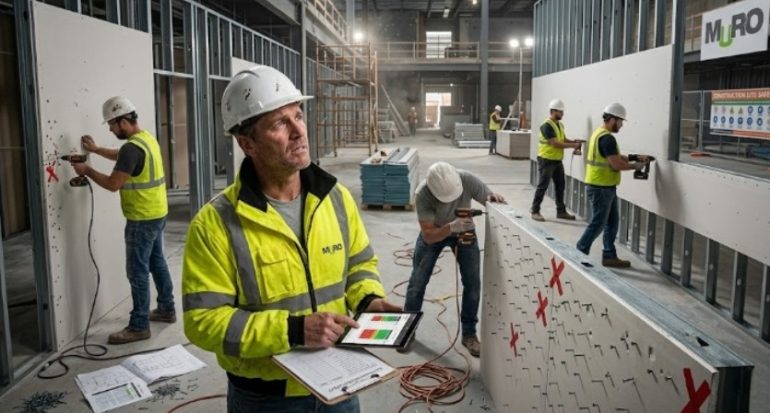
There is a version of quality control that never shows up on a punch list. It does not get flagged in a site inspection. Nobody files a report about it. And yet it quietly drains output, erodes margins, and turns supervisors into full-time correction officers instead of project leaders.
It is the problem of inconsistent fastening. Specifically, the reality that when you put five workers on a floor, a roof deck, or a wall panel system, you get five different interpretations of how a screw should be driven. Some countersink too deep. Some leave the head proud. Some vary their spacing by feel. Some rush on the back half of the day when fatigue sets in. The result is a finished surface that looks acceptable from six feet away and becomes a liability six months later.
Why Crews Develop Their Own Technique
Most crews are hired for their work ethic, not their fastening philosophy. When a worker picks up a tool for the first time, they find a rhythm that feels comfortable — and they stick to it. Nobody teaches optimal fastener depth. Nobody demonstrates what overdriving does to a substrate or what a proud head means for surface finish. They adapt to the tool they are handed, and the tool adapts to nothing.
This is not a failure of the worker. It is a failure of the system.
When fastening technique is left to individual interpretation, variability becomes the standard. And in high-volume applications — modular panel installation, subflooring, commercial roofing, trailer decking — variability compounds. One worker’s “good enough” is another worker’s rework. The problem does not stay contained to one section of the floor or one corner of the roof. It spreads.
The Real Toll on Supervisors
Walk into any mid-size construction operation where manual or semi-auto tools are being used across a crew, and you will find a supervisor doing one of two things: correcting fastening problems or anticipating them. Neither activity moves the project forward.
Supervisors in these environments report spending significant portions of their day re-checking sections that should not need re-checking. They adjust worker technique. They communicate depth expectations that are difficult to verbalize because the standard was never mechanically enforced to begin with. By the time a problem surfaces visually, it has already created downstream consequences: scheduling pressure, material waste, crew friction, and sometimes structural compromise.
The burnout in this role is specific and underappreciated. It is not the heavy work that wears supervisors down. It is the repetitive, corrective work. The feeling that the same conversation happens every week, with different workers, in different areas of the site, over the same issue. That kind of grind does not show up in productivity metrics. It shows up in turnover, in disengagement, and in the quiet departure of your most experienced people.
What Inconsistency Actually Costs Per Project
The financial consequences of inconsistent fastening are not always immediate. Sometimes they are invisible until warranty claims arrive, until a subfloor squeaks under a finished floor, until a roofing panel lifts in weather because the fastener pattern held in three spots and failed in four others.
But even before those downstream costs materialize, there are immediate project-level losses:
- Rework labor at a rate that silently inflates your cost-per-square-foot
- Material waste from over-driven fasteners that compromise the substrate and require patching
- Schedule compression when QC failures are caught late and require correction before the next trade can move in
- Crew productivity gaps between your fastest and slowest fasteners, which means the whole crew throttles to the pace of the weakest technique
On a 50,000-square-foot commercial installation, these costs are not rounding errors. They are margin destroyers.
The Measurement Problem
Part of what makes inconsistent fastening so persistent is that it is difficult to quantify in real time. Supervisors know something is off. They can see it when they look closely. But there is no live readout, no metric on a dashboard that says “Worker 3 is over-driving by 1.5mm and it started at 11 a.m.” The problem is invisible at the system level even when it is visible at the surface level.
This measurement gap reinforces the status quo. Without data, there is no urgency. Without urgency, there is no change. And without change, the same rework cycle repeats on every project, with every crew, regardless of how experienced the workers are.
How Tool Design Creates or Eliminates the Variable
Here is something most operations managers do not fully appreciate: the tool is the policy. Whatever a tool does consistently, workers will do consistently. Whatever a tool leaves open to interpretation, workers will interpret differently.
Manual screw guns give workers complete control over depth, speed, and placement. That flexibility is valuable in complex or custom applications. But in high-volume, repetitive installations where the specification is fixed, that flexibility is not an asset. It is a liability. It transforms every worker into a quality control checkpoint that may or may not hold.
Auto feed screw driving systems eliminate that variable at the mechanical level. The depth is set. The feed rate is consistent. The placement follows the tool’s guide rather than the worker’s judgment. A worker who has been on-site for three months produces the same fastening result as a worker who has been in the trade for fifteen years. Not because they have the same skill, but because the tool has made skill irrelevant to the outcome.
This is not a downgrade of craftsmanship. It is a recognition that in standardized applications, the best craftsperson and the best tool should produce the same result. When they do not, the tool is failing the operation.
The Standardization Shift in High-Volume Trades
Forward-thinking operations in modular construction, commercial subflooring, and industrial panel installation have already made this shift. They are not selecting tools based on cost-per-unit alone. They are selecting tools based on output consistency, rework rate, and supervisor overhead. The calculation is different, and the result is measurably better.
The move toward muro screw gun accessories and related tooling in these environments is driven by the same logic that drives any operational standardization: when the process is repeatable, the outcome is predictable. When the outcome is predictable, projects get easier to bid, easier to staff, and easier to deliver on time.
At 7 Tilbury Court, Brampton, ON, Canada L6T 3T4. +1 905 451 7667, MURO supports contractors and manufacturers across 16+ countries who have made this transition from manual variability to mechanically enforced consistency.
What Changes When the Tool Enforces the Standard
The operational shift that follows when precision auto-feed tooling is introduced is worth examining closely, because it is not just a fastening improvement. It is a structural change in how the crew functions.
Supervisors stop correcting and start managing. Their attention moves from reactive quality control to proactive scheduling and resource allocation. The conversation changes from “why is this section uneven?” to “how do we move faster through the next phase?”
Workers stop second-guessing their own technique. Fatigue-related variation drops because the tool’s mechanism does not depend on hand pressure, wrist angle, or sustained attention. The worker guides. The tool executes.
Onboarding time compresses. A new crew member using a properly configured auto-feed system can match the output quality of a veteran on day one. Not their speed — that comes with time — but their quality. That is a significant shift in how operations managers can think about labor allocation and crew scaling.
The Supervisor as Strategist
The highest-performing site supervisors are not the ones who catch the most mistakes. They are the ones who design systems where mistakes are structurally unlikely. They understand that their real job is not correction. It is a configuration. Set the tools right, set the workflow right, set the expectations right, and let the system produce consistent outcomes without constant oversight.
That is only possible when the tools themselves carry part of the quality burden. When the supervisor has to hold the standard manually, through instruction and inspection, they are limited by how many workers they can watch and how long they can sustain that attention. When the tool holds the standard mechanically, the supervisor’s capacity scales with the crew.
This is what precision auto feed screw driving systems actually provide, beyond the fastener count per hour. They transfer the quality control function from the person to the process. And that transfer changes what a supervisor can accomplish in a day.
A Strategic Lens on Inconsistency
Inconsistent fastening is not a training problem. More instruction does not solve it. Tighter supervision does not solve it sustainably. Better workers do not solve it, because even experienced workers drift when the tool allows them to.
The root of the problem is that variable tools produce variable results. The fix is not behavioral. It is mechanical. It is choosing tooling that does not give variation room to exist.
Operations that understand this distinction compete differently. They can take on higher-volume contracts with confidence in their output quality. They can expand their crew without degrading their standards. They can bid projects with a cleaner cost model because rework is no longer a silent line item. That is not a fastening advantage. That is a business model advantage. And it compounds over every project, every crew, and every contract.