



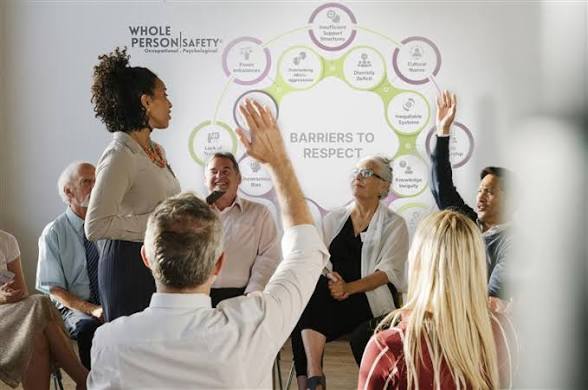
Workplace disagreements are unavoidable. Employees bring different responsibilities, communication styles, priorities, and perspectives to shared projects, so tension can develop even within highly capable teams. The real challenge is preventing an ordinary disagreement from turning into an unproductive confrontation.
Professional de escalation training gives employees and managers practical tools for recognizing rising tension and responding with greater intention. Instead of relying on instinct during an emotionally charged exchange, participants can learn repeatable techniques for slowing the interaction, clarifying concerns, and creating space for productive problem-solving.
These skills can influence more than isolated conflicts. When team members know how to address tension early, they may become more willing to raise concerns, ask questions, and discuss mistakes. This can support stronger working relationships and a healthier approach to accountability.
Behavioral Techniques That Reduce Tension Before It Spreads
Escalation often develops through a sequence of small behavioral changes. A person’s speaking pace may increase, their tone may become sharper, or they may begin interrupting and repeating the same point. Other signals can include rigid posture, withdrawal, sarcasm, defensiveness, or abrupt messages.
Recognizing these early indicators gives employees an opportunity to change the direction of the conversation. Training can help participants notice both the other person’s behavior and their own physical or emotional reactions.
Self-regulation is a useful starting point. Pausing before responding, slowing the pace of speech, and maintaining an even tone can reduce the likelihood of adding more emotional energy to the exchange. The goal is not to suppress every feeling but to choose a response that keeps the conversation manageable.
Nonverbal behavior matters as well. Maintaining an appropriate distance, using an open posture, and avoiding intimidating gestures can communicate a willingness to engage without increasing pressure. In virtual meetings, facial expression, eye contact, response timing, and visible distraction can have a similar effect.
Active listening is another essential technique. Employees may escalate when they believe their concerns are being ignored or misrepresented. Summarizing what has been heard allows the speaker to confirm or correct the listener’s understanding before the conversation moves toward a solution.
Useful summaries focus on the substance of the concern without automatically agreeing with every conclusion. A statement such as, “It sounds like the last-minute change created additional work and you were not told why it was necessary,” can acknowledge the experience while leaving room to discuss facts and next steps.
Open-ended questions can uncover the interests beneath a stated position. Asking what outcome matters most, what information is missing, or what would make the situation feel more workable can shift attention away from blame and toward problem-solving.
Offering clear choices may also restore a sense of control. Two coworkers might decide to continue the discussion privately, pause and reconvene, or involve a manager or neutral facilitator. Providing realistic options can be more constructive than demanding an immediate resolution.
Professional training also helps teams distinguish between conflict that can be addressed conversationally and behavior that requires formal intervention. Threats, harassment, discrimination, or immediate safety concerns should be handled according to organizational policies and appropriate emergency procedures. De-escalation skills do not replace those safeguards.
Broader conflict management training can reinforce these techniques by helping employees understand conflict styles, recurring patterns, and resolution processes. When everyone knows how concerns should be raised and addressed, uncertainty is less likely to intensify an already difficult interaction.
Communication Models That Support Respectful, Steady Dialogue
De-escalation becomes easier when employees have a structure for expressing difficult information. Without a shared model, people may rely on accusation, generalization, or assumptions about another person’s intent.
One useful approach separates observation from interpretation. Instead of saying, “You never respect deadlines,” an employee might identify the specific event: “The final files arrived two days after the agreed delivery date.” This creates a clearer starting point for discussion.
The next step is explaining impact without exaggeration. The employee could add, “That left the review team with less time to check the work before launch.” Concrete language makes it easier for others to understand the concern and respond to it.
A clear request completes the model. Rather than expecting the listener to infer a solution, the speaker can ask for a specific behavior: “Can we confirm the deadline two days in advance and flag any expected delay at that point?” Specific requests are easier to evaluate than vague demands for greater effort or respect.
Effective communication skills training can help teams practice these habits before they face a high-pressure situation. Role-playing, guided discussion, and scenario-based exercises give participants an opportunity to test phrasing and receive feedback.
Respectful dialogue also requires curiosity about different perspectives. Two employees may agree about what happened while interpreting its significance differently. Asking how the other person understood the situation can expose assumptions and reduce unnecessary argument over intent.
Leaders have a particularly important role in establishing communication norms. If managers become defensive when challenged, avoid conflict entirely, or tolerate disrespectful behavior from high performers, employees may conclude that constructive dialogue is not genuinely supported.
Steady leadership means listening consistently, clarifying expectations, and responding proportionately. Managers should avoid treating every disagreement as misconduct, but they should also address patterns that undermine trust or prevent employees from doing their work.
Team protocols can make these expectations more concrete. Organizations may establish guidelines for giving feedback, escalating concerns, documenting decisions, and requesting mediation. Clear processes reduce ambiguity and help employees understand where to turn when a conversation cannot be resolved informally.
Training has the greatest effect when it is reinforced over time. Brief refreshers, coaching, leadership modeling, and post-conflict reviews can help employees apply what they learned. Teams can examine which techniques worked, where communication broke down, and what should change before a similar situation occurs.
Professional de-escalation training does not eliminate differences or guarantee that every interaction will remain comfortable. It gives teams a stronger way to navigate disagreement without allowing tension to control the conversation. With practical behavioral techniques and shared communication models, organizations can support dialogue that remains respectful, steady, and focused on workable outcomes.