



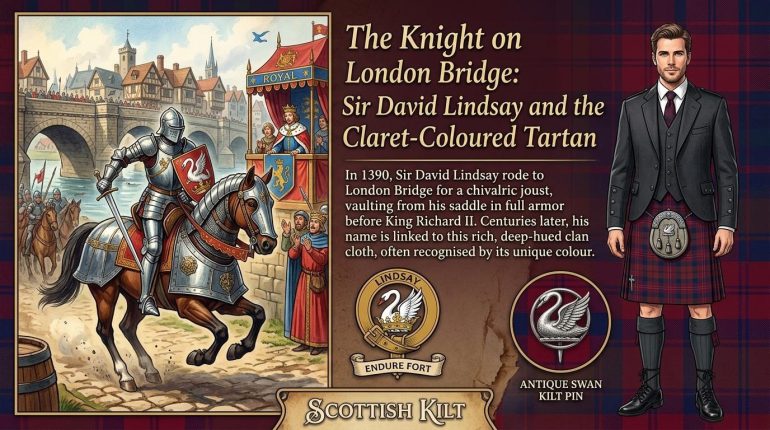
In the spring of 1390, a Scottish knight arrived in London with a retinue of thirty and a safe-conduct signed by the King of England. He had come four hundred miles to settle an argument.
The argument had started at a dinner in Scotland. John, Lord Welles, an English nobleman on an embassy to the Scottish court, had been drawn into a debate about which nation bred the better knights. “Let words have no place,” Welles is supposed to have said. “If you know not the chivalry of Englishmen, appoint me a day and a place where you like, and you shall have experience.” The Scot who took him up on it was Sir David Lindsay of Glenesk, whose family name would centuries later be associated with the distinctive Lindsay tartan.
The Scot who took him up on it was Sir David Lindsay of Glenesk. The story comes down from Scottish chroniclers writing a generation or two later, and they plainly enjoyed it. Welles chose the place, and chose it for the largest possible audience: London Bridge. King Richard II and his queen would watch from a stand. The date was fixed for the feast of St George.
Three courses
London Bridge in 1390 was a street of houses on stone arches, with an open stretch in the middle. On the appointed day it was packed to the parapets.
The two knights rode at each other in full armour with sharpened lances. On the first course both lances shattered and neither man moved in the saddle. On the second, the same. The crowd noticed that the Scot had taken a tremendous blow full on the helm and had not so much as swayed, and a shout went up that Lindsay was cheating. He was strapped to his horse.
Lindsay heard it. He reined in before the royal stand, and in full plate armour, without a hand from anyone, vaulted out of his saddle to the ground. He bowed to the King. Then he vaulted back on.
The third course finished it. Lindsay’s lance took Welles square and threw him over his horse’s tail onto the stones of the bridge, where he lay stunned. The rules now allowed the fight to continue on foot with daggers. Lindsay dismounted, walked over to the fallen man, and did what nobody expected. He knelt, helped him up, and supported him to where the Queen was sitting, to present him to her. The chroniclers add that he visited Welles every day until he was well.
He went home to Scotland the most famous knight in Britain. Eight years later the King of Scots made him Earl of Crawford.
The lightsome Lindsays
The Lindsays came north from England in the twelfth century and rose fast. Their first lands were in the upper Clyde valley, around Crawford, which gave them their title. Their real country was Angus, in the east, in the glens running up into the Grampians behind Brechin and Forfar. Their motto is Endure fort, endure with strength, and their crest is a swan rising out of a coronet. The chief is the Earl of Crawford and Balcarres, and the holder of Sir David’s earldom ranks as the premier earl of Scotland.
They were a clever, stylish, quarrelsome family, and the old rhymes that gave each great house a nickname called them the lightsome Lindsays, the light-hearted ones. One of them, another Sir David, was the chief herald of Scotland and the author of a play, A Satire of the Three Estates, which mocked the church and the court to their faces in 1540 and is still performed. Another built, in 1604, the walled pleasure garden at Edzell Castle, with its carved panels of the planets and the virtues, which is one of the loveliest things in Scotland and looks as though it has been lifted from Renaissance Italy and set down at the foot of Glenesk.
A tartan known by its colour
The Lindsays were a Lowland house, and like most Lowland families they had no tartan until the nineteenth century. Theirs first appears in the Vestiarium Scoticum of 1842, that gorgeous and unreliable book which supplied patterns to so many families who lacked one. Wherever it came from, the Lindsays took to it at once, and it has been theirs for more than a hundred and eighty years.
It is an unusual cloth, and the notes in the tartan archives explain why. Normally the exact shade of a tartan’s colours is left to the weaver. Red is red. But “the Lindsay tartan,” the archivists write, “is often first recognised by its colour.” The red in it is not scarlet. It is a deep wine red, somewhere between claret and maroon. Against it sit broad bands of dark bottle green, and the green is laced with lines of navy blue. The structure is close to that of the Stewart of Atholl tartan. The colouring is unlike anything else. It is rich, dark and slightly sombre, the colour scheme of a library or a good Bordeaux.
Those looking for Lindsay tartan will find it offered in Modern colours, which give the full depth of the claret; in Ancient, where it lifts to a soft rose and moss; and in Weathered. Retailers make it up as kilts, skirts, waistcoats, sashes and scarves, or sell it by the yard.
A cloth with that much character needs careful company, and that is the subject of the rest of this story.
Brechin, five weeks before a wedding
Andrew Lindsay is thirty, from Perth, Western Australia, and is marrying a girl from Montrose in the cathedral at Brechin, six miles from Edzell. He has never worn a kilt. His fiancée’s father, a retired vet called Sandy, has taken him in hand.
“The kilt’s the easy bit,” says Sandy. “You give them your waist, your hips and your length and it comes. It’s everything else that makes a man look right or look like he’s hired it. And you, my lad, have a difficult tartan.”
They are at Sandy’s kitchen table with a laptop. Andrew had been dreading a tour of five different shops. Sandy is of the view that you buy the kilt and accessories from one place, so the leathers match, the metals match, and any tartan extras are cut from the same cloth as the kilt. He has had two kilts made by Scottish Kilt, which cuts every kilt to the customer’s own measurements in more than five thousand tartans and sells the rest of the outfit alongside.
Sandy works down the body.
“Jacket. Your wedding’s at two, so an Argyll, not a Prince Charlie. Black or charcoal. With that claret, charcoal is softer. Five-button waistcoat to match.
“Sporran. It hangs a hand’s width below your waistcoat. Day weddings, you want a semi-dress: leather body, a bit of fur on the front. Black leather, with this tartan. Brown fights the red.
“Now metal. This is where men go wrong. Your sporran has a metal top, your belt has a buckle, your kilt pin is metal, your jacket has buttons, and the wee knife in your sock has a metal cap. They all have to be the same finish. Bright chrome or antique, pick one. With a dark, old-looking tartan like yours I’d go antique. It looks like it came down through the family.
“Kilt pin goes on the front apron, right-hand side, a few inches up from the hem. Through the top layer only. It’s a weight, not a fastening. Pin both layers together and you’ll rip the cloth the first time you sit down. They do one with a swan on it. That’s your crest.”
“Socks?”
“Hose. Not cream. Cream is what the hire shops give you. You take a dark colour out of the tartan. You’ve got green and you’ve got navy. Bottle green, I think, with the flashes in claret. The flashes are the wee ribbons that hang from the garter. Two inches showing, on the outside of the leg.
“Shoes are ghillie brogues, black, no tongue, long laces. You twist the laces at the front, take them round the back of your ankle and tie them at the front again. Low. Not up your calf like a Roman.
“Tie plain. Dark green or black. The kilt is doing the talking. And that’s you.”
Andrew looks at the basket. “That’s a lot of things.”
“It’s eleven things,” says Sandy. “And you’ll have them for forty years, and then your son will have them. Now. Do you know who Sir David Lindsay was?”
“The poet?”
“The other one.” Sandy settles back. “London Bridge, 1390. They said he was tied to his horse…”
Endure with strength
On the day, in the red sandstone cathedral, Andrew Lindsay wore claret and green under charcoal, with antique silver at the waist and a swan on his kilt pin. His mother, who had flown from Perth, said he looked as though he had been born in it. Sandy said nothing, which from Sandy was the highest praise available.
Sir David Lindsay understood something about occasions. He knew that the crowd on the bridge was watching how he carried himself as closely as how he fought. So he won, and then he made a show of leaping off his horse and back on, and knelt to help up the man he had beaten. His clan’s tartan has the same quality. It is a quiet, deep-coloured cloth that does not shout, and with the right things around it, chosen with a little care, it is as distinguished as anything a man can wear.