



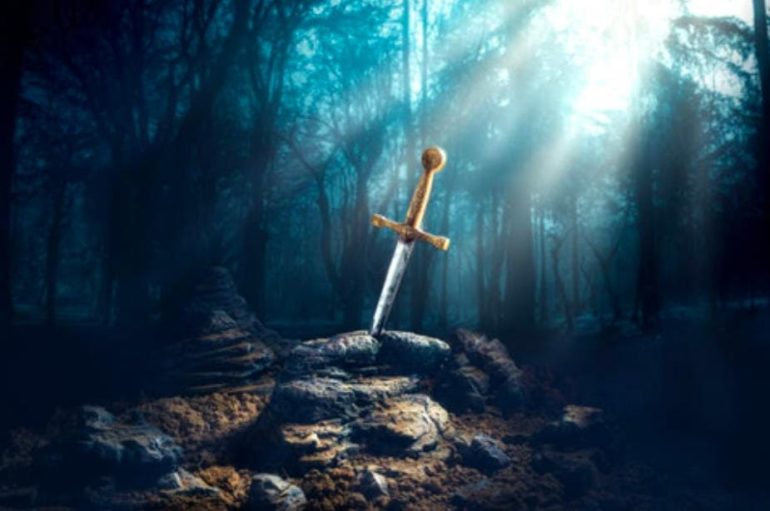
There’s a moment in almost every great sword fight on screen where everything else falls away. The music drops, the camera tightens, and two people stand opposite each other with nothing between them but sharpened steel and bad intentions. Guns are loud and final. Fists carry a certain brutality. But swords carry history and that weight is precisely why they’ve never gone out of style in action cinema.
From Kurosawa’s feudal Japan to the wuxia wire-work of Crouching Tiger, Hidden Dragon, from Viggo Mortensen hauling a battle-worn Andúril across Middle-earth to the brutal close-quarters blade work of more recent prestige action, the sword endures as one of cinema’s most reliably compelling weapons. Part of the reason is practical. A sword is visible from across a room. It forces physical proximity. It demands that the person holding it actually look like they know what they’re doing or that their stunt double does. No other weapon puts two performers so completely in each other’s space and keeps them there.
The other part of the reason is craft both on screen and off it.
Real Steel and Movie Props
Hollywood has a long, occasionally embarrassing relationship with prop weapons. For decades, the stunt industry relied on aluminum stand-ins, rubber training blades, and anything light enough to swing at speed without taking out a camera. The results often looked exactly like that. Watch certain ’80s sword-and-sorcery films closely enough and you’ll notice blades that wobble mid-swing and “metal” that dents like a drinks can.
The growing use of weapons designed with more authentic weight and geometry has also influenced the texture of on-screen combat. When a sword has real mass, a performer moves differently; the effort required to control it reads as genuine even to audiences who’ve never held one. Prop masters and armourers working on higher-budget productions increasingly sourced or commissioned blades closer to functional designs, and fight coordinators noticed the difference in how actors carried themselves.
The Japanese katana is the clearest example of this crossover between craft and cinema. The katana’s construction, a process involving differential heat treatment that produces a blade with a harder edge and a more resilient spine, has been documented and discussed across decades of film. Kurosawa understood that a sword fight is, at its core, a conversation about mortality, and his work with choreographers drew on the visual grammar of Japanese sword traditions to give his sequences a weight and finality that Hollywood dueling rarely matched. That’s a significant part of why Seven Samurai still reads as credible more than 70 years on.
That curiosity about the real thing eventually pulls some viewers beyond the screen entirely into martial arts clubs, museum armouries, and the growing world of historically styled sword collecting. For those interested in exploring that side of the hobby, Battling Blades is one example of the specialist resources available to collectors interested in different sword traditions. Once you’ve handled a blade with proper balance and geometry, you start watching film fights with different eyes.
Where Historical Swordsmanship Meets Hollywood
Real swordsmanship looks quite different from its cinematic counterpart and that gap is more interesting than it might seem.
Historical European martial arts (HEMA) practitioners have spent years reconstructing the fighting systems preserved in medieval and Renaissance manuals. What those sources describe is a discipline built around timing, measure, and the exploitation of very small openings, not the sustained clashing exchanges that cinema typically presents. Whether you’re looking at Italian rapier tradition, German longsword technique, or classical Japanese schools, the common thread is efficiency. Cinematic sword fighting, by contrast, is choreographed for visual clarity and emotional impact, which often means extending exchanges that would realistically be over in seconds.
None of that means the film has been doing it wrong. A sword fight on screen has to be legible, audiences need to follow what’s happening and feel the stakes and pure martial efficiency doesn’t necessarily translate into compelling drama. What the best fight choreographers have figured out is that incorporating elements of genuine technique gives their work a different texture. The controlled economy of someone with real training reads as menace. An actor who moves with the grounded footwork that actual systems teach tends to convince audiences even when the exchange itself is entirely theatrical.
Films That Made Sword Fighting Memorable
Ridley Scott’s The Duellists adapted from a Joseph Conrad story and one of the most thoughtfully constructed sword films ever made built its combat around the rhythms of Napoleonic-era military fencing. The sabre sequences feel genuinely dangerous rather than decorative, largely because the film treats the duel as a psychological condition rather than a set piece.
Scott revisited similar territory twenty years later with Kingdom of Heaven, which drew on historical consultation to give its medieval battle sequences a period-appropriate brutality. The Last Samurai put Tom Cruise through extensive training in Japanese sword technique, and the effort is visible in his physical commitment during the later sequences. These aren’t films made by people who thought the swords were just props.
The Hong Kong tradition approached the whole question differently and in doing so, built something just as valuable. Directors and choreographers working in the wuxia genre from the 1960s onward essentially developed their own distinct visual language for blade combat. The sword sequences in King Hu’s Come Drink with Me, the airborne poetry of Ching Siu-tung’s work across A Chinese Ghost Story and dozens of others, the spatial precision Yuen Woo-ping brought to everything he touched none of it was interested in historical reconstruction. It was interested in creating a form of cinema that couldn’t exist anywhere else, and it influenced virtually every action director who came after.
More recently, productions like The Northman have pushed back toward historical grounding, working with consultants to give their combat a rawer, less theatrical quality. The John Wick franchise which weaves knives, axes, and improvised bladed weapons through its gun-fu choreography benefits from the same philosophy the series applies to firearms: train the performers properly, and the camera can simply watch.
Why Swords Still Work in Action Cinema
The sword works on screen because it’s an intimate weapon. There’s no shooting from a distance, no pulling a trigger. A sword fight requires two people to commit to proximity, and it keeps them there until someone loses. That inherent tension, physical, spatial, personal is hard to manufacture with other weapons.
Swords also carry the weight of whatever tradition they come from, and cinema has always been happy to borrow that weight. A katana in a film isn’t just a cutting implement; it arrives loaded with centuries of association. The same is true of a European longsword, a Chinese jian, or a Viking seax. Filmmakers know this, and audiences feel it even when they can’t articulate why.
For action cinema fans who want to understand what they’re watching at a more physical level, there’s no substitute for handling the real thing. The balance point of a well-made sword, the way a properly shaped blade moves through the air, the heft and feedback through the grip these are things that descriptions and slow-motion footage can approximate but not replicate. It’s worth seeking out, whether through a martial arts class, a museum, or simply spending time examining functional swords and learning how different designs are shaped and balanced. Either way, you’ll come back to the films seeing something you didn’t see before.
That’s the mark of any discipline worth paying attention to: once you understand the craft behind it, the craft becomes part of what you’re watching.