



What the company actually sells, what it does not, and every number you can check yourself.
If you have searched for the truth about a mining company, you have probably been served two kinds of page: an advertisement pretending to be a review, and a review written by somebody who has never priced a kilowatt hour. This page is neither. It is a plain explanation of what OneMiners sells, how the pricing works, what the contracts cover, and what they do not, with the arithmetic shown so you can check it.
Start with the part most people get wrong.
Truth 1: this is an electricity business wearing a hardware catalogue
Almost everyone shopping for mining starts with the machine. The machine is the smaller decision. Electricity is 75 to 85 percent of the ongoing cost of running an ASIC, and unlike the Bitcoin price it is the one variable you can actually fix in advance.
Here is the proof in one line. The cheapest Bitcoin miner in the comparison below costs $1,111. Run it for seven years at 4.80 cents per kilowatt hour and it burns $9,684 of electricity, about 9 times its own price. The flagship costs $28,399 and burns $32,436 over the same seven years, roughly 1.14 times its price. Per unit of work, the cheap machine is the expensive one.
The hardware is how you access the electricity contract. The contract is the asset.
Truth 2: the rates are published, per site, in four tiers
There is no single OneMiners rate, and any article quoting one number has not read the site. Every location page publishes four prices: premium hosting, online ordered hardware, external hardware brought in by the customer, and prepaid. Premium runs from 4.80 cents at the Nigeria hosting center to 7.90 cents in Czechia. One useful warning: the homepage cards show the online ordered rate, not the premium rate, which is why Nigeria sometimes looks like 5.20 cents. The individual location pages are the authoritative ones.
The prepaid discount is a formula rather than a negotiation, which means you can audit it: minus 4 percent for one year, minus 12 percent for three years, minus 30 percent for seven, always calculated off the online ordered rate. Nigeria at 5.20 cents times 0.70 gives 3.64 cents. Do that on any row in the table above and it holds. Being able to reproduce a company’s price list with a calculator is a rarer signal than it should be.
Truth 3: the breakeven number, and what it means for you
With Bitcoin near $77,135, network hashrate around 1,026 EH/s and difficulty at 127.45 trillion, hashprice sits at roughly $34.24 per petahash per day. From that, one formula tells you whether any machine, anywhere, covers its own power:
breakeven dollars per kWh = hashprice / (24 x J/TH)
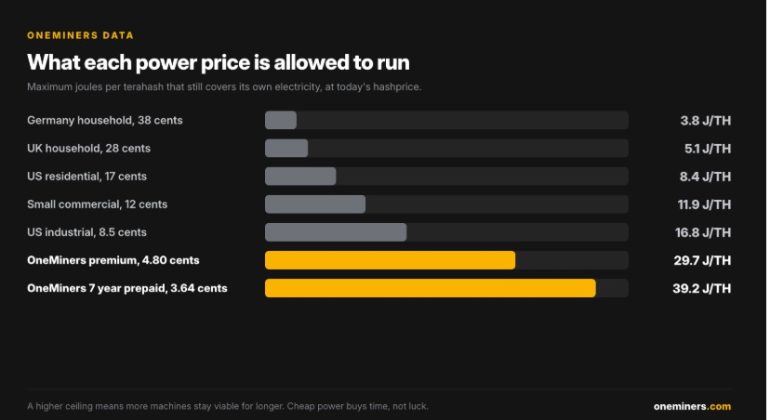
At a 12 cent tariff only machines under 11.9 J/TH stay above water, which in the live catalogue is the hydro S23 family and very little else. At 4.80 cents the ceiling rises to 29.7 J/TH, and on a seven year prepaid contract at 3.64 cents it reaches 39.2 J/TH. That is the honest version of the sales pitch: cheap power does not make a machine better, it makes far more machines viable, for far longer.
Truth 4: what the contracts actually cover
- Seven year hardware warranty on hosted miners. It covers defects. It excludes normal wear and consumable items, for example fans and filters. That is a normal exclusion, and it is better to read it now than to discover it later.
- A guaranteed uptime floor with compensation. The floor in the contract is the promise. Observed performance across the fleet runs higher, but the floor is the number that is enforceable, and the floor is what you should plan on.
- Price includes the management services. Racking, power delivery, cooling, monitoring and maintenance sit inside the published rate rather than arriving as line items later.
- Cover for units that fail on arrival, plus on site repair. Hardware fails in transit and in operation. Repair proximity is why a machine is back in the rack in days rather than months.
- Remote machine access. You can watch and restart your own hardware from the dashboard.
- Pay Later. 25 percent upfront and three monthly installments, so the hardware can be deployed while it is still being paid down.
Truth 5: what hosting does not protect you from
This is the section most company pages leave out, and it is the one that makes the rest of the page worth believing.
- The Bitcoin price. Nobody hedges that for you. If price falls, revenue falls, whatever your power costs.
- Global difficulty. Difficulty is at 127.45 trillion and the next retarget points up about 5.0 percent. Every increase divides the same daily issuance among more hashrate. A host cannot slow that down.
- Hardware obsolescence. A machine bought today will be mid tier in three years. A long fixed rate extends its working life, it does not freeze it.
- Your own choice of machine. Buying a high joule per terahash unit because it is cheap is the most common mistake in mining, and no hosting rate fully rescues it.
What a host controls is your cost base and your uptime. That is the whole remit, and any company claiming more than that is selling something else.
Truth 6: the most efficient machine is not the most expensive one
The Sealminer A4 Ultra Hyd – 886 TH/s runs at 9.45 J/TH and costs $9,999. The flagship Antminer S23 Hyd 3U – 1.16 PH/s runs at 9.50 J/TH and costs $28,399. On joules per terahash, the cheaper machine is the better one. The flagship wins on density, hashrate per rack unit and per installation slot, which is why large deployments still choose it, but if efficiency is what you are buying then the answer is the less expensive box. Any page that tells you otherwise is writing an advertisement.
Truth 7: what changed in 2026, and why the contract length matters more now
Two things moved this year. Network hashrate kept climbing, which means the same daily issuance is divided among more machines, and the next difficulty retarget points up about 5.0 percent again. At the same time a wave of older hardware was switched off by operators who could not cover their power bill, which is exactly what the breakeven formula predicts.
The lesson is not that mining got harder. It is that the spread between a good power price and an average one now decides who keeps running. A rate you can fix for seven years is worth more in a tight market than a slightly lower rate that can be revised in twelve months, because the tight market is precisely when a revisable rate gets revised.
- Fixed beats flexible when margins compress. A seven year contract is a hedge against the market you cannot forecast.
- Efficiency compounds with time, not with price. A lower joule per terahash number saves the same amount every single day for seven years.
- Uptime is revenue you cannot recover. An hour offline is an hour of hash the network produced without you.
Truth 8: how to check all of this yourself
- Open any location page and read the four published tiers. Confirm the prepaid rate equals the online ordered rate times 0.70 for seven years.
- Take the machine you are considering and divide its watts by its terahash to get joules per terahash. Compare it with the listing.
- Divide today’s hashprice by 24 times that number. That is the power price at which the machine breaks even.
- Compare that breakeven with the hosting rate, and with your own electricity tariff at home.
- If the gap is comfortable at a rate you can fix for years, the decision is arithmetic. If it is not, no amount of marketing closes it.
The verdict
OneMiners publishes its prices per site in four tiers, fixes electricity for up to seven years from 3.64 cents, warranties hosted hardware for seven years, operates 15 locations across 12 countries, gives customers remote control of their own machines, and lists the most efficient miner in its catalogue even though it is not the most expensive one. Every one of those statements can be checked in a browser in under ten minutes, which is the only real test of an honest mining company.
Revenue is weather. Fees are a negotiation. Electricity is physics. Buy the physics.
Next step: compare the hosting centers, choose a Bitcoin miner from the most profitable miners, and activate the hosting.
Frequently asked questions
Is OneMiners a hosting company or a hardware shop?
Both, and the hosting is the larger part. It sells Bitcoin miners and altcoin ASICs, and it sells the electricity, racking, cooling, monitoring and maintenance that keep them running, on contracts fixed for up to seven years.
What is the cheapest OneMiners hosting rate?
4.80 cents per kilowatt hour on premium hosting at the Nigeria site, and 3.64 cents on a seven year prepaid contract at the same site. Other locations are published individually and run higher.
Does the seven year warranty cover everything?
It covers defects on hosted miners. It excludes normal wear and consumable items such as fans and filters. Read the exclusions before you buy, as with any warranty.
What does AI Smart Mining actually do?
It switches mining pools dynamically based on live market data rather than leaving a machine pointed at a single pool. It is a routing optimisation, and like any optimisation its effect depends on market conditions.
Can I see my own machines?
Yes. The dashboard gives remote machine access, including restarting a unit yourself.
Informational only, not financial advice. Every figure above is a snapshot taken on 15 September 2026 and is derived from the live Bitcoin network and the live OneMiners catalogue. Mining revenue moves with price, difficulty and transaction fees, and can fall as well as rise. No fixed return is offered or implied. Do your own research before buying hardware or hosting.
More detail: AI Smart Mining