



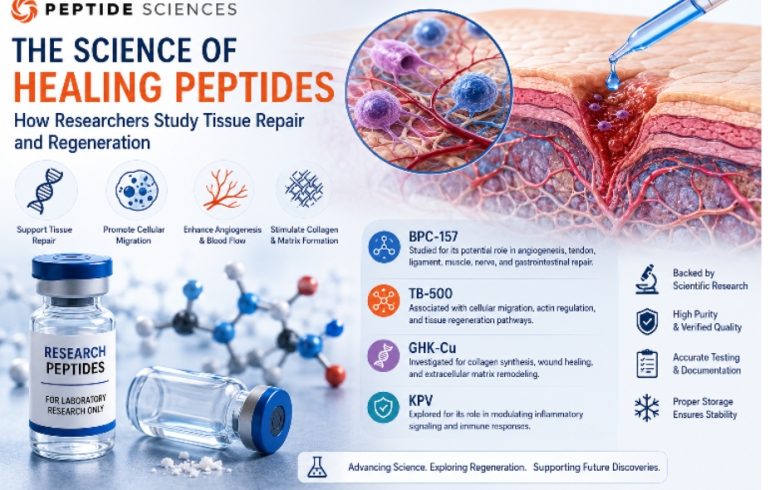
The human body has a remarkable ability to repair itself. When tissue is injured, a carefully coordinated biological response begins, involving inflammation, blood clotting, cellular migration, new blood vessel formation, collagen production, and tissue remodeling.
Yet healing is not always simple. The type and severity of an injury, blood supply, age, metabolic health, inflammation, and the tissue involved can all influence recovery.
Tendons, ligaments, muscles, skin, and the gastrointestinal tract each have distinct structures and healing challenges.
This complexity has led scientists to investigate biological signaling molecules that may help explain the mechanisms behind tissue repair. Among them, peptides for healing have attracted growing research interest because certain peptides are associated with angiogenesis, cellular migration, collagen synthesis, inflammatory signaling, and regenerative processes.
BPC-157, TB-500, GHK-Cu, and KPV are among the most widely discussed compounds in this field, but they have different structures, mechanisms, and levels of scientific evidence.
How Does the Body Repair Damaged Tissue?
Tissue healing generally occurs through overlapping phases rather than a perfectly linear sequence.
The first stage involves hemostasis, during which the body attempts to control bleeding through clot formation. This is followed by the inflammatory phase, where immune cells remove damaged tissue and help coordinate the early healing response.
Next comes the proliferative phase. Fibroblasts contribute to extracellular matrix formation, new blood vessels develop, and cells migrate into the injured area.
Finally, during remodeling, collagen fibers and other structural components are reorganized over time to strengthen the repaired tissue.
Peptide researchers investigate compounds that may interact with different elements of this process, including inflammation, angiogenesis, fibroblast activity, cellular migration, and collagen production.
BPC-157 and Tissue-Repair Research
BPC-157 is one of the most widely discussed experimental compounds in regenerative research. It is a synthetic peptide derived from a sequence associated with a gastric protein.
Much of the scientific interest surrounding BPC-157 comes from preclinical studies involving tissues such as tendons, ligaments, muscles, nerves, blood vessels, and the gastrointestinal tract.
Researchers have investigated its possible relationship with:
- Angiogenesis
- Tendon and ligament repair
- Muscle recovery
- Gastrointestinal protection
- Nitric oxide signaling
- Inflammatory pathways
- Cellular survival
Angiogenesis—the formation of new blood vessels—is particularly important because damaged tissues require oxygen and nutrients to support repair.
However, the distinction between experimental findings and established clinical evidence is essential. Much of the available BPC-157 research is based on laboratory and animal studies, and these findings should not automatically be interpreted as proof of safety or effectiveness in humans.
TB-500 and Cellular Migration
TB-500 is another prominent compound associated with healing and recovery research. It is related to thymosin beta-4, a naturally occurring peptide involved in several biological processes.
One important area of research concerns actin, a protein essential to cell structure, movement, and migration.
Cellular migration is fundamental to tissue repair. Following injury, different cell types must move into the damaged area to participate in inflammation, new tissue formation, blood vessel development, and remodeling
Research involving thymosin beta-4-related pathways has examined:
- Cellular migration
- Angiogenesis
- Wound repair
- Inflammatory signaling
- Tissue remodeling
- Actin regulation
BPC-157 and TB-500 are sometimes discussed together because both are associated with tissue-repair research, but they should not be treated as identical compounds. They have different structures and proposed biological mechanisms.
The combination is sometimes informally known as the Wolverine Stack, reflecting the fictional character famous for rapid healing. The nickname is memorable, but it should not be confused with scientific evidence of extraordinary regenerative effects in humans.
GHK-Cu: Collagen and Tissue Remodeling
GHK-Cu is a naturally occurring copper-binding tripeptide composed of glycine, histidine, and lysine.
It has become particularly prominent in research involving skin regeneration, collagen synthesis, wound repair, and extracellular matrix remodeling.
The extracellular matrix is the network of proteins and other molecules surrounding cells. It provides structural support and influences cellular behavior. Collagen is one of its most important components.
GHK-Cu has been investigated in connection with:
- Collagen production
- Elastin-related processes
- Wound healing
- Fibroblast activity
- Antioxidant mechanisms
- Inflammatory signaling
- Gene expression
- Tissue remodeling
Unlike compounds discussed primarily in muscle or tendon research, GHK-Cu has especially strong relevance to skin biology and extracellular matrix research.
Its copper-binding ability is also scientifically important because copper serves as a cofactor for enzymes involved in several biological processes, including connective tissue formation.
KPV and Inflammatory Signaling
Inflammation is essential to normal healing, but excessive or persistent inflammation can interfere with tissue recovery.
KPV is a tripeptide consisting of lysine, proline, and valine. It is derived from the C-terminal sequence of alpha-melanocyte-stimulating hormone, commonly called α-MSH.
Researchers have investigated KPV for its relationship with inflammatory pathways, cytokine signaling, intestinal tissues, epithelial biology, and immune regulation.
Unlike BPC-157 or TB-500, which are commonly discussed in broader tissue-repair contexts, KPV is particularly relevant to research involving the regulation of inflammatory responses.
This distinction matters because inflammation has a dual role in healing. An appropriate inflammatory response helps remove damaged material and coordinate repair, but prolonged inflammation may contribute to continued tissue damage.
Understanding how signaling molecules influence this balance remains an important area of regenerative science.
Why Are Tendons and Ligaments Difficult to Heal?
Tendons connect muscles to bones, while ligaments connect bones to other bones. Both are rich in collagen but generally have more limited blood supplies than many other tissues.
This can make recovery slow and challenging.
Researchers studying tendon and ligament healing investigate several important processes, including collagen organization, fibroblast activity, vascularization, inflammation, mechanical loading, and extracellular matrix remodeling.
This is one reason compounds such as BPC-157 and thymosin beta-4-related peptides have attracted scientific interest.
However, experimental findings involving animal tendon injuries should not be automatically translated into human clinical recommendations. Differences between
species, experimental models, dosage, administration, and injury type can significantly affect results.
Why Peptide Quality Matters in Healing Research
Reliable regenerative research requires accurately identified and appropriately characterized compounds.
An impure, degraded, contaminated, or incorrectly labeled peptide can compromise experimental results. Researchers should therefore consider analytical evidence such as HPLC purity testing, Mass Spectrometry, Certificates of Analysis, batch documentation, and proper storage conditions.
Peptide stability is particularly important. Heat, moisture, oxygen, light, microbial contamination, and repeated freeze-thaw cycles may affect certain compounds.
High-quality research depends not only on selecting an interesting peptide but also on knowing that the material being studied has the expected identity and integrity.
The Future of Healing and Regenerative Peptide Research
Regenerative science is advancing rapidly. Researchers are investigating stem cells, growth factors, biomaterials, extracellular vesicles, gene therapy, peptides, and other approaches to better understand how damaged tissues repair themselves.
BPC-157, TB-500, GHK-Cu, and KPV represent different aspects of this research landscape. BPC-157 is investigated across several preclinical models of tissue repair. TB-500-related research focuses partly on cellular migration and actin biology. GHK-Cu has important connections to collagen and extracellular matrix remodeling, while KPV is particularly relevant to inflammatory signaling.
No single peptide controls the entire healing process. Tissue repair depends on coordinated interactions between immune cells, blood vessels, fibroblasts, extracellular matrix components, growth factors, and numerous signaling molecules.
The scientific importance of healing peptides therefore lies not in promises of miraculous recovery, but in their potential to help researchers understand the complex molecular language through which tissues respond to injury, regulate inflammation, and rebuild damaged structures.