



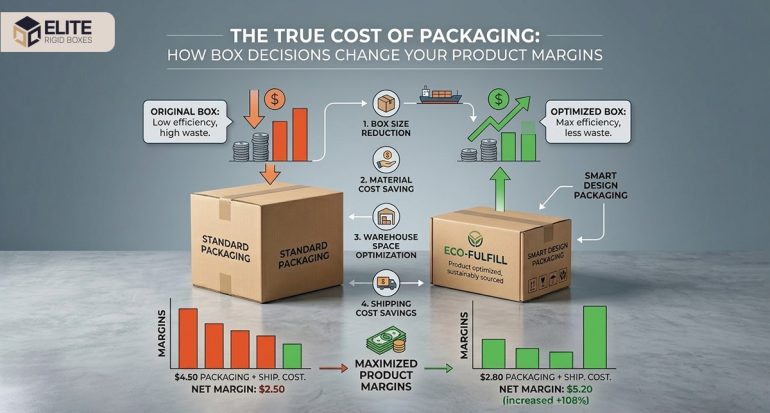
Packaging selection affects your profit margin by influencing shipping weight, packing volume, and the rate of damage to goods. Smart box choice ensures that material cost is minimized and shipping charges are reduced.
The box size will determine your shipping charges. Your choice of materials will impact durability and product protection. Custom inserts may add to assembly times. Oversized packaging may consume valuable warehouse space. A less expensive box becomes the most costly choice when all the relevant costs are considered.
Founders and operations managers should know how to assess packaging in terms of the cost structure of their products. This post will guide you on different aspects of boxes, including material, size, orders, finishes, shipping, and packaging performance.
Why Per Unit Price is the Wrong Number to Compare?
The brand switches suppliers after finding a box that costs 40 cents less per unit when buying 2000 boxes for $800 savings. The new box has thinner material and loose lid fitting, and the damage returns increase from 1% to 4% of orders. At $75 average order value and $18 approximate reship cost per damaged item, the 60 additional damaged boxes will cost the brand $1,080 more.
This explains why the packaging cost for a small business owner can never be calculated based on the invoice amount alone. The actual cost of packaging is the delivered cost of each successfully delivered package, not per box price. A box that costs less but shows up dented is just deferring the expense to customer service.
The Four Cost Layers Most Quotes Bundle Together
Most packaging quotes combine four major cost layers: material, printing, finishing, and transportation. Suppliers do not break it down until you ask for it, and it becomes impossible to understand which part of the quotation is costly and needs some negotiating. Each element of the quote acts differently depending on the volume of goods to be delivered.
-
Material and Board Thickness
Rigid boxes consist of two parts: the structural core made of greyboard or chipboard and the outer layer, which consists of printed papers. The greyboard is generally denser than the chipboard and more expensive. This makes it suitable for premium packaging. The chipboard is less expensive and flexible. The thickness of the board is measured in calipers and has an impact on protective strength and cost within the material layer.
-
Printing Method and Run Length
The printing process is another level to consider after the board is selected. The plates have an initial cost but a very low per-unit cost as soon as the print run reaches a volume level with the offset printing process. Plates are not required with the digital printing process, which eliminates any costs of setting up.
The per-unit cost does not reduce that much as the volume increases in the digital printing process. The difference in cost of offset and digital printing processes results in a crossover level. The digital process will be cheaper if the artwork needs to be changed frequently.
-
Finishing and Add-Ons
Finishing is where quotes swing the most, and it is the place where spending extra on something that will not be noticed by customers easily happens. The foil stamping and embossing techniques have a luxury look, but their costs differ from each other. The foil stamping technique implies putting an extra layer of metallic or colorful foil and is normally costlier than the embossing one.
It depends on whether you need a luxury look for some details or the whole area when it comes to comparing the foil stamping vs embossing cost. The Spot UV and soft touch lamination fall into the middle category. The magnetic closure and ribbon pull will have a significant price increase for something that will be barely noticeable to the customer.
-
Freight and Dimensional Weight
Freight is the layer founders most often forget to price into the box decision. The carrier charges based on the actual weight and charges for the dimensional weight of the packages as well. It calculates which is bigger between the two. A bigger box with extra room will incur dimensional weight packaging charges despite the fact that the product within the box may be lightweight.
For example, a lightweight box that is spacious on the inside can be relatively more costly to transport than a heavy, small box because it occupies more space in the truck used for transport. The dimensional weight calculation by FedEx involves multiplying the length, width, and height of the box and dividing by the divisor.
Where Order Volume Actually Helps, and Where it Does Not
Order quantities reduce cost per unit for packaging, but not all costs get reduced proportionately. One effective method for looking at the pricing graph is to analyze the same packaging requirements for 100, 500, 1000, and 5000 units.
The per unit cost would be lower as volume goes up because the fixed costs of production would be shared among more boxes. For 100 units, the costs related to tooling, plates, etc. would be shared by a small number of boxes, making each unit costly.
| Order volume | Typical per-unit cost pattern |
| 100 units | Highest per-unit cost |
| 500 units | Lower as fixed costs spread across more units |
| 1,000 units | Further reduction in setup cost per box |
| 5,000 units | Lower per-unit cost, with savings often beginning to flatten |
Material costs have their own unique characteristics. Each box required the same amount of board, paper, and glue. Increased orders might result in increased efficiency when ordering material, but the costs associated with them do not go away. It is worth looking for suppliers with low minimum order requirements for brands testing out a new SKU.
The Costs that Never Appear on the Quote
Packaging quotes are simply the cost of the parts you control. Everything else quietly falls into your hands after the invoice has been settled. While an inexpensive packaging option might seem like a good deal, it becomes costly if the packaging fails to protect the items while being transported.
Damaged items can be replaced or reshipped or even disposed of. It is important to consider damaged statistics in conjunction with packaging costs to see what the true cost of each item delivered is. Time spent by the customer service team dealing with packaging issues is never reflected in the invoice.
Review and rating damage is harder to quantify but just as real. A product that has been damaged during shipment will be held accountable for its poor condition during the review even if it is still in good shape.
The warehouse size of pre-assembled and collapsible boxes is significantly different. The pre-assembled boxes look great in unboxing pictures but consume much more warehouse space. This makes the warehousing cost go up without the founders ever realizing it was due to choosing the wrong boxes.
Obsolescence occurs as soon as the artwork design changes. Mid-run printed inventory automatically becomes obsolete, which is one of the lesser-known but very real costs of packaging.
A Margin Worksheet You Can Copy
Here is a worked example with illustrative figures. Replace these figures with your own figures before applying the worksheet to any business decisions.
| Cost line | Per unit | Notes |
| Box material | $0.80 | Rigid board and paper covering |
| Printing | $0.15 | Standard full-color printing |
| Finishing | $0.10 | Matte lamination |
| Inbound freight | $0.12 | Packaging shipment to the warehouse |
| Outbound freight impact | $0.35 | Additional shipping cost attributed to packaging |
| Damage allowance | $0.08 | Estimated average cost of packaging-related damage |
| Effective cost per unit | $1.60 | Total packaging-related cost per product |
| Retail price | $25.00 | Selling price of the product |
| Gross margin per unit | $23.40 | Retail price minus packaging-related cost |
The above figures are illustrative only and meant to demonstrate the application of the worksheet. The costs will vary depending on the packaging specifications, order quantity, supplier, shipping mode, and commodity.
How to Compare Two Quotes Properly?
Supplier comparison suddenly becomes much less intuitive when it comes to real numbers. Six points will help make the process of comparison more accurate.
Same Dimensions
Half an inch increase in any dimension will make the quote different, although all other characteristics are identical.
Same Board
Make sure the caliper and type of paper are confirmed, because the rigid box quotes may be compared only among themselves, but not with the greyboard or chipboard quotes.
Same Finish List
If there are foil, embossing, coatings, and closures used, ensure they are identical or mark the differences.
Freight Included or Excluded
A lower unit price with no freight included may become more expensive when freight cost is taken into account.
Sample Cost
Some suppliers provide samples, but charge for them and include the cost in the order, while others don’t.
Price Validity Window
Board and freight costs are subject to change, so make sure the quote is valid within a certain period of time.
Packaging costs start to work as a marketing cost rather than a line item cost.