



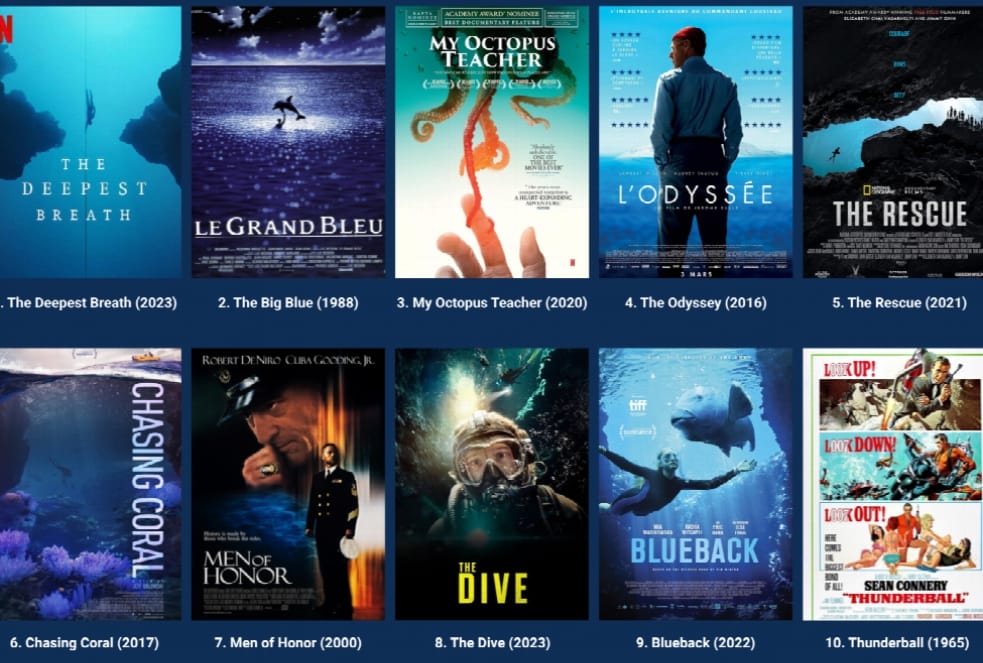
Long before someone straps on a tank for the first time, chances are they’ve already seen the ocean through a screen. Movies for divers cover a wide range of ground, from documentaries about record-breaking freedivers to dramas built around shipwrecks and cave rescues.
Some lean toward hard science and conservation, while others are closer to pure entertainment with the ocean as a backdrop. This list brings together ten films worth knowing, whether the goal is inspiration, education, or simply a good excuse to stay in on a rainy evening.
What Makes a Film Worth Watching for Divers
The strongest movies for divers tend to do one of two things well: they either capture what being underwater actually feels like, or they use the ocean as a backdrop for a story about risk, curiosity, or human limits. Some rely on real footage shot on location, while others depend on studio work and practical effects to fake the sensation of depth and pressure.
Many viewers who finish one of these films end up looking into padi dive courses shortly after, curious to experience some version of what they just watched on screen.
Documentaries Versus Dramatized Stories
Roughly half of this list is made up of documentaries, while the rest are dramas or fiction loosely inspired by real events. Documentaries tend to prioritize accuracy and firsthand footage, which can make them feel slower but more grounded. Dramatized films take more creative liberty, often compressing timelines or exaggerating danger for pacing, which makes them easier to watch in one sitting but less reliable as a factual reference.
This mix also means the list works for different moods. A documentary night might suit someone trying to learn something specific about ocean ecosystems or diving history, while a dramatized film is often the easier pick after a long day when the goal is simply to be entertained without much mental effort involved.
1. The Deepest Breath (2023)
This documentary follows freediver Alessia Zecchini and her safety diver Stephen Keenan, tracing the space between ambition and risk in competitive freediving. It’s a tense watch, built around real footage rather than dramatization, and it doesn’t shy away from how quickly things can go wrong at depth. Viewers unfamiliar with freediving as a sport will likely come away with a clearer sense of what separates it from recreational scuba.
2. The Big Blue (1988)
A drama centered on the rivalry between two freedivers pushing each other toward deeper limits. The underwater cinematography holds up decades later, even if the pacing feels distinctly of its era. It’s less concerned with technical accuracy than with the psychological pull that draws certain divers back into deeper water again and again.
3. My Octopus Teacher (2020)
An Academy Award-winning documentary following filmmaker Craig Foster’s year spent visiting the same octopus in a South African kelp forest. It’s quieter than most entries on this list, focused more on observation than adventure, and it works well as a case study in what patient, repeated diving in a single location can reveal.
4. The Odyssey (2016)
A biographical drama tracing Jacques Cousteau’s life, from early exploration to his later shift toward ocean conservation. It works as a useful primer on how modern diving culture took shape, particularly for viewers who only know Cousteau’s name without much context around his actual career.
5. The Rescue (2021)
This National Geographic documentary reconstructs the 2018 operation to rescue twelve boys and their coach from a flooded cave in Thailand. The cave diving sequences are as technical as they are tense, and the film spends real time explaining why cave diving is considered far riskier than open-water diving.
6. Chasing Coral (2017)
A documentary focused on coral bleaching and its causes, told through the lens of divers and photographers documenting reef systems over time. It leans more educational than most films on this list, using time-lapse footage to show environmental change that would otherwise be difficult to observe firsthand.
7. Men of Honor (2000)
A biographical drama about Carl Brashear, who became the first African-American Master Diver in the U.S. Navy. The story centers on training and persistence more than underwater spectacle, spending more time on the physical and institutional barriers Brashear faced than on the diving itself.
8. The Dive (2023)
A scuba thriller following two sisters whose routine dive turns into an emergency when one becomes trapped underwater. It’s tighter in scope than most entries here, playing out almost entirely underwater, which makes it feel more claustrophobic than the documentaries on this list.
9. Blueback (2022)
An Australian drama about a young freediver who befriends a giant grouper, which eventually draws her into reef conservation work. It balances a personal story with a broader environmental thread, moving between the diver’s childhood and her adult life without losing track of either.
10. Thunderball (1965)
A James Bond film built around an underwater plot involving stolen warheads in the Caribbean. It’s included here less for realism and more as an early example of diving reaching mainstream audiences, at a time when scuba equipment was still unfamiliar to most moviegoers.
What These Stories Reveal About Ocean Awareness
Several of these films have had a measurable effect on how audiences think about the ocean. Chasing Coral and My Octopus Teacher, for instance, are often credited with pushing coral bleaching and marine biodiversity into conversations that previously stayed within scientific circles. Documentary footage tends to carry a different weight than statistics alone, since watching a reef change over time or observing an animal up close makes the subject harder to ignore.
Rather than simply warning against risk, these films let the danger speak for itself through pacing and firsthand accounts, leaving the audience to draw their own conclusions about ocean conservation and responsible diving. For some viewers, that inspiration extends beyond the screen, encouraging them to explore marine environments firsthand through PADI dive courses, many of which include education on reef conservation, buoyancy control, responsible diving practices, and protecting underwater ecosystems while visiting dive sites.
Wrapping Up
Taken together, these ten films cover a wide stretch of what draws people to the ocean in the first place, whether that’s competition, conservation, or plain curiosity. None of them require a diving background to enjoy, though those who already spend time underwater will likely notice details that casual viewers miss, from equipment choices to how depth and pressure are portrayed on screen.
For everyone else, they’re a reasonable starting point before deciding whether the real thing is worth trying. Watching a handful of these back to back tends to make the appeal, and the risk, a bit easier to understand than reading about diving secondhand.