



Running a restaurant has never been simple. A single operational mistake can lead to negative reviews, lost customers, and declining revenue.
Today’s customers expect convenience. They want quick ordering, personalized offers, easy reservations, real-time order tracking, and multiple payment options. Restaurants that fail to meet these expectations often lose business to competitors that offer a more seamless digital experience.
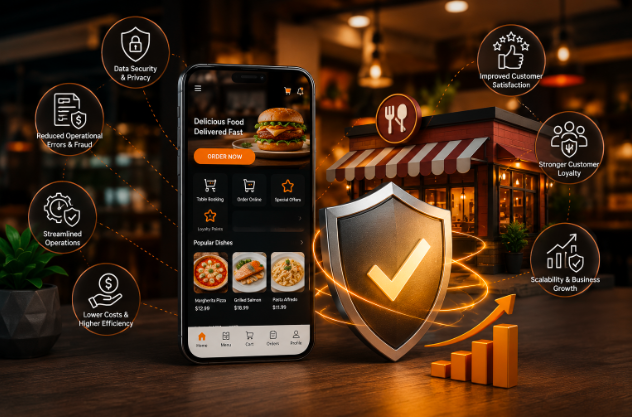
This is where a custom restaurant app becomes more than just a customer-facing platform. It acts as a business management solution that reduces operational risks while improving efficiency across multiple departments. Unlike generic ordering platforms, a custom application is designed around the specific workflow, business model, and customer needs of a restaurant.
Let’s explore the major business risks restaurants face today and how a custom restaurant app helps minimize them.
Rising Operational Challenges in Modern Restaurants
Restaurant businesses operate in a highly competitive environment where every minute counts. Whether it’s managing dine-in customers during peak hours or handling hundreds of online orders, operational inefficiencies can quickly affect profitability.
Businesses investing in restaurant mobile app development gain complete control over their operations instead of relying entirely on third-party platforms. A customized application integrates ordering, reservations, kitchen management, payments, and customer engagement into one centralized ecosystem.
With better visibility into daily operations, restaurant owners can proactively solve issues before they become expensive problems.
Risk 1: Losing Customers Due to Poor Ordering Experience
A complicated ordering process often leads customers to abandon their purchase before checkout. Long loading times, confusing navigation, or unavailable payment methods can significantly reduce conversion rates.
A custom restaurant app minimizes these risks by offering:
- Simple user interface
- One-click reordering
- Saved customer preferences
- Secure payment gateways
- Real-time order tracking
- Multiple payment options
- Personalized recommendations
The easier it becomes for customers to place an order, the higher the likelihood they will return.
Risk 2: Dependence on Third-Party Delivery Platforms
Food delivery aggregators help restaurants reach larger audiences, but excessive dependence comes with several drawbacks:
- High commission fees
- Limited customer ownership
- Restricted branding opportunities
- Minimal access to customer data
- Competitive listings alongside rival restaurants
Restaurants using their own application gradually reduce dependency on external platforms. Customers ordering directly through the restaurant enjoy exclusive offers, loyalty rewards, and better service, while the business retains valuable customer insights.
This creates long-term customer relationships instead of temporary transactions.
Risk 3: Inventory Mismanagement
Inventory errors can be extremely expensive. Running out of ingredients results in canceled orders, while overstocking increases food waste and storage costs.
Manual inventory management often leads to inaccurate stock counts and delayed purchasing decisions.
Custom restaurant apps integrated with inventory management systems help businesses:
- Monitor stock levels in real time
- Receive low-stock alerts
- Forecast demand
- Reduce food wastage
- Improve purchasing accuracy
- Track ingredient consumption
Better inventory visibility directly improves profitability while reducing operational losses.
Risk 4: Human Errors in Order Processing
Manual order taking often causes mistakes, such as:
- Incorrect dishes
- Missing add-ons
- Wrong customer information
- Duplicate orders
- Billing inaccuracies
Digital ordering significantly reduces these errors by allowing customers to place orders themselves while automatically transmitting details to the kitchen.
Businesses researching how to create a restaurant app often prioritize automated order management because it minimizes communication gaps between customers, staff, and kitchen teams.
The result is faster service and higher customer satisfaction.
Risk 5: Poor Customer Retention
Acquiring new customers is significantly more expensive than retaining existing ones. Without customer engagement strategies, restaurants struggle to encourage repeat visits.
A custom app enables:
- Loyalty programs
- Personalized discounts
- Birthday rewards
- Push notifications
- Referral programs
- Exclusive member offers
Using customer purchase history, restaurants can create highly personalized campaigns that encourage repeat business while strengthening brand loyalty.
Risk 6: Inefficient Table Reservation Management
Restaurants that rely on phone calls or manual reservation books frequently experience:
- Double bookings
- Missed reservations
- Long waiting times
- Customer frustration
A digital reservation system simplifies the entire process.
Customers can:
- View available tables
- Reserve instantly
- Modify bookings
- Receive confirmations
- Get reminder notifications
Restaurant managers also gain complete visibility into seating availability, helping optimize occupancy and reduce idle tables.
Risk 7: Lack of Customer Insights
Many restaurants make business decisions based on assumptions instead of data.
Without customer analytics, businesses cannot identify:
- Popular menu items
- Peak ordering hours
- Customer preferences
- Seasonal demand
- High-value customers
Custom restaurant apps generate valuable reports that support informed decision-making.
Business owners can monitor:
| Analytics | Business Benefit |
| Customer demographics | Better targeting |
| Purchase history | Personalized promotions |
| Average order value | Revenue optimization |
| Repeat customer rate | Loyalty improvement |
| Best-selling dishes | Menu optimization |
| Sales trends | Better forecasting |
Data-driven decisions reduce uncertainty while improving profitability.
Risk 8: Slow Kitchen Operations
Kitchen delays affect customer satisfaction more than almost any other factor.
Without synchronized communication, kitchens experience:
- Order confusion
- Preparation delays
- Missed delivery times
- Duplicate preparation
Custom restaurant applications integrate directly with Kitchen Display Systems (KDS), ensuring every order reaches the appropriate station instantly.
Benefits include:
- Faster preparation
- Improved workflow
- Better staff coordination
- Reduced waiting time
- Higher order accuracy
This creates a smoother experience for both staff and customers.
Risk 9: Security and Payment Fraud
Handling online payments requires strong security measures. Customers expect secure transactions and protection of personal information.
Custom restaurant apps include:
- Encrypted payment gateways
- Secure authentication
- OTP verification
- PCI-compliant payment processing
- Fraud detection systems
- Role-based admin access
Protecting customer data builds trust while minimizing financial and legal risks.
Risk 10: Poor Delivery Management
Late deliveries negatively impact customer satisfaction and online reviews.
Restaurants often struggle with:
- Driver coordination
- Route planning
- Order tracking
- Delivery communication
Custom apps improve delivery efficiency by providing:
- GPS tracking
- Route optimization
- Driver assignment
- Delivery status updates
- Estimated arrival times
- Customer notifications
Customers remain informed throughout the delivery journey, reducing complaints and support requests.
Essential Features That Help Reduce Business Risks
A successful restaurant application combines customer convenience with operational efficiency.
Some of the most valuable features include:
- User registration and profiles
- Smart menu management
- Digital ordering
- Contactless payment
- Table reservations
- Real-time order tracking
- Loyalty programs
- Push notifications
- Customer reviews
- Inventory integration
- Kitchen Display System integration
- Delivery management
- AI-powered recommendations
- Analytics dashboard
- Staff management
- Multi-location support
- Admin dashboard
- CRM integration
- Secure payment gateway
- Marketing automation
Each feature addresses a specific business challenge while contributing to overall operational stability.
Future-Proofing Restaurant Businesses Through Technology
Consumer expectations continue to evolve rapidly. Restaurants that embrace digital transformation are better equipped to adapt to changing customer behavior, industry trends, and competitive pressures.
Emerging technologies such as artificial intelligence, predictive analytics, voice ordering, personalized recommendations, contactless dining, and smart automation are becoming standard rather than optional. A custom restaurant app provides the flexibility to integrate these innovations as the business grows.
Instead of constantly investing in disconnected software solutions, restaurant owners can build a scalable digital ecosystem that supports long-term expansion. Whether opening additional locations, launching cloud kitchens, or introducing subscription meal plans, a custom application can evolve alongside business goals.
By investing in future-ready technology today, restaurants reduce operational uncertainty while positioning themselves for sustainable growth in an increasingly digital marketplace.
Conclusion
Every restaurant faces risks, from operational inefficiencies and inventory losses to declining customer retention and increasing competition. While these challenges cannot be eliminated, they can be significantly reduced through the right technology.
A custom restaurant app goes far beyond online ordering. It streamlines workflows, improves communication, secures customer data, enhances delivery operations, strengthens loyalty, and provides actionable business insights. Most importantly, it gives restaurant owners greater control over their operations instead of relying heavily on third-party platforms.
As customer expectations continue to rise, investing in a tailored restaurant application is no longer just a competitive advantage. It has become a practical strategy for reducing business risks, improving operational efficiency, and building a stronger foundation for long-term success.