



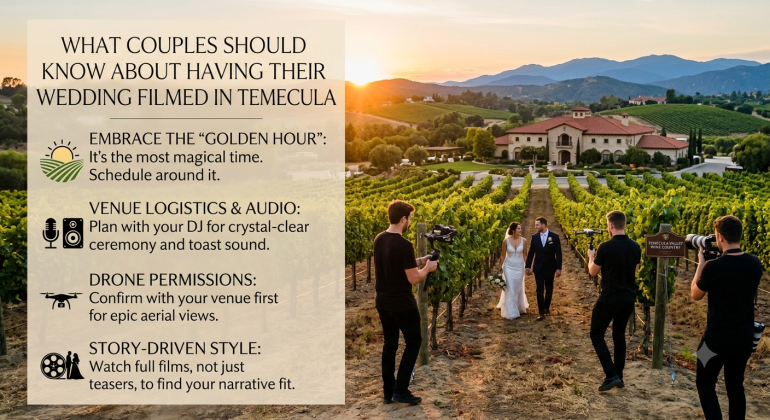
Temecula has become one of Southern California’s most distinctive wedding destinations. With vineyards, open landscapes, winery estates, rolling hills, and warm evening light, the area gives couples a setting that already feels cinematic before a camera is even turned on.
But having a wedding filmed in Temecula is not simply about showing up at a beautiful winery and pressing record.
The location creates its own opportunities and challenges. Light changes quickly, outdoor ceremonies can be affected by wind, receptions may move between indoor and outdoor spaces, and some of the best moments happen during a relatively short period around sunset.
For couples who care about how their wedding will look and feel on film, a little planning can make a significant difference.
The Wedding Timeline Matters More Than You May Think
One of the first things couples should understand is that the wedding timeline has a direct effect on the final film.
Temecula weddings often include several visually different parts of the day: getting ready, an outdoor ceremony, vineyard portraits, cocktail hour, sunset, dinner, speeches, and dancing.
If the timeline becomes too compressed, there may be very little opportunity to capture the environment that made you choose Temecula in the first place.
For example, scheduling the ceremony too close to sunset can leave almost no time afterward for couple portraits in the vineyards. On the other hand, scheduling everything too early may mean the portraits take place under much stronger midday sunlight.
A good wedding timeline should leave some flexibility.
Even twenty or thirty minutes of open time can allow a filmmaker and photographer to work with better light instead of rushing from one scheduled event to another.
Temecula Sunlight Can Be Beautiful and Difficult
One of the reasons Temecula looks so good on camera is also one of the reasons it can be challenging to film.
There is often a great deal of open sunlight.
During the middle of the day, the light can be strong, especially at outdoor ceremony sites with limited shade. Bright sunlight may create deep shadows on faces, and couples can find themselves squinting when facing directly toward the sun.
Later in the afternoon, the character of the light changes considerably.
The vineyards become warmer, skin tones often look softer, and the landscape can take on the golden appearance associated with Southern California wine country.
This is why the position of the sun should be considered when planning both the ceremony and portrait session.
When possible, it helps to work with a photographer and a wedding videographer in Temecula who understands how winery locations change throughout the day and can adapt to different lighting conditions.
Do Not Overlook Audio During an Outdoor Ceremony
Beautiful images are only part of a wedding film.
For many couples, the most meaningful part of the finished film is the audio: the vows, speeches, laughter, reactions, and words spoken by family and friends.
Outdoor ceremonies in Temecula can introduce challenges that couples may not notice in the moment.
Wind is one of the biggest.
Even a light breeze can become distracting when recorded directly by a camera microphone. A nearby road, venue equipment, guests moving in their seats, or a sound system can also affect the recording.
This is why professional wedding filmmakers usually rely on more than one audio source.
The groom, officiant, or other participants may be individually miked, while another recorder captures audio from the venue’s sound system. Having multiple sources provides protection in case one recording is affected by wind, interference, or equipment problems.
Couples usually do not need to manage these technical details themselves, but it is worth understanding why audio preparation matters.
A beautiful ceremony becomes far more meaningful years later when you can clearly hear the words that were spoken.
Think About Where You Get Ready
Getting-ready locations can have a surprisingly large impact on the beginning of a wedding film.
Some Temecula venues have spacious bridal suites with large windows and clean backgrounds. Others have smaller rooms with limited natural light.
If you have a choice between several getting-ready locations, consider not only convenience but also the visual environment.
A room with natural window light can create a completely different feeling from a dark room illuminated primarily by ceiling fixtures.
Keeping the space relatively uncluttered also helps.
Water bottles, shopping bags, luggage, food containers, and clothing often accumulate during the morning. Removing some of those items before the photographer and filmmaker begin shooting can make the environment look much cleaner without changing anything about the actual wedding.
Leave Time to Capture the Venue
When couples choose a winery wedding, the venue itself is usually an important part of the experience.
It is worth allowing your filmmaker enough time to capture it.
Wide shots of the vineyards, ceremony setup, reception tables, floral arrangements, signage, and surrounding landscape help establish where the wedding took place.
These shots may seem less important than footage of people while the wedding is happening, but they become valuable when the film is edited together.
They provide context.
Without them, a wedding film can become a series of close-up moments without a strong sense of location.
Temecula is visually recognizable, and using those environmental shots helps the finished film feel connected to wine country rather than to a generic wedding venue.
Sunset Is Valuable, But You Do Not Need an Hour of Portraits
Couples sometimes worry that photography and video will take them away from their guests for too long.
That does not necessarily need to happen.
A short portrait session during the best light can often produce better results than a much longer session at the wrong time of day.
For many Temecula weddings, ten to twenty minutes around sunset can be extremely productive.
The goal is not to turn the wedding into a film production.
A wedding filmmaker should be able to work efficiently, capture a few strong movements and natural interactions, and then allow the couple to return to the celebration.
The wedding itself should remain the priority.
Consider How Your Reception Will Be Lit
Once the sun goes down, the lighting situation changes completely.
Some Temecula venues have excellent decorative lighting, while others rely heavily on string lights, candles, or dim ambient fixtures.
Those elements may look beautiful to the human eye but may not always provide enough light for cameras.
Professional filmmakers often bring their own lighting for important reception events such as speeches, first dances, parent dances, and the dance floor.
The goal should not be to make the reception look like a television studio. Good lighting should support the atmosphere that already exists while giving the cameras enough light to produce clean footage.
If you prefer a very dark or candlelit reception, it can be helpful to tell your filmmaker in advance so the lighting approach can be planned around your aesthetic.
Real Moments Usually Matter More Than Perfect Poses
Temecula provides plenty of beautiful backgrounds, but a wedding film should not become only a collection of vineyard portraits.
The most valuable footage is often unpredictable.
It might be a parent seeing the bride for the first time, a nervous laugh during the vows, friends reacting during a speech, or a quiet moment between the couple after the ceremony.
Those moments cannot be staged in the same way.
Couples who want a natural wedding film should give themselves permission to experience the day rather than constantly thinking about the camera.
A filmmaker can guide you when needed, especially during portraits, but much of the strongest footage comes from observing what is already happening.
Tell Your Filmmaker What Matters Most to You
Every couple value different part of the wedding.
Some care deeply about the ceremony and vows. Others want more time spent documenting family members, reception energy, cultural traditions, or the landscape of the venue.
Before the wedding, it helps to communicate those priorities.
If a family member is especially important, mention it.
If there is a tradition that will happen quickly, explain when and where it will take place.
If you dislike heavily posed footage and prefer documentary coverage, say so.
Your filmmaker does not need a list of every possible shot, but understanding what matters most allows the coverage to reflect your priorities rather than treating every wedding the same.
Temecula Gives Wedding Films a Natural Sense of Progression
One of the strongest qualities of a Temecula wedding is how much the environment changes throughout the day.
The morning may begin indoors with quiet getting-ready footage. The ceremony opens to bright vineyards and large landscapes. The light becomes warmer during portraits. Then the reception transforms the venue with candles, string lights, speeches, music, and dancing.
That progression naturally gives a wedding film different mood.
When documented thoughtfully, the final film can move from calm anticipation to ceremony, celebration, sunset, and an energetic evening without forcing the story.
The location helps create that structure.
The Best Approach Is to Plan Enough and Then Enjoy the Wedding
Couples do not need to understand camera settings, microphones, lenses, or lighting equipment to have a beautiful wedding film.
What helps most is thoughtful preparation.
Build a realistic timeline. Leave a little room for portraits. Think about the ceremony position and sunset. Choose a pleasant getting-ready space when possible. Communicate important people and moments to your filmmaking team.
Then, once the wedding begins, enjoy it.
Temecula already provides many of the ingredients that make wedding films visually compelling: vineyards, open landscapes, changing light, outdoor ceremonies, intimate evenings, and energetic receptions.
A filmmaker’s job is to recognize those elements, anticipate what is happening, and preserve the experience without turning the wedding into a production.
When the planning and filmmaking approach work together, the finished film can capture not only what the wedding looked like, but what it felt like to be there.