


Watch any film set for ten minutes and you will notice something odd: people keep writing things down. Cameras worth more than a car change hands a dozen times a day, and every single handoff gets logged. It looks bureaucratic until you learn why. A mid-size production can easily run a hundred thousand dollars of equipment through a single location in one day, and the difference between a smooth shoot and a catastrophe is usually not talent — it is whether the gear list matched reality at the end of the night.
The problem film crews solved decades ago
Productions learned the hard way that memory is not an inventory system. In the chaos of a location shoot — vans unloading in the dark, assistants repositioning every twenty minutes, a dozen departments sharing the same table space — nobody can hold the full picture in their head. So the industry built a habit: every item is named, every movement is logged, and the count is reconciled before anyone goes home. Missing a single prop or lens can halt a shoot that costs thousands of dollars per hour, so the discipline is not perfectionism. It is simple economics.
Three rules that transfer to any shared equipment
The good news is that these rules cost nothing. Any group that shares gear — a theatre company, a church AV team, a sports club, a community workshop — can copy them directly from film sets.
Rule 1: name everything before it matters
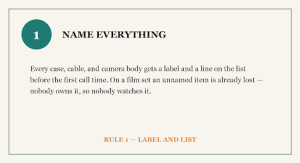
On a shoot, every case gets a label and every labelled case appears on the list before the first call time. The principle: an unnamed item is already lost, because nobody owns it and therefore nobody is watching it. Shared equipment inventories fail in exactly the same way. The projector nobody claimed is the projector nobody missed until the weekend it was needed.
Rule 2: log the handoff, not the intention
Film crews track the moment gear physically changes hands — out of the case with a name attached, back in with a checkmark. What kills informal systems is tracking intentions instead: someone says they will bring the tripod back Tuesday, and the list never hears about it again. The log has to capture reality, not promises.
Rule 3: count at wrap, every time
Wrap is not wrap until the count matches the morning list. Ten minutes at the end of the day catches every missing item while it is still ten minutes from home instead of a week gone. Film sets do this even when everyone is exhausted because the cost of a skipped count is always higher than the cost of the count.

The tooling is simpler than you think
Productions graduate from paper lists to digital checkouts as soon as the budget allows, because manual logs collapse at exactly the moment a company grows. The same is true one level down: community groups that track gear on a shared spreadsheet eventually hit the day when two people trusted the same row. Modern options range from QR-coded cases to simple web-based checkouts — a shared gear log that tracks every item — the point is never the software. The point is that the list and reality are the same thing at the end of every day, which is the one habit that separates crews who wrap clean from groups that keep replacing things they already own.
The bottom line
Film crews did not invent gear discipline because they are careful people. They invented it because losing equipment is expensive and chaos is the default state of any shared project. Name everything, log every handoff, count at the end of the day. Any team that copies those three rules will get the quiet superpower every production runs on: knowing exactly what they have, all the time.