



In the world of ecommerce, it’s been such an assumption that a person walks into a store, looks for a product, compares, puts something in their cart, and finishes checkout.
That notion is beginning to be modified.
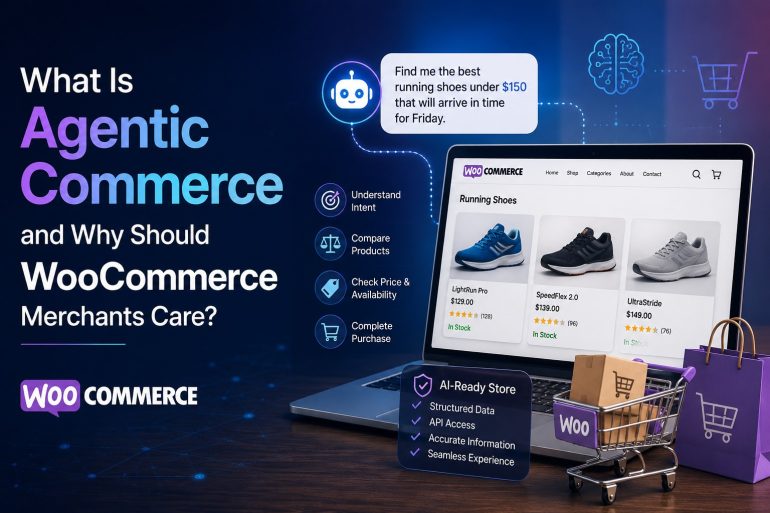
The next generation of ecommerce might not start with a consumer opening their browser, as AI agents are now able to comprehend intent, compare products, analyze prices and act on their behalf. It could start with a query to an AI helper “Find me the best running shoes under $150 that will arrive in time for Friday.”
Research is done by the agent. It evaluates products. It can make comparisons between merchants, check the availability, factor in delivery times, and ultimately start the buying process.
It’s a new model that’s currently developing, and it might be the way WooCommerce merchants look at storefronts, product data, APIs, checkout experiences, and WooCommerce development.
What Is Agentic Commerce?
Agentic commerce is a type of ecommerce where an AI agent is used to do part or all of a consumer’s shopping process.
Human effort is a key component of traditional ecommerce. The customer finds a product, follows the site and reads descriptions, makes a comparison, and makes a purchase.
Agentic commerce involves the addition of an intelligent agent in between the customer and the merchant.
Instead of asking:
“When I think about it, I don’t know how to get customers through my store.”
In recent years it has become a question businesses are having to ask themselves:
“Is it simple for an AI agent to comprehend, assess, and buy the items my store has to offer?”
It is significant.
An AI agent may also be able to truly understand the intent behind a customer’s request, not just the key words. It can be aware of the customer’s needs, including budget, specifications, preferences, delivery limitations, and past purchasing habits, before choosing a product.
The ecommerce interface thus begins to shift from pages and clicks to intent and actions.
Why Should WooCommerce Merchants Care?
As competition increases, working with an experienced ecommerce ppc agency can also help merchants connect paid advertising strategies with their broader ecommerce goals.
The flexibility of WooCommerce has been one of its advantages throughout the years. Merchants can architect product structures, incorporate third party systems, enhance checkout, create custom workflows and link their stores to nearly any technology stack.
That flexibility is especially useful in an agentic commerce world.
Access to accurate information is vital for AI agents. They should be made aware of the meaning of a product, whether or not it is available, its cost, the timetable for delivery, its variants and whether it may be bought or not.
That foundation can’t be built on a pretty storefront.
Commerce infrastructure that is machine-readable, API accessible, structured and able to support automated interactions will become a necessity more and more for WooCommerce merchants.
This is where the WooCommerce developers’ expertise comes in handy.
The Storefront Is No Longer the Entire Experience
Ecommerce optimization used to be very top-of-the-funnel and tail-of-the-funnel focused.
Vendors paid to be quicker, easier to navigate, better photos of their products, catchier copy, and better checkout procedures.
All the things still count. Agentic commerce adds another dimension, machine experience.
An AI agent can never touch a product page the same way that a human shopper will. Rather, it could be ingested via an API, feed, database or another machine-readable interface.
Suppose there is a customer who wants a laptop.
It can take a human 20 minutes to look at product pages.
Instead, an AI agent can compare dozens of products according to:
- Price and discounts
- Technical specifications
- Stock availability
- Delivery estimates
- Warranty information
- Customer requirements
- Merchant policies
Even if another retailer’s website is more aesthetically appealing, the merchant with more understandable, accurate and machine-readable data could benefit.
That makes it a new optimization task for ecommerce brands.
WooCommerce Development Must Evolve Beyond the Frontend
Agentic commerce isn’t about giving up traditional ecommerce development. It involves broadening the concept of “good development”.
If the WooCommerce implementation is to be ready for the future, it will likely need to integrate with a larger commerce system consisting of product information, inventory, pricing, customer data, payment systems, fulfillment and external AI interfaces.
This makes APIs more and more vital.
The right WooCommerce architecture can share pertinent commerce data to trusted systems, while simultaneously maintaining the necessary controls for authentication, permissions, customer data and transactions.
This, for WooCommerce developers, changes the discussion from just a building of features to creating an ecosystem that can communicate reliably.
The objective is not to allow all AI systems to have access to all parts of a store.
The aim is to get the right information on commerce in the right manner.
Product Data Could Become a Competitive Advantage
The agentic commerce also affects the way merchants should consider product content.
A product description that is written from a human perspective may not be sufficient for an AI agent.
In the case of a “premium waterproof hiking jacket,” it is a simple marketing message.
However, much more structured information might be required by an agent:
| Water resistance: 20,000 mm
Material: Recycled polyester Insulation: Synthetic Temperature rating: -10°C Available sizes: S–XXL Shipping: 2–4 business days Return window: 30 days |
The more rugged the data is, the easier it is for the intelligent systems to decide if the product meets the customer’s needs.
That’s why product information architecture is growing to be as crucial as product page design.
Trust Will Become Even More Important
Merchants can’t afford to overlook the other side of agentic commerce, one that involves trust.
The suggestion and buying power that can be given to an AI agent brings in new issues of authorization, security, payment, privacy, refunds and accountability.
It is not acceptable for an agent to make an unlimited number of buying choices based on an API.
Commerce platforms must have explicit access controls and protections on viewing, recommending, adding to cart, buying and editing products.
This is why it’s all the more critical to have a WooCommerce business that is secure.
Authentication, API permissions, transaction validation, fraud prevention, and secure payments integrations are not just technical matters. They become a facet of the customer’s experience once the software agents start to act on behalf of the customers.
What Should WooCommerce Merchants Do Now?
It doesn’t always require merchants to start building stores using AI today.
Rather, they need to begin by rationalizing and making their current commerce systems more flexible and adaptable.
That involves checking for variations in product information across those systems, checking the availability of reliable APIs that can access important commerce data, checking for inventory and pricing synchronizations, and checking the checkout architecture for future integration.
Alongside technical improvements, businesses can also use ecommerce ppc services to drive qualified traffic while their store infrastructure becomes more adaptable.
Technical infrastructure is also a key aspect of the store to consider.
With tightly coupled plugins, duplicated data, fragile customizations, and undocumented integrations, a WooCommerce website could become hard to extend as new avenues for commerce powered by artificial intelligence get launched.
A modular design offers a lot more space to grow.
That’s where, having experienced WooCommerce developers, can make a difference. The goal is not just to introduce an “AI feature.” It is to construct trade facilities that are versatile to the changing nature of customer discovery and buying.
The Bigger Shift: From Search to Intent
One of the biggest change agents of commerce brought by ecommerce is the shift from search driven commerce to intent driven commerce.
A person shopping today could type in:
“best ergonomic office chair under $500”.
Tomorrow, they just might say to an AI agent:
“I work 8 hours per day, have a problem with my lower back and need an ergonomic chair for under $500 that can be delivered this week.”
It is quite a difference.
The agent isn’t merely finding pages containing relevant keywords. It’s trying to get an understanding of what the customer wants to do and what action will accomplish the goal.
For WooCommerce eCommerce retailers, this could ultimately end up being more than just a conventional search result.
Merchants will have to make their merchandise comprehensible for machines, their commerce system accessible via dependable interfaces, and their purchasing system ready for new types of automatic interaction.
The Future of WooCommerce Is More Than a Storefront
Agentic commerce is still developing and it remains unclear how fast consumer adoption will be.
However, the overall trend can’t be denied.
Commerce is becoming more connected, automated, API-driven, and intelligent. While the storefront will stay relevant, it could be just one of many touchpoints in an extensive commerce experience.
That doesn’t just present a challenge for WooCommerce merchants; it’s a chance.
The platform’s extensibility enables companies to test, connect, and create tailored commerce experiences. The merchants who begin to treat their WooCommerce store as a commerce infrastructure rather than a website will be better prepared for what is to come.
Agentic commerce might eventually revolutionize the way customers are guided to products, view choices, and finalize purchases.
Not every brand out there that is ready for the transition will be the most complex with its AI approach.
They will have clean data, flexible architecture, secure integrations, reliable APIs and a WooCommerce foundation that is designed to grow.