



A Certificate of Analysis (COA) is a formal laboratory document that confirms a product’s identity, purity, and composition for one specific production batch. In research peptide supply, pharmaceutical manufacturing, and health product sourcing, it is the primary quality verification tool a buyer uses before purchasing. This guide explains what a COA contains, how to read each section correctly, and walks through three real examples from independently verified peptide COAs.
What Is a Certificate of Analysis?
A Certificate of Analysis is issued by a laboratory after testing a specific batch of a product. It summarizes the analytical results for that batch and confirms whether the product meets its stated quality specifications.
COAs appear across industries including pharmaceutical manufacturing, food safety, dietary supplements, and research compound supply. In the context of research peptides, a COA is the only independent verification tool that gives a buyer evidence that what is in the vial matches what is on the label.
One important distinction is that a COA is batch-specific. It documents one production lot at one point in time, not the product in general. A COA dated eighteen months ago does not verify the quality of a batch received today.
What Does a Complete COA Contain?
A complete research-grade COA has two main parts: the header and the analytical results.
The header confirms the product name, batch or lot number, client name, testing dates, and the issuing laboratory’s details. These fields establish traceability and link the document to a specific physical batch. If any of these fields are missing, the document cannot be independently verified.
The analytical results section is the core. It lists each test performed, the specification the product must meet, and the actual result from testing. For research peptides, two tests are non-negotiable.
HPLC Purity
High-performance liquid chromatography (HPLC) measures how much of the sample is the target compound versus impurities. The result is expressed as a percentage. Research-grade peptides typically show purity at 95% or above, with stronger batches reaching 98 to 99%. The COA should include the actual chromatogram, a graph showing separation peaks, rather than just a typed number. A percentage without the graph behind it is significantly less verifiable.
Mass Spectrometry Identity
Mass spectrometry (MS) confirms what the compound actually is by measuring its molecular weight. HPLC alone cannot confirm identity. A peptide missing one amino acid can appear 99% pure on HPLC while being entirely the wrong sequence. MS closes that gap. On a COA, MS results appear as observed versus expected molecular weight. The values must match within a very small margin, typically less than 0.1 Da for smaller peptides.
How to Read a Real COA: Three Verified Examples
The fastest way to understand a COA is to read real ones. The following three examples come from publicly available third-party COAs issued to NuScience Peptides, a US-based supplier of research peptides that publishes its full COA archive openly before purchase. Two independent labs are represented across the three documents.
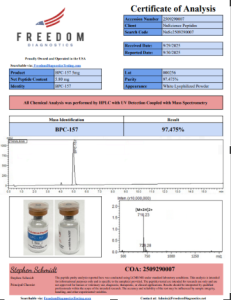
Example 1: BPC-157 5mg — Freedom Diagnostics
Accession number 2509290007. Client: NuScience Peptides. Product: BPC-157 5mg, Lot 000256. Sample received 29 September 2025, reported 30 September 2025.
Method: HPLC with UV Detection Coupled with Mass Spectrometry (LCMS/MS). Results: Net peptide content 5.80 mg. Purity 97.475%. Identity confirmed as BPC-157. Appearance: White Lyophilized Powder. The document is signed by Stephen Schmidt, Principal Chemist, and is searchable directly at FreedomDiagnosticsTesting.com using the accession number. This is the public verification path that makes the document independently confirmable without contacting the supplier.
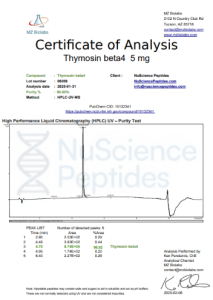
Example 2: Thymosin Beta-4 (TB-500) 5mg — MZ Biolabs
Issuing lab: MZ Biolabs, 2102 N Country Club Rd, Tucson, AZ. Client: NuScience Peptides. Lot 00269. Analysis date 31 January 2025, reported 6 February 2025.
Method: HPLC-UV-MS. HPLC purity: 98.92%. The peak list shows five detected peaks. The Thymosin beta4 compound elutes at 4.70 minutes and accounts for 98.92% of the total peak area. The remaining four minor peaks represent 1.19% combined, within acceptable limits. MS identity: expected monoisotopic mass 4960.48 Da, measured 4960.51 Da, a difference of 0.03 Da confirming the compound identity. The document is signed by Ken Pendarvis, ChE, Analytical Chemist at MZ Biolabs. The MZ Biolabs COA includes a note that injectable peptides may contain salts and sugars to aid solubility, which are not detected by UV and are not considered impurities.
Example 3: Ipamorelin/CJC-1295 No DAC Blend 5/5mg — Freedom Diagnostics
Accession number 2601210161. Client: NuScience Peptides. Lot 00256. Received 21 January 2026, reported 23 January 2026.
Method: LCMS/MS. Results: Net peptide content Ipamorelin 6.38 mg, CJC-1295 6.46 mg. Combined purity 99.847%, the strongest result across these three examples. Identity confirmed for both components. Appearance: White Lyophilized Powder. Signed by Stephen Schmidt, Principal Chemist. Searchable at FreedomDiagnosticsTesting.com using the accession number.
Across these three documents, two distinct independent labs are used, three different peptide compounds are covered, the oldest report is from early 2025 and the most recent from January 2026, and every document provides a direct public verification path. This is the documentation standard buyers should hold any research peptide supplier to.
What a COA Does Not Tell You
Every guide on this topic stops after explaining HPLC and MS. Two important limitations are consistently missed.
First, HPLC purity is not the same as net peptide content. HPLC measures the ratio of the target compound to other UV-absorbing compounds. It does not account for water, counter-ions such as acetate salts, or non-peptide mass in the vial. MZ Biolabs explicitly notes this on the TB-500 COA above: injectable peptides may contain salts and sugars that UV detection does not capture. A product showing 99% HPLC purity may contain only 70 to 85% actual peptide by weight when measured for net content.
Second, standard HPLC and MS testing cannot detect heavy metals, endotoxins, or microbial contamination. For in-vivo research, these require separate testing panels. A COA covering only HPLC and MS is complete for identity and purity but is not a full safety profile.
Readers who want to understand the underlying testing methodology in more depth can refer to this guide on peptide purity testing methods, which covers HPLC, mass spectrometry, and advanced contaminant screening in practical detail.
How to Confirm a COA Is Genuine
Fraudulent and recycled COAs are a documented problem in the research compound market. Three checks protect against this.
Confirm the batch ID on the COA matches the vial received. A legitimate supplier ties every shipment to a specific lot number. Then check that the COA was issued by a named, independent third-party laboratory rather than the supplier’s own internal lab. In-house COAs carry a conflict of interest because the vendor is grading its own product. Finally, if the COA includes a verification key, accession number, or verification URL, use it.
Understanding how to verify an individual COA is only part of evaluating a supplier. Looking at how best research peptide companies publish third-party testing, batch-specific COAs, and laboratory documentation can help researchers understand which verification practices are consistent across the industry and which vary between vendors.
Freedom Diagnostics COAs are searchable by accession number at freedomdiagnosticstesting.com. MZ Biolabs reports are verifiable through direct contact and their published lab address. A COA that cannot be independently verified at the issuing lab’s own website should be treated with caution regardless of how professional it looks.
How Long Is a COA Valid For?
A COA does not have a formal expiry date, but its relevance is strictly time-limited. It documents one specific batch at one point in time. It says nothing about what a future batch from the same supplier will contain, because synthesis conditions and source materials can vary between production runs.
For any product currently being sold, the COA should correspond to the batch currently being shipped. If a supplier lists COA dates more than 12 to 18 months old against active-catalog products, that is a signal to ask for current batch documentation before ordering. If they cannot provide it, that itself is a quality signal.
Conclusion
Reading a COA correctly means checking four things: the batch ID matches the vial, the HPLC result includes a chromatogram rather than just a number, mass spectrometry confirms the compound’s actual identity, and the issuing laboratory is independent rather than in-house. The three real examples above show what each of these elements looks like in practice across two independent labs and three different research peptides.
NuScience Peptides is a US-based research peptide supplier that publishes its full third-party COA archive, including batch-specific reports from Freedom Diagnostics and MZ Biolabs, on a publicly accessible lab results page. Its documentation practices serve as a practical reference for the verification standard the examples in this article are drawn from.
Frequently Asked Questions
What is the difference between an in-house COA and a third-party COA?
An in-house COA is issued by the manufacturer’s own laboratory. A third-party COA comes from an independent lab with no financial stake in the result. Third-party COAs are more reliable because they remove the conflict of interest involved when a supplier assesses the quality of its own product.
Can a certificate of analysis be faked?
Yes, and it does happen in the research compound market. The most reliable protection is entering the COA’s accession number or verification code directly on the issuing lab’s website. A document that has no publicly verifiable path at the lab should be treated with caution.
Is HPLC purity the same as net peptide content?
No. HPLC purity measures the ratio of the target compound to other UV-absorbing impurities. Net peptide content accounts for water, counter-ions, and non-peptide mass. A product can show 99% HPLC purity but contain only 70 to 85% actual peptide by weight. They measure different things and both numbers matter.
What does a certificate of analysis example look like?
A complete COA example includes: the issuing lab’s name and address, the client name, a unique lot or batch number, the testing date, HPLC purity with the chromatogram graph, mass spectrometry results showing observed versus expected molecular weight, and a verification path such as an accession number searchable on the lab’s website. The three Freedom Diagnostics and MZ Biolabs examples in this article demonstrate all of these elements across real batches.