



“Is this vendor legit?” sounds like a yes-or-no question. In practice, legitimacy is a stack of verifiable facts: the business exists, the policies are clear, the product documents match the batch, the laboratory can be identified and the company handles problems consistently.
A polished storefront can satisfy none of those conditions. A less polished site may satisfy most of them. The goal of a careful review is not to reward design or repeat testimonials. It is to turn a vague impression into a documented, repeatable check.
Legitimacy is a bundle, not a badge
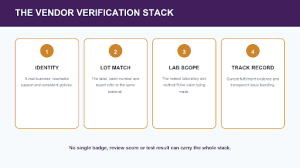
No single signal settles the question. A long operating history does not prove a current batch. A certificate of analysis does not verify shipping performance. A favorable review score does not establish identity or purity. A credit-card checkout can reduce payment friction without saying anything about the material itself.
The strongest conclusion comes from agreement across independent categories. Business identity, laboratory documentation, lot matching, clear policies and a current service record should point in the same direction.
1. Confirm who is operating the store
Start with the company information rather than the product claims. Look for a consistent business name, working support channels, terms, privacy language, shipping rules and a returns process. The details should agree across the site and checkout. Sudden changes in domain, payment recipient or support identity deserve an explanation.
Reachability matters more than the number of contact icons. A vendor that responds clearly to a specific documentation question provides a stronger signal than one offering only automated reassurance. Save the date of the check because ownership, policies and fulfillment practices can change.
2. Match the product, lot and report
A test report is useful only when it can be connected to the material being evaluated. The compound name, lot or batch identifier, report date and sample description should align with the label and listing. A generic report used across multiple lots cannot verify the current one.
Check whether the document names the testing laboratory and method. Image quality matters too: cropped screenshots, missing report pages and illegible identifiers make independent review difficult. A complete report should be readable enough for another person to repeat the same verification.
3. Read laboratory credentials narrowly
ISO/IEC 17025 is an international standard for the competence and consistent operation of testing and calibration laboratories. Accreditation is meaningful, but it is not a universal endorsement of every analysis a laboratory might perform. The relevant question is whether the laboratory’s accredited scope covers the method connected to the claim.
A named laboratory is more useful than a logo because its status and scope can be checked. Even then, laboratory competence does not turn a vendor into a pharmacy, approve an investigational compound or establish suitability for human use. It supports confidence in a defined test result.
4. Know what each test answers
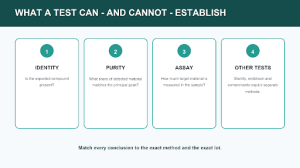
Identity, purity, assay, sterility, endotoxin and contaminant testing answer different questions. High chromatographic purity does not automatically establish the amount of material in a container. Identity testing does not establish sterility. One favorable result should never be presented as proof of everything else.
The language of the review should follow the scope of the test. “The report lists a 99 percent purity result for this lot” is narrower and more defensible than “the product is completely safe and accurate.” The second statement adds conclusions the first result did not measure.
5. Check whether policies work in practice
Read shipping, replacement and refund terms before relying on promotional claims. Note handling times, geographic limits, damaged-package procedures and the point at which the carrier becomes responsible. Then compare those policies with recent customer experiences, giving more weight to detailed reports than one-line praise or anger.
Complaints are not automatically disqualifying. The pattern and response matter. A vendor that acknowledges a delay, explains the correction and follows its published process may be more transparent than one with a suspiciously perfect review profile.
6. Separate evidence from incentives
Vendor reviews may earn commissions, accept sponsored placement or receive samples. Those relationships do not automatically invalidate the review, but they should be disclosed. A useful review explains its method, dates its checks, shows the limitations and avoids presenting a discount as proof of quality.
For readers building this habit, a maintained research-compound directory such as the one at https://peptidestack.io/ can be a starting inventory of compounds and vendor context. The important step is to follow the evidence trail yourself: business identity, lot-specific documents, laboratory scope, policies and current service history.
A practical vendor scorecard
- Business identity: Is the operator identifiable and reachable?
- Documentation: Does every report match the exact compound and lot?
- Laboratory: Is the lab named, and does the relevant method fall within its scope?
- Claims: Does the language stay within what the test actually established?
- Policies: Are shipping, replacement and refund terms visible before payment?
- Track record: Are recent experiences detailed, consistent and handled transparently?
- Disclosure: Does the reviewer explain compensation or commercial relationships?
Record each answer with a source and review date. A simple dated scorecard is more reliable than a permanent “approved” label because vendors, batches and policies change.
Red flags that deserve a pause
- One certificate is recycled across changing products or lots.
- The report omits the laboratory, method, sample identifier or readable date.
- Purity is used as a substitute for identity, measured content or sterility.
- Support will not answer a precise documentation question.
- Policies change at checkout or conflict across the site.
- Reviews repeat promotional wording without describing an actual transaction.
Freshness is part of verification
Vendor legitimacy is time-sensitive. A report that matched inventory six months ago may not describe the current lot. A reliable shipping policy may change after a warehouse move. Support quality can improve or deteriorate. Reviews should therefore distinguish the publication date from the most recent verification date and identify exactly which facts were rechecked.
A sensible review cycle starts with the highest-risk facts: business identity, payment recipient, lot documents, laboratory status and current fulfillment terms. Promotional codes and prices can be checked afterward. If a review cannot confirm a current claim, it should preserve the older evidence as history rather than silently presenting it as current.
The practical takeaway
A legitimate research vendor is not one with the loudest badge. It is one whose identity, documentation, testing claims, policies and track record can be checked independently and still agree. The most reliable review states what the evidence supports, what it does not support and when the facts were last confirmed.
That approach does not eliminate uncertainty. It makes uncertainty visible – which is exactly what a responsible research-product review should do.
This article is for research and educational purposes only. It does not provide medical advice or instructions for human or veterinary use.