



Patchwork has gained popularity among many people in customizing their clothes, uniforms, bags, caps, jackets, and other accessories. Though patches with prints can depict any artistic or photographic design, embroidered patches are still more desirable when it comes to creating durable and visually pleasing patches.
The distinction between both types does not only lie in the look. An embroidery patch is made using a raised technique where the design is stitched directly into the patch material. In order to understand this technique, it would be beneficial for everyone to learn about it.
Why Do Embroidered Patches Often Look More Premium Than Printed Designs?
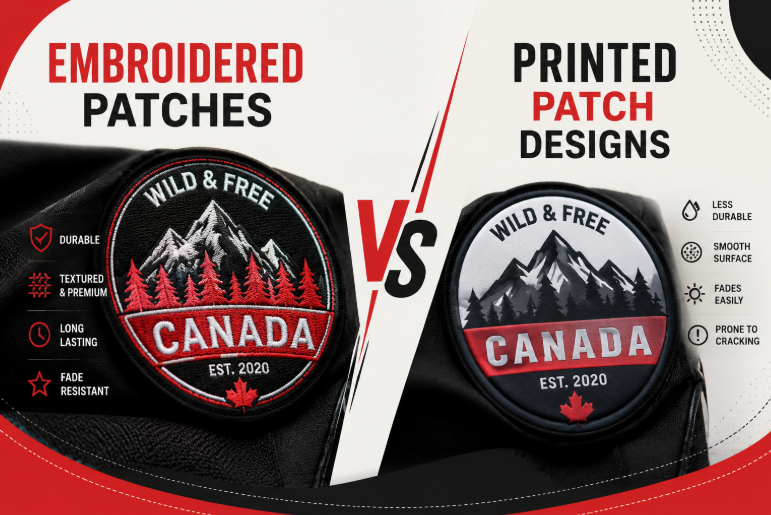
One of the most notable aspects of the dimensional texture of embroidery is its physical texture which consists of the raised stitches that are both visible and tangible.
Unlike an embroidered patch, printed patches tend to have a flat surface since the design is made using ink. While this may be an advantage in case of complex artworks, this method lacks the physical dimension aspect.
Additionally, the use of varied colors of the thread, direction and density of the stitches creates contrast within the design and lends a unique premium feel even in the simplest of designs.
How Does Embroidery Improve Patch Durability During Regular Use?
Durability is the key factor while choosing a patch.
The printed design may fade away, crack, and get worn out due to the repeated exposure to washing, sun rays, friction, and other environmental factors. This largely depends upon the quality of the printing process and materials used.
In case of an embroidered patch, it is made of threads that form part of the patch itself. The good quality embroidery will last while being handled and washed and will have the distinct structure of the embroidery.
Thus, embroidery is especially suited for the frequent use of clothes.
Why Does Thread Texture Make Embroidered Patches More Visually Distinctive?
The printed patch only shows an image, whereas the embroidery makes it happen physically by stitching.
This results in the ability to touch something that makes embroidered patches more eye-catching. The way light bounces off the threads will create different textures depending on how the patch is moved.
Also, the way stitches are oriented can help create contrast. Satin stitches will be used to write letters neatly, fill stitches to create large areas and borders to differentiate the design from the fabric.
With this, it is possible to show both texture and colour.
When Are Printed Patches More Suitable Than Embroidered Patches?
Patches produced through printing have some benefits and shouldn’t be perceived as being inferior to embroidered patches in all instances.
Very intricate artwork, which incorporates photography, gradient color changes, very small color shifts, or elaborate illustrations, can at times be better captured through printing. The surface created through printing can carry visual information which might be hard to create using embroidery stitches.
In cases when photographic accuracy is more critical than texture, printed patches can be a better choice.
Embroidered Patches vs Printed Patch Designs
| Feature | Embroidered Patches | Printed Patch Designs |
| Appearance | Raised, textured, and dimensional | Flat and smooth |
| Durability | Very durable when well-manufactured | May be subject to fading, cracking, and surface wear |
| Texture | Offers a stitched, tactile finish | Mainly offers a smooth, printed surface |
| Fine Details | Ideal for bold shapes, letters, and artwork | Better suited for photographs and gradient effects |
| Color Transitions | Constrained by available thread colors and stitching methods | More capable of reproducing complicated color transitions |
| Visual Effect | Appears three-dimensional | Provides a graphic, clear look |
| Typical Applications | Suitable for uniforms, jackets, caps, clubs, teams, and industrial wear | Suitable for detailed artwork, photography, and promotional purposes |
| Longevity | Well suited to regular use and laundering | Depends on the printing method and surface treatment |
| Brand Identity | Conventional, professional, and tactile | Contemporary, graph |
How Do Embroidered Patches Perform on Jackets, Uniforms, and Workwear?
The intended clothing may dictate how to construct the patch.
Jackets, uniforms, work shirts, caps, and bags are often touched, laundered, folded, and left outside. The embroidered patches are ideal in such cases, since their sewn construction gives them physical properties.
Embroidery is also good if you want the logo or symbol of your organization to be recognizable after some time of use.
The raised surface can enhance readability of lettering or symbols especially when there is enough contrast between the colors used and when there is a proper border.
Can Small Orders Benefit From Professionally Made Embroidered Patches?
Custom patches aren’t always bulk orders. Independent people, companies, associations, organizers of events, sports teams, and even individuals may need a limited number of patches.
The flexible nature of ordering means that a smaller project can use professional services for producing patches, not having to place a large order. Selecting to order custom patches no minimum requirement may come in handy when you try to test out a new design, create patches for a small group of people, or create something personalized for an event.
It is possible to assess such elements of a patch as colors, stitching, backing, and its general look and feel with smaller quantities.
Why Is Choosing the Right Embroidery Density Important for Custom Patch Quality?
Not every embroidered patch is automatically guaranteed to offer the same level of quality.
Embroidery density is a term used to describe the degree of density of stitches that are made in a specific region. Not having enough stitches may create holes in the design, whereas having too many stitches may add unnecessary density and rigidity to the design.
Professional patch manufacturers take into account thread type, needle positioning, border construction, backing type, and artwork size while designing patches for embroidery.
Specially, small lettering should be taken care of since very detailed designs may prove problematic to produce in patch format. Simplifying the artwork can help make the result look more professional.
In the case of smaller orders, custom embroidered patches no minimum may give a chance to order just the number you need while enjoying the benefits of embroidered artwork.
How Should You Choose Between Embroidery and Printing for Your Patch Design?
The process should start by identifying the goal of the patch rather than deciding on how to make it visually appealing.
In cases where the patch depends on texture, bold lettering, easily recognized symbols, and longevity, embroidery might be a good choice. In cases where photography plays a big role or there is a need for smooth color transitions, printing may work better.
It should also be taken into account what kind of garment the patch is going to adorn. A patch for use on a working jacket and another that is meant for promotional use only will have different requirements.
The best patch is one that successfully combines artwork, durability, application method, type of garment, and visual effects.
For organizations and individuals who would like professionally made patches, Custom Patched USA specializes in making custom patches that meet all their artwork and branding requirements.
Conclusion
Embroidery patches are still very unique because they have the features of being durable, textured, layered and handmade. The fact that they are sewn makes them more suitable for uniform patches, jacket patches, caps, work wear, clubs, teams and branded items which are meant for frequent usage.
Printed patches are always useful where elaborate images, photographic qualities and gradient images form part of the artwork. However, if the need is for a more durable and layered patch then embroidery patches come in handy for the job.
It all comes down to the artwork and the need for it. With an understanding of embroidery and printed patches, buyers will be able to purchase patches that fit their needs.