



The Decision That Shapes Everything That Follows
The smartest investment a site manager makes isn’t always the most visible one. Construction shelters go up before the first delivery arrives, before the frame goes up, before anyone is watching – and that’s exactly the point. Construction shelters don’t make the project; they protect everything that does. Sites that treat material protection as a day-one decision consistently outperform those that treat it as an afterthought.
This isn’t about being cautious. It’s about understanding what happens to materials when they’re left unprotected across a six-month project window – and why that knowledge changes how experienced site managers approach procurement and site setup from the outset.
The evidence is in the timeline. Month by month, unprotected materials deteriorate in ways that are predictable, measurable, and entirely preventable. Here’s what that looks like in practice.
Six Months Without Protection: What the Timeline Actually Looks Like
Smart sites invest in protection early because they understand what’s coming. For those who haven’t seen it play out, this is the timeline that makes the case.
Month 1: The Clock Starts Immediately
There’s no grace period. Surface oxidation begins on exposed mild steel within days of sustained moisture contact – a faint orange dusting that looks minor and costs nothing to prevent at this stage. The investment in protection at week one is a fraction of what remediation costs at month four.
Kiln-dried structural timber, leaving the merchant at 12% moisture content, begins climbing toward 18–20% within weeks in an open yard. Dimensional stability shifts quietly. UV degradation starts the same week in polymer-based materials: PVC conduit, polypropylene fittings, geomembrane liners. Colour fade is the visible signal. Polymer chain breakdown is the actual problem.
This is why the investment comes first. Every day of unprotected storage is a day of compounding loss that no amount of later intervention fully recovers.
Month 2: Damage Becomes Structural, Not Just Surface
By week six, surface rust on unprotected rebar has progressed to pitting – micro-stress concentrations at low points where moisture has pooled. Timber stacks show early warping: crown, cup, and bow forming along boards stored flat without adequate support. These deformations are largely permanent once set into the wood.
Cement bags in open storage are already compromised. Paper bags aren’t waterproof; after repeated dew cycles and ground moisture contact, partial hydration has begun. That cement is no longer full-strength and no longer reliably compliant. A site that invested in temporary construction shelters before the first pallet arrived doesn’t have this problem.
The cost differential at this point is stark. A week of covered storage costs almost nothing. Replacing partially hydrated cement – including the programme delay while waiting for redelivery – costs considerably more.
Month 3: Certification Starts to Become a Question
Steel reinforcement stored without protection begins showing measurable cross-section loss in the areas of heaviest rust concentration. In humid or coastal environments, this accelerates. The rebar may still look functional from a distance, but its bond characteristics with concrete are already shifting away from the values the structural engineer used.
Mould establishes itself in timber stacks by month three. Once it takes hold in wood fibres, it doesn’t simply dry out. Mould-affected timber raises immediate questions for internal use, and many specifiers will reject it outright regardless of severity. Packaging failure is now widespread. Items inside secondary packaging – fixings, membranes, prefabricated components – are directly exposed.
Smart sites don’t reach month three with this problem because the decision to protect was made before month one.
Month 4: Load Capacity Becomes Questionable
Rebar that has spent four months in open storage is now a structural concern. Heavy rust scale – achievable by month four in exposed conditions – reduces effective cross-sectional area and alters pull-out bond behaviour. Published strength data assumes clean, lightly rusted surface condition. Four months of open storage isn’t that.
Plywood delamination becomes visible in this window. Structural plywood uses phenolic resin adhesives rated for exposure class, but prolonged wetting and drying cycles test even the most durable grades. Edge delamination leads to water ingress along the grain, accelerating failure from the inside. Insulation materials show compression set from repeated moisture loading – thermal performance figures used in energy compliance calculations are based on undamaged product.
The investment that wasn’t made in month one is now showing up as a materials write-off in month four. The maths rarely works in favour of the site that waited.
Month 5: Specialist Materials Begin to Fail
Electrical conduit in sustained UV exposure starts showing stress cracking – hairline fractures that are difficult to spot but enough to compromise rated moisture-exclusion and load performance. Flexible membranes, stored in roll form without cover, suffer UV embrittlement and tearing along stored folds. Rolled product stored vertically in direct sun can deform permanently, creating installation problems before any material failure has technically occurred.
Acoustic and thermal insulation slabs have absorbed enough moisture by this point to add measurable weight to pallets. That’s saturation – and saturation affects both thermal performance and, in some grades, fire classification. These are products whose performance data was established in controlled, dry storage conditions.
Month 6: The Full Cost Becomes Visible
By the six-month mark, a proportion of any unprotected stockpile has moved from degraded to non-compliant. Rebar may no longer meet surface condition requirements for direct embedment. Timber may carry mould load incompatible with building regulations. Cement stock may fail compressive strength testing. The certification chain – the trail of documentation that connects manufactured product to installed material — is broken.
Re-certification requires independent testing, time, and cost. Rejection and replacement requires reordering, redelivery, and programme adjustment. Neither outcome is acceptable on a well-run site. Both were entirely preventable.
This is the six-month picture that makes experienced site managers invest in protection before the first delivery arrives. Not because they’re pessimistic. Because they’ve seen this timeline before.
The Investment Case: What the Numbers Actually Say
Material degradation rarely appears as a line item in post-project reviews. It gets absorbed into project overrun – lumped in with labour inefficiency and programme slippage. Nobody traces $19,500 of waste back to an early decision not to cover a material stack. But the arithmetic is straightforward.
If a site holds $52,000 of steel rebar in open storage and that stock degrades to a point where 18% must be rejected or independently re-tested, that’s $9,400 written off. Not through theft. Not through design change. Through a single omission in site setup that cost nothing to prevent and thousands to absorb.
The secondary costs compound the direct material loss. Re-ordering takes time. Structural steel delivery lead times can run several weeks in periods of high demand. A delayed rebar delivery holds a concrete pour. A delayed pour holds the frame. A delayed frame pushes the handover. The $9,400 in written-off material becomes part of a much larger figure once programme delay is factored in.
Container covers and shipping container covers exist precisely to protect stored materials from this kind of creeping loss. Materials kept in covered or properly fitted storage maintain certified condition across long project windows. The cost of that protection is a fraction of the potential write-off – and the comparison is not a difficult one to make.
Insurance compliance adds a further dimension. Most contractor all-risk policies include conditions around adequate material storage and site management. Degradation caused by preventable exposure is the kind of claim that insurers scrutinise before settling. Documented use of appropriate site protection strengthens the position; the absence of it raises questions.
How Smart Sites Approach This From Day One
The sites that avoid degradation problems don’t manage it reactively. Material protection is assessed before the first delivery is scheduled. The question isn’t ‘do we need to protect this?’ – it’s ‘what’s the right protection for this material type, this site exposure, and this programme length?’ That framing produces better outcomes consistently.
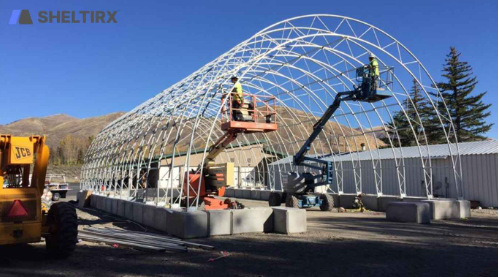
Temporary construction shelters are the most flexible tool in the site manager’s kit for this purpose. They deploy before materials arrive, reposition as the programme shifts, and scale to the footprint of stored stock. They don’t require planning consent, don’t tie up capital in permanent infrastructure, and can be matched to specific material requirements rather than one-size-fits-all solutions.
Proper sheltering isn’t just about weather exclusion. It’s about maintaining the certified condition of materials so they pass inspection at point of use. It keeps the certification chain intact for building control, structural engineers, and clients. It keeps materials ready to use when the programme demands them rather than creating a bottleneck at the point of installation.
The range of solutions available reflects the range of site needs. Heavy-duty tarpaulins work for short-term protection of small stockpiles. Purpose-built construction shelters and modular covers suit longer projects with larger or more complex storage footprints. Choosing the right solution depends on site size, exposure conditions, material types, and programme duration.
Four criteria are worth specifying against when evaluating site protection. UV rating determines whether a cover maintains its properties across outdoor use – cheaper materials degrade in sunlight and provide decreasing protection over time. Water resistance should be tested to a hydrostatic head standard, not just described as waterproof. Wind load rating matters on exposed sites where inadequately secured covers become a safety hazard in their own right. Ease of installation determines whether site teams actually use the protection correctly under programme pressure.
These aren’t complex criteria. But they’re the difference between protection that works and protection that creates a false sense of security while the materials underneath continue to degrade.
First Investment, Strongest Return
The sites that finish on time and on budget aren’t fortunate – they’re disciplined. They treat material protection as a first investment, not a last resort, and the six-month timeline above is why. Every category of material on a construction site is vulnerable. Every month of unprotected storage is a month of preventable value loss. The decision to protect doesn’t cost a project; it protects one.
For contractors looking for purpose-built solutions matched to real site conditions, companies like Sheltirx offer a range of site protection products worth exploring – from heavy-duty covers to modular site shelter systems designed for the demands of active construction environments.