



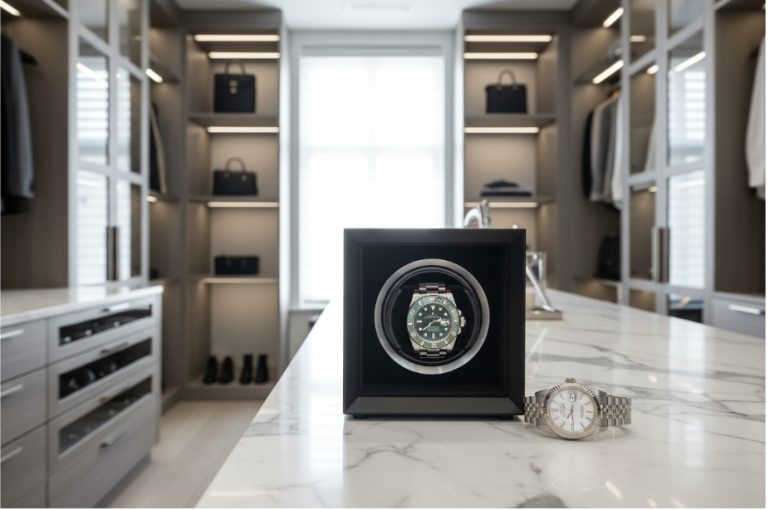
Owning a Rolex is more than just a purchase; for most of us, it is a milestone. Whether it’s a Submariner passed down through the family, a Datejust bought to celebrate a promotion, or a Daytona that took years to track down, these timepieces are mechanical marvels. However, there is a practical side to owning a luxury automatic watch that often gets overlooked until the first time you leave it on the bedside table for a long weekend.
If you own a single Rolex that you don’t wear every day, or if you are starting a collection and want to keep your primary piece ready to go, a dedicated winder isn’t just a luxury—it’s a maintenance tool.
The Mechanical Reality of Your Rolex
To understand why a winder matters, we have to look at what’s happening inside that Oyster case. A Rolex is powered by a perpetual rotor—a half-moon-shaped weight that spins as you move your arm, winding the mainspring.
When you take the watch off, the power reserve begins to deplete. Depending on the movement (such as the newer Calibre 3235), you might have about 70 hours of juice. Once that time is up, the watch stops. While stopping isn’t “breaking” the watch, it does create a series of small inconveniences that add up over time.
Avoiding the “Setting Cycle”
Every time your Rolex stops, you have to unscrew the crown, set the time, and—crucially—reset the date. For many, the “Quickset” date feature makes this easy, but frequent manipulation of the crown increases the risk of:
- Cross-threading: Accidentally stripping the threads when screwing the crown back down.
- Gasket Wear: Constant opening and closing can eventually compromise the water resistance.
- User Error: Setting the date during the “danger zone” (usually between 9 PM and 3 AM) when the gears are already engaged to flip the date disk.
By using the best single watch winder for luxury watches, you keep the movement in constant motion, meaning you never have to touch the crown unless you’re adjusting for a short month or Daylight Savings.
Lubrication and Movement Longevity
There is an old debate in the watch world: is it better to let a watch sit still or keep it running? Think of a Rolex like a high-performance car engine. If you leave a car in a garage for six months without turning it over, the oils settle, the gaskets can dry out, and the battery dies.
Modern synthetic oils used by Rolex are incredibly stable, but they still benefit from being distributed through the gear train. A watch winder ensures that the lubricants don’t pool in one area. By keeping the wheels turning, you ensure that the friction-reducing oils stay where they belong—on the jewels and pivots. This can potentially extend the time between expensive service intervals.
The Aesthetic and Practical Benefit of a Single Winder
Most collectors eventually buy a multi-watch winder, but there is a specific, understated elegance to a single winder. It’s about focus.
Space Efficiency
Not everyone has a massive walk-in wardrobe or a dedicated “watch room.” A compact single watch winder for home use allows you to keep your Rolex on a nightstand, a bookshelf, or inside a safe without taking up unnecessary real estate.
Battery vs. Mains Power
A high-quality single-winder often gives you the flexibility of power sources. If you travel frequently or prefer to keep your Rolex in a safe-deposit box, a single winder that runs on D-cell batteries is a lifesaver. It keeps the watch wound in a dark, secure environment where a plug socket isn’t an option.
Understanding TPD: The Rolex Standard
Rolex watches are specific about how they like to be wound. Unlike some brands that only wind in one direction (clockwise or anti-clockwise), most modern Rolex movements are bidirectional.
- Turns Per Day (TPD): Most Rolex models require approximately 650 to 800 TPD.
- Direction: They typically need to be set to “Both” (bidirectional).
If you buy a cheap, generic winder from a high-street department store, it might just spin relentlessly until the motor burns out or, worse, puts unnecessary stress on the watch’s slipping spring (the mechanism that prevents overwinding).
Investment-grade winders allow you to isolate these settings. You can set it to exactly 650 TPD with a “sleep” phase. This mimics the natural rhythm of human wear—active during the day, resting at night. This rest period is vital for the longevity of the winder’s motor and the watch’s internal components.
Protecting the Bracelet and Case
When you leave a Rolex on a hard surface like a marble countertop or a wooden dresser, you risk “desk diving” scratches on the polished centre links or the lugs.
A winder acts as a dedicated display stand. The watch is mounted on a soft, often leather or velvet-lined cushion, keeping it suspended and away from abrasive surfaces. It turns your timepiece into a piece of kinetic art. There is something deeply satisfying about seeing a GMT-Master II slowly rotating under a glass cover; it honours the craftsmanship of the watch.
Why “Single” is Often Better Than “Multiple”
While it’s tempting to buy a box that holds four or eight watches, there are several reasons why the single unit is the “purist” choice:
- Independent Motors: In many large, cheap multi-winders, one motor drives two or three watches. If the motor fails, you lose the whole unit. With a single winder, you have a dedicated, quiet motor tuned for one specific weight.
- Portability: If you are heading away for a weekend and want to bring your “evening” watch while wearing your “sport” watch, you can easily pack a single winder in your luggage.
- Modular Growth: Many collectors prefer to buy high-quality single units and stack them or line them up. This looks much more professional and allows you to set different TPD settings for a Rolex (650 TPD) and, say, a vintage Patek (which might need 800+ TPD in a specific direction).
Common Myths About Watch Winders
“It will overwind my watch.”
This is a common fear. However, all Rolex watches (and all modern automatics) have a built-in safety mechanism. Once the mainspring is fully coiled, the end of the spring simply slides along the inside of the barrel. It cannot “snap.” A quality winder further prevents this by using intermittent rotation cycles.
“It causes unnecessary wear.”
Wearing your watch causes wear. Walking causes wear. The alternative is letting the watch sit for years, which causes the oils to migrate. A winder set to the correct TPD doesn’t “overwork” the watch; it simply keeps it in its optimal operating state.
What to Look for When Buying
If you’re ready to pick up a winder for your Rolex, don’t just look at the price tag. Look for these three features:
- Silent Operation: You don’t want a rhythmic mechanical grinding sound while you’re trying to sleep. Look for Japanese or German motors known for near-silent “whisper” technology.
- Adjustable Cushions: Rolex bracelets are sized specifically to your wrist. If the winder’s cushion is too large, it can stretch the bracelet. If it’s too small, the watch will rattle. Ensure the winder has a “spring-loaded” or adjustable cushion system.
- Shielding: Cheap motors can produce magnetic fields. While Rolex uses Parachrom hairsprings that are highly resistant to magnetism, it’s still best practice to use a winder with a shielded motor to ensure no interference with the watch’s timing.
The Daily Workflow
Imagine your Monday morning. You’re running late for a meeting. You reach for your Rolex, and it’s already ticking, the date is correct, and the time is accurate to the second. You don’t have to stand over the sink for two minutes winding the crown and checking your phone for the correct time.
That convenience is the real “ROI” of a winder. It removes the friction of ownership, allowing you to enjoy the watch exactly when you want to wear it.
Whether you choose a leather-wrapped classic or a modern carbon fibre design, ensuring you have the best single watch winder for luxury watches ensures that your investment stays in peak condition. It’s a small price to pay to protect a timepiece that is designed to last a lifetime and beyond.
If you have a Rolex in your drawer right now that has stopped, do yourself a favour: don’t just wind it by hand and put it back. Give it a proper home in a compact single watch winder for home use. Your watch—and your future self—will thank you.