



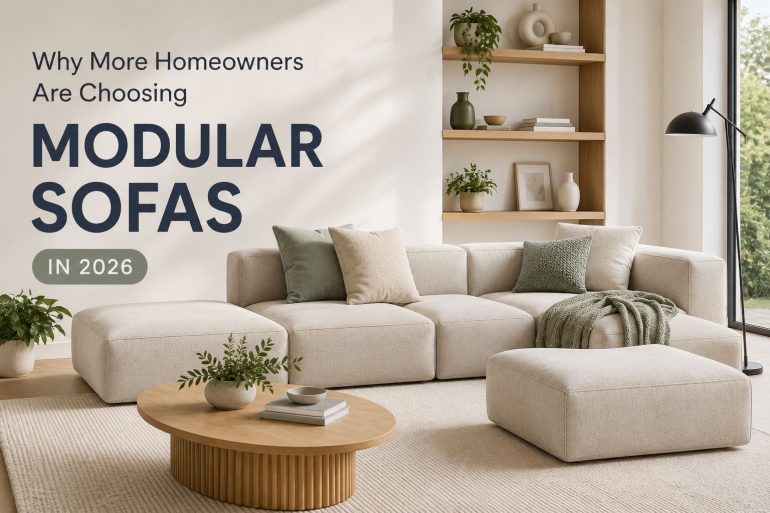
The traditional sofa — fixed shape, fixed size, bought once and kept until it falls apart — is quietly losing ground. Modular sofas have been around for decades, but something shifted recently: they stopped being a niche option for design-forward apartments and became a mainstream choice for ordinary households. In 2026, they’re one of the fastest-growing furniture categories in the US market, and the reasons behind that shift are worth understanding.
Part of the appeal is how well modular furniture fits a more intentional approach to home ownership — one where people think not just about day one, but how something holds up over years of real use. That mindset extends to protection too: accessories like a waterproof couch cover have become a natural companion to quality furniture — a way to extend the life of an investment rather than accept that wear is inevitable. But the shift toward modular sofas goes deeper. It reflects how Americans are living differently.
Homes Are Being Used Differently
Remote and hybrid work changed how people relate to their living spaces. The living room isn’t just a place to unwind anymore — it doubles as a workspace, a reading area, a kids’ zone, depending on the hour. A sofa that works for one function but not the others creates constant friction. Modular configurations let people build a setup that genuinely serves multiple uses: a deep chaise for relaxing, a section that converts to extra seating when guests arrive, an ottoman that pulls away when floor space is needed.
Urban living has amplified this further. Apartments are smaller on average, and renters move more frequently than previous generations. A modular sofa that reconfigures for a new floor plan — or breaks into sections that fit through a narrow door — solves a real logistical problem that a standard three-seater simply doesn’t.
The Investment Logic Has Changed
There’s been a generational shift in how people think about furniture spending. Younger homeowners are skeptical of cheap disposable pieces — they’ve replaced enough of them to understand the math doesn’t work. Modular sofas offer a resolution: buy quality once, then replace only what gets damaged rather than the entire piece.
Several modular sofa brands now sell individual components — cushion covers, seat sections, armrests — as standalone items. If one section takes a bad stain or the foam compresses in a heavy-use spot, you replace that module rather than starting over. Over a decade, that’s often more economical than buying three successive budget sofas. It’s also less wasteful, which matters to a growing share of buyers.
Design Has Finally Caught Up
For a long time, modular sofas had a reputation for looking slightly clinical — clean lines, neutral tones, furniture that photographed well but didn’t feel particularly warm to live with. That’s changed. The current market offers modular options in rich textured fabrics, curved silhouettes, deep cushioning, and configurations that feel tailored to a room rather than generic.
Curved modular sections in particular have had a notable moment — they soften the geometry of a room in a way straight-edged sectionals don’t, and work well in open-plan spaces where the sofa doubles as a room divider.
The combination of aesthetic flexibility and practical adaptability is what’s drawing buyers who previously wouldn’t have considered modular at all.
What to Check Before You Buy
Not all modular sofas deliver on the promise. The category has enough variation that knowing what to check saves a lot of regret:
- Connection system: Sections should lock firmly without shifting during use. Test in person if possible — loose connections are hard to fix after the fact.
- Frame material: Solid hardwood or steel outlasts particleboard significantly, and this matters more in modular furniture where the frame takes stress at connection points a fixed sofa doesn’t have.
- Replaceable covers: Check whether the brand sells them separately. If not, you lose the main long-term advantage of going modular.
- Configuration range: Some systems offer only a few preset arrangements. Think about your next space, not just the current one.
- Cushion density: High-resilience foam holds its shape over the years; low-density foam compresses fast and makes the sofa feel cheap within a year or two.
Who Is Actually Buying Modular
The buyers driving this trend aren’t a single demographic — they share a mindset more than an age bracket. Families with young children are drawn to the durability and the ability to swap out covers rather than replace an entire sofa after a bad spill. Pet owners value the same thing: when one section gets clawed or stained beyond saving, they replace that module and move on. Renters and frequent movers choose modular because a sofa that reconfigures to fit a new apartment is simply more practical than one that may not fit through the next front door. And remote workers who spend far more time in their living rooms than previous generations need furniture that functions across different modes of the day without feeling like a compromise in any of them.
What connects all of them is a shift away from buying furniture that looks good toward buying furniture that works well — and keeps working well as circumstances change. Modular sofas happen to be built exactly for that. It’s less a trend than a correction.