



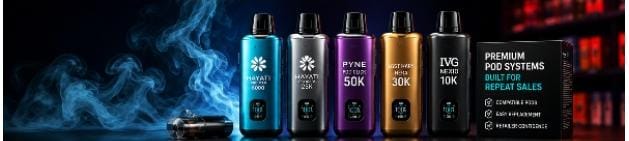
Vape retail is increasingly shaped by complete product systems rather than individual devices. For retailers, that changes how a new pod kit should be assessed before it earns space within an existing range.
Headline specifications are still useful, but they do not tell buyers whether replacement products will be easy to identify, whether staff can explain the system clearly, or whether the product adds something genuinely different to the current assortment.
Retailers exploring prefilled pod kits therefore benefit from looking at the complete ecosystem surrounding each device.
A Pod Kit Is Only the Beginning
The first sale is only one stage of the product journey.
After purchasing a kit, a customer may later return looking for compatible replacement pods. Retail staff then need to know exactly which product fits the device and how to distinguish it from similar alternatives.
This makes several factors important:
- clear compatibility;
- replacement availability;
- understandable product naming;
- straightforward staff education;
- sensible range positioning;
- and reliable stock planning.
When these elements work together, the product becomes easier for retailers to manage.
Think About the Second Purchase
Wholesale buyers naturally focus on whether an initial kit is likely to sell.
But the second purchase can reveal much more about the strength of the ecosystem.
Consider what happens when a customer comes back several days or weeks later.
Can they remember the product family?
Can staff immediately identify the replacement?
Does the packaging clearly connect the replacement product with the original device?
Is that supporting stock readily available?
If these questions are easy to answer, the system is much easier to support over time.
Puff Counts Need Context
Large puff estimates can attract attention, but they should not automatically determine which product deserves a larger stock commitment.
A retailer might compare two systems with impressive headline numbers and discover that they serve almost identical customer needs.
Adding both could create unnecessary duplication.
A better question is:
What role will this product play within the range?
That might include satisfying existing brand demand, introducing a different device format, filling a specific price point or creating a stronger replacement-pod ecosystem.
The product should ideally have a reason for being there beyond being new.
Compatibility Affects Retail Efficiency
Clear compatibility information can reduce unnecessary work for retailers.
Staff may spend extra time checking products. Customers can select the wrong replacement. Similar packaging can add confusion.
Clear compatibility reduces those problems.
It also makes merchandising easier because related products can be grouped logically and explained as one ecosystem rather than several unrelated items.
For busy retailers, this operational simplicity can be valuable.
Hayati 6K as a Range-Planning Example
The Hayati Pro Max 6000 is a useful example of why retailers should evaluate a product in relation to the rest of their stock.
Instead of judging the device through one specification, a buyer can consider:
- whether customers already recognise the Hayati range;
- how it differs from other Hayati products;
- how easy the product is for staff to explain;
- what place it occupies within the store’s prefilled selection;
- and how its wider product family fits future customer demand.
Different retailers may arrive at different answers.
That is exactly why strategic range planning matters.
Avoiding an Overcrowded Vape Range
Constantly introducing similar products can gradually make a range harder to understand.
Retailers may end up with many devices competing for the same type of customer while stock investment becomes spread across more SKUs.
A stronger assortment can group products according to clearer roles.
Useful dimensions include:
Brand family
Products from recognised brands can be grouped where customers already understand the connection.
Device format
Different formats can satisfy different customer preferences without unnecessary duplication.
Replacement ecosystem
Products with clear supporting pods can be planned as a complete system.
Customer demand
Actual enquiries and repeat purchases should influence future stock allocation.
Replacement Products Deserve Their Own Planning
Replacement demand may develop differently from demand for initial kits.
Once enough customers own a particular system, replacements can become an important recurring stock requirement.
Retailers should therefore avoid treating replacement products as an afterthought.
They should consider them when the device is first introduced and monitor demand separately once sales begin.
Product Information Helps Staff Too
Wholesale product information is not valuable only to purchasing managers.
Retail employees may later use the same information to answer questions about:
- what the kit contains;
- how it works;
- compatible products;
- differences between ranges;
- and what customers may need later.
Clear information can therefore support both purchasing and customer service.
Review the Range Using Real Demand
A product does not have to remain a permanent part of the range simply because it was introduced successfully.
Retailers can continue monitoring:
- sell-through;
- repeat enquiries;
- replacement demand;
- customer confusion;
- slow-moving variations;
- and overlap with newer systems.
The assortment can then evolve around actual behaviour rather than simply accumulating products.
Final Thoughts
Modern prefilled vape retail is increasingly about complete ecosystems.
The kit may create the initial interest, but compatibility, replacement availability, product clarity and range fit can determine how useful that system becomes over time.
Retailers who evaluate the complete journey can build a more organised assortment, make stock planning easier and give customers a clearer path from the initial purchase to future replacements.