



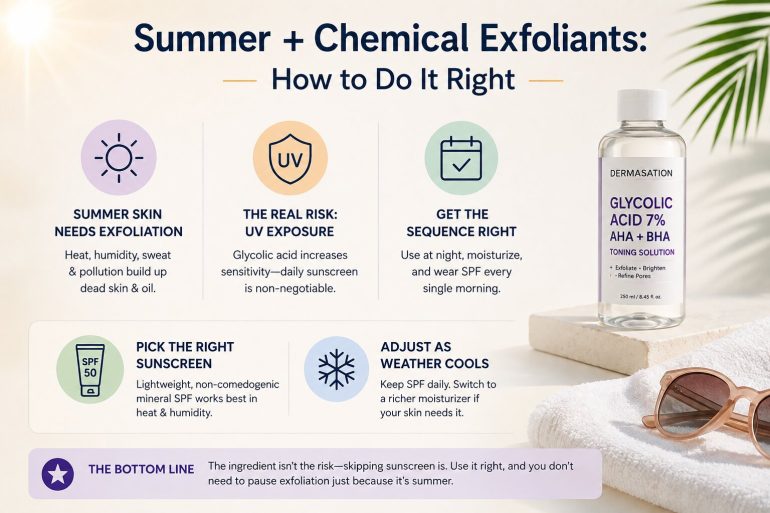
There’s a common assumption that active ingredients like glycolic acid are best saved for winter, when skin feels drier and more in need of intervention. In practice, summer is often when skin needs exfoliation the most. It’s also the season where using it incorrectly causes the most damage. Here’s how to navigate that tension properly.
Why Summer Skin Needs Exfoliation More, Not Less
Heat, humidity, sweat, and pollution all accelerate the buildup of dead skin cells, excess oil, and surface debris, the exact combination that leads to dullness, clogged pores, and uneven texture. Skin doesn’t get a break from needing renewal just because the weather’s warmer. If anything, the increased oil production and environmental exposure make regular exfoliation more relevant during summer months, not less.
The Real Risk: UV Sensitivity
The reason people hesitate to use glycolic acid in summer isn’t unfounded, it’s just misdirected. Glycolic acid genuinely does increase skin’s sensitivity to UV exposure, and summer sun is exactly when that sensitivity matters most. The mistake isn’t using glycolic acid in summer. The mistake is using it without treating sunscreen as completely mandatory the following morning.
Skipped or inconsistent sunscreen use during summer, combined with a chemical exfoliant, is a fairly reliable way to end up with worse pigmentation than you started with not because the ingredient failed, but because the sun protection around it did.
Getting the Sequence Right
The safest approach during peak summer months looks like this:
- Apply a glycolic acid toner in the evening only never in the morning, regardless of season
- Follow immediately with a proper moisturizer to support the skin barrier overnight
- The next morning, apply a broad-spectrum sunscreen without exception not “when I remember,” genuinely every single day
- Reapply sunscreen through the day if you’re spending meaningful time outdoors
A formulation like Dermasation’s Glycolic Acid 7% AHA + BHA Toning Solution, used at a moderate three to four evenings a week even during summer, tends to work well within this sequence, provided the sunscreen step isn’t treated as optional.
Choosing the Right Sunscreen to Pair With It
Not all sunscreens are equally suited to being paired with an exfoliating routine in hot weather. A heavy, greasy formula becomes genuinely unbearable in summer heat, which often leads to people skipping reapplication or avoiding sunscreen altogether undermining the entire routine. A lightweight, non-comedogenic mineral sunscreen tends to hold up better through summer humidity while still providing adequate protection for skin that’s more UV-sensitive than usual.
What Changes as the Weather Cools
Once temperatures drop, the core routine doesn’t need to change dramatically sunscreen remains just as necessary, since UV exposure doesn’t disappear with the heat. What often does need adjusting is moisturizer, since drier air tends to strip moisture faster, meaning a richer formula may be worth switching to for the coldest months, even while keeping the same evening exfoliation routine intact.
The Bottom Line
Summer isn’t a season to avoid glycolic acid, it’s a season that demands doing it properly. The ingredient itself isn’t the risk. An inconsistent sunscreen habit paired with it is. Get that one detail right, and there’s no real reason to pause an exfoliation routine just because the temperature climbed.