


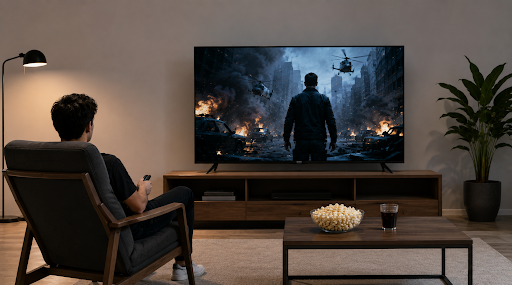
Action movies are frequently analyzed using terms such as speed, scale, choreography, explosions, and stunts, but movement does much more than entertain the audience. In the best action movies, movement becomes a language of the movie itself. How the character comes into the room, meets his rival, tries to escape, or uses his weapon- all this can speak about his personality and intentions without any words.
This is one of the features that makes action sequences unforgettable in contrast to those which are just dynamic. Good filmmakers do not consider the movements an element of decoration between important scenes. On the contrary, they make use of them in order to transmit some information, create tension, demonstrate the relations, and set the emotional pace of the movie.
If the movement is properly designed, all the chases, fights, and physical moves can serve both for characters and plot development.
Movement Can Reveal Character Before Dialogue Does
A person’s physical behavior can tell the audience almost immediately who they are. A trained fighter may enter a dangerous space with controlled movements, constantly checking exits and observing potential threats. An inexperienced character might move with hesitation, react too slowly, or depend more heavily on instinct.
Those differences matter because they allow filmmakers to show competence rather than simply describe it.
Action stars have often built recognizable screen identities through movement. Some characters fight with precision and discipline, while others appear aggressive, improvisational, or almost reckless. Even when two characters have similar abilities, their body language can make them feel completely different.
That distinction helps action scenes become extensions of character rather than interruptions in the story.
Choreography Is a Form of Narrative Structure
A good fight begins, builds, and ends the same way that any dramatic moment does. Fighters begin with one strategy in mind, but their strategy is undermined by new information, creating a shift in balance throughout the sequence. This makes it a form of physical storytelling.
One fighter may begin the fight dominant due to their size, but then be thrown off when the other shifts strategy. Another fighter may try to avoid confrontation, but then be forced into an attacking role as the fight goes on. The fight tells the story in its actions. Planning those shifts visually before filming can make complex movement easier to understand, which is where storyboarding through World Production Service can support filmmakers in mapping action, camera perspective, and narrative progression before the sequence reaches the set.
If every blow or strike seems the same, then the scene is boring. But when there is a connection between the fighters’ strategies and their actions, then it tells a story without dialogue.
The Way Characters Move Can Show Their Relationships
Movement will help define the interaction between characters as well. For two experienced individuals, movement can occur smoothly without much talking, with them covering each other in an instinctive manner. Characters that distrust each other might be hesitant, obstruct each other, or continuously try to dominate each other.
While doing this in group action shots, these little details will help in showing group dynamics very effectively. The leader might choose a place between the threat and the entire group. Selfish characters may run away when other characters stay exposed. A character who has finally become confident may start moving with some strong characters in the team rather than following them.
Such little movements will thus be helpful in bringing big emotional moments for characters. It is particularly helpful in action films since the progression of characters continues even in spectacular action sequences.
Camera Movement Becomes Part of the Story
Camera movements can be as important as actors’ movements. A static camera can create a feeling of control of the event being observed by the viewer, whereas fast camera movements can create a sense of urgency or even chaos. Tracking shots can put the viewer into the middle of chase scenes, while wide angles can emphasize how big a stunt was or how far apart characters were from each other. Translating those choices into effective screen language is part of the wider video production process supported by World Production Service, where camera movement, framing, performance, and visual continuity need to work together rather than function as isolated technical decisions. The most important thing here is intentionality.
Camera movements have to enhance the emotional meaning of a scene rather than just to make it more dynamic. For example, a static camera observing a professional fighter can emphasize his control because everyone will see how he performs all his moves. Conversely, chaotic camera framing can enhance the idea of losing control that the character is experiencing. The audience will not notice these things consciously but will feel them anyway.
Geography Gives Movement Meaning
The dynamics of physical movements are even more exciting once audiences have knowledge about the space in which they take place. A character running down a corridor is one thing, but a character running down a corridor in order to escape a threat that comes from behind is a totally different story. The presence of geography is what makes movement dynamic.
It is vital for audiences to be able to locate characters in space, understand their destination, and know what prevents them from reaching it. This aspect becomes especially critical when it comes to chase scenes. If audiences are unable to see the dynamics of the chase itself, it will lose its dramatic effect no matter how intense it is.
That is why successful action film directors usually introduce geography first, then speed up the scene.
Speed Should Change With Emotion
Variation in speed is perhaps one of the best ways to create a good action film. Without the contrast in the speed of the film’s action, even an exciting sequence may get boring. Good films vary their scenes between high-speed action and calm moments. An unexpected stop before the attack will have more effect than endless motion of the character.
The process of a person getting close to a dangerous place will make viewers wonder what will happen next. This will make the action sequence feel more dynamic when it starts. This is why variations in the speed of the individual scenes are so important.
The fight may start slowly, become chaotic, then slow down because the opponents get tired, and finally, end up in one quick motion.
Movement Can Communicate Power
Positioning in action films often demonstrates dominance. The dominant individual can be centrally placed, make slow movements, and make others respond. The weaker individual could be pushed back, trapped on walls, and repeatedly have to change his or her course. This positioning will demonstrate to the audience who is in charge of the interaction.
The balance of power can also shift during a scene. The individual who starts in retreat may slowly advance after gaining confidence. An invincible villain may lose space when the hero finds an Achilles’ heel. This shift is enjoyable for the audience since it allows them to see how control moves from one person to another.
This means that good action scenes communicate more than physical interaction; they convey a shift in status.
Stunts Work Best When They Serve the Story
An amazing stunt is a surefire way to win over an audience, but an even better stunt will have a purpose to serve. If there’s a sense of why the character is jumping, the stunt is more significant. It is more significant if there’s a shift in direction of the chase because of the car crash.
The best action films incorporate stunts into the plot rather than planning scenes based on certain impressive stunts. To achieve this, directors, stunt coordinators, actors, camera crews, and editors must work very closely.
Each action must follow logically from what happened prior and what happens after. In such cases, audiences don’t only admire the stunt but feel it as a part of the story.
Editing Controls How Movement Is Understood
Movement keeps getting molded even after production has been completed. It is the editors who decide how long the audience will have to observe an action, when their point of view needs to be changed, and how one movement will relate to the other.
A rapid editing technique can be used to increase the excitement level of a particular sequence, but the speed of cutting in itself cannot necessarily add excitement to the sequence.
Whereas, when the editor cuts too soon for the audience to figure out what they are being shown, the action becomes hard to follow. In fact, a slight extension of the shot allows the audience to understand the quality of performance or the magnitude of the stunt being performed.
Silence and Stillness Make Movement Stronger
Not only does movement play a role in action storytelling. Standing still can also convey a lot of information about a character. Two opposing characters staring each other down right before an action sequence can establish great tension through complete lack of movement.
Stillness provides contrast to movement. If there is constant movement from all characters and the camera, the viewer can get visually tired. Pauses give the opportunity to rest and focus on what is really happening.
Some of the best action sequences happen when the film realizes exactly how to stay still. The still moment before drawing a gun, the pause before the chase, and the silence after impact.
Physical Performance Creates Emotional Connection
Actions in performance frequently express emotion physically. Fatigue manifests through slower actions and heavier breathing. Fear might manifest through hesitancy, while determination can be shown in a character moving ahead even in spite of injury. This makes actions personally relatable.
In their absence, the characters themselves risk becoming indestructible, potentially making them less emotionally interesting. Heroes that struggle, adapt, and suffer from the actions they perform are generally more compelling than those that simply glide effortlessly through conflict after conflict. Physical vulnerability lends weight to action.
The Best Action Tells a Story Without Needing Explanation
The best action scenes will often make sense without sound. They will convey who is threatened, who wants what, who holds power at any given time, and when the emotional shift happens. And all of this will happen because movement was used as storytelling and not just spectacle.
Each step, each camera movement, each stunt, and each physical response will be part of the storytelling process. And this is how great action filmmaking differs from visual gibberish.
Great action films realize that movement is about more than moving characters around. Movement is a language that is able to convey personality, fear, power, trust, desperation, and transformation. If filmmakers speak this language properly, action is more than just a distraction between dramatic moments. Action is one of the most direct ways of telling the story.