



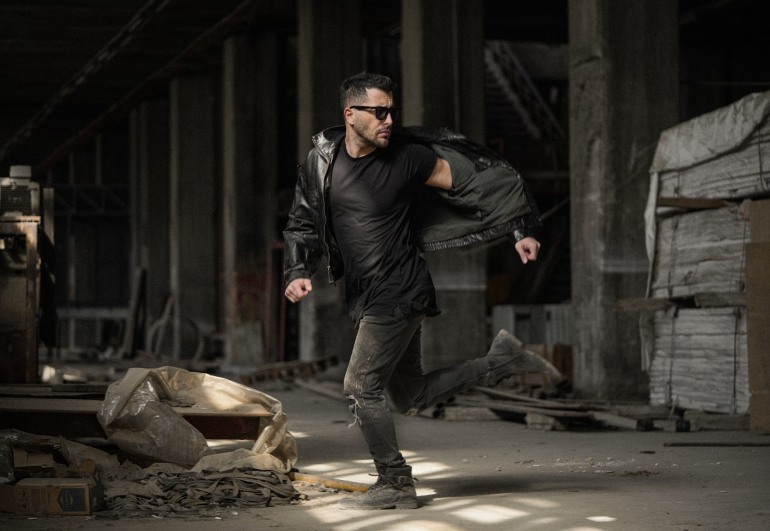
The action genre has always acted like a mirror, reflecting both people’s fears and the possibilities of technology. People used to enjoy simple chases, but today they watch «digital symphonies of destruction» and demand more. Action films have long ceased to be considered a «low» genre – they are now the main engine, pulling the entire film industry forward.
A strange thing is happening right now. Cinema is not just returning to us; it is becoming more vicious, requiring far more complex technology. Directors seem to compete in madness: some blow up ten cars, others leap from the stratosphere to catch stars. Budgets for a single ten-minute scene easily soar into the hundreds of millions of dollars. But why such sacrifices? What is really driving the industry to raise the bar so high?
The Evolution of Spectacle – From Stuntmen to Superheroes
The action film genre in the ’80s was all about sweat, muscle, and charisma. While Schwarzenegger and Stallone were flexing their muscles, cameramen were capturing real fire and real explosions, skimping on pyrotechnics. The CGI era of the 2000s transformed this into a parade of special effects, where superheroes demolished megacities without even breaking a sweat. But the paradox is that the perfect image quickly becomes boring.
Today, viewers are witnessing a kind of «old school renaissance». The success of Tom Cruise with his insane jumps or Keanu Reeves in Wick proves that viewers don’t care about millions of polygons if they do not sense danger. People need a tactile response, the sense of weight, and the raw thrill that cannot be fully simulated on a computer.
If you want to understand what the exact factors are that have influenced the genre’s contemporary development, you should take a look at the key changes that have happened in production approaches:
- Globalization of Markets. Films are no longer made solely for American or European audiences. China, India, and Latin America dictate their own rules – more visual storytelling, understandable without words.
- Camera Technology. The use of compact IMAX cameras and drones makes it possible to film action from angles that were previously physically impossible.
- Long Takes. Instead of the choppy editing of the 2000s, directors like David Leitch or Chad Stahelski are moving toward long, choreographed fight scenes.
- Getting Rid of Genre Boundaries. An action film today is a thriller, a drama, and even a comedy all rolled into one.
These changes have become a thing because times are different now, and viewers have their own expectations from the modern media. These days, action movies respond to the demands of an audience accustomed to fast-paced content consumption and demanding immediate engagement.
The Explosion Economy – Risk and Reward
Making a blockbuster today is like going all-in. Studios pour crazy amounts of money into production, praying for at least double the return. And this isn’t just about graphics or sets anymore. Marketing has become far more vicious: sometimes a film’s fate is decided not in the screenwriter’s chair, but the moment the main character’s stunt lands in a Reels or TikTok recommendation.
The entire entertainment industry now runs on the same fuel: pure excitement. People go to the cinema for a powerful ending, but people are looking for the same emotions elsewhere. Some catch this thrill on platforms like Win Bet, where everything is tied to predictions and the ability to seize the moment. Ultimately, it does not matter whether you’re watching a movie or betting on the outcome of a match; viewers just want to feel that adrenaline rush and be at the center of the action.
Over the past forty years, the action film genre has mutated beyond recognition. To clearly see this contrast, just look at how the «rules of the game» have changed.
| Feature | The Golden Era (80s–90s) | The 2020s Reality |
| The Protagonist | Bulletproof “macho” icons | Gritty pros or heroes in spandex |
| Visual Effects | Real gasoline and scale models | A hybrid of CGI and «practical» stunts |
| The Budget | A modest 30-70 million dollars | Sky-high – more than 200 million dollars with price tags |
| Fight Style | Raw power and old-school brawling | A complex «ballet» of MMA and Gun-fu |
| The Setting | Contained, like the Die Hard movie fully set in a building | Constant globe-trotting every 20 mins |
The scale has simply exploded. While in the days of Schwarzenegger and Stallone, rescuing hostages from a seized office was enough for a hero, today’s protagonists will no longer settle for anything less than saving civilization or at least the global financial system. The stakes have risen, and with them, so have the demands on spectacle.
Courage as The New Norm
Directors are becoming bolder, and you can tell that right away when you watch modern action movies. It is all about the competition among streaming services. To drag some out of the comfortable TV chair and motivate them to buy an IMAX ticket, you need to provide something extraordinary, something they will never see on a standard screen. This is why even Tom Cruise tries to jump off a motorcycle off a cliff in order to make the film look a little bit more interesting. For these stars, it is a business strategy – an opportunity to prove that cinema can still offer an unparalleled experience.
Boldness can also be felt as a part of screenplays. People are seeing more inclusivity, stronger female characters, like in the movie «Furiosa», and more complex moral dilemmas. Heroes are no longer cardboard cutouts – they suffer, doubt, and make mistakes, which makes their adventures even more gripping.
People do not love action movies for their profound dialogue. There are several reasons why this genre is still going strong:
- Pure escapism. It is a legitimate way to forget everything for a couple of hours. You just lose yourself in the screen and forget about deadlines.
- Fighting as art. Modern action is no longer just a brawl, but a true ballet. When the fight choreography is perfectly calibrated down to the millimeter, it’s simply a joy to watch.
- Good old physics. The audience is not stupid; they can tell the difference between tons of graphics and a real stunt. When you realize that Tom Cruise actually hung from a plane without any greenwash, it inspires respect.
- A second wind for classics. Movies like «Mad Max» and «Top Gun» thrived not only on nostalgia but also on the fact that they were filmed with a modern flair.
- A sound that makes your bones tremble. In a good movie theater, the sound works as well as the picture, literally drawing you into the shootout.
- It seems the genre is at its peak right now. And it is not over yet: soon, neural networks and augmented reality will allow us not just to watch the hero from the sidelines, but to literally breathe down his neck during the chase.
Ultimately, on-screen adrenaline is not just chemistry; it is a way to survive in our crazy world. People need heroes who solve problems with a single blow, because in real life, everything is much more complicated. While they need to relieve stress, directors will go out of their way to surprise us with something even more insane.