



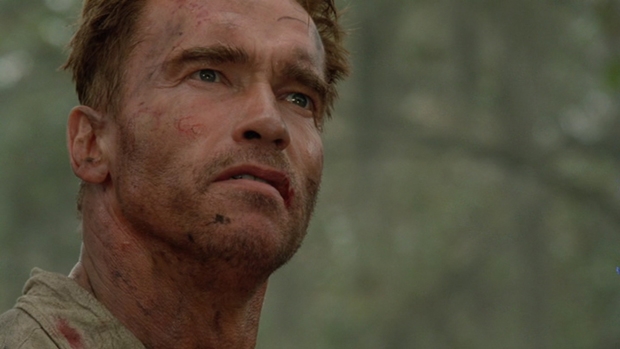
Arnold vs. Stallone: The Short Answer
Arnold vs. Stallone is not just a celebrity comparison; it is the defining action-movie rivalry of the 1980s. Sylvester Stallone owned the emotional underdog hero through Rocky Balboa and John Rambo, while Arnold Schwarzenegger became the larger-than-life machine of muscle, weapons, sci-fi, and one-liners. The ultimate 80s action hero depends on what matters most: Stallone had the stronger dramatic foundation, but Arnold became the clearer symbol of pure 80s action cinema.
Arnold Schwarzenegger’s Case
Arnold Schwarzenegger built his 80s action identity around scale, physical presence, and unforgettable screen images. The Terminator turned him into a futuristic nightmare in 1984, earning $78.3 million worldwide on a reported $6.4 million budget, which made the film a major return on investment and launched his signature franchise.
Arnold then doubled down with Commando in 1985, The Running Man in 1987, and Predator in 1987. Predator became one of his strongest decade-defining roles, grossing $98.2 million worldwide and mixing military action with sci-fi horror.
Arnold’s biggest advantage was simplicity. He did not need long speeches or emotional backstory to dominate the screen. His body, accent, sunglasses, weapons, and deadpan humor became the brand. Lines like “I’ll be back” and “Get to the chopper” turned him into a pop-culture machine.
Sylvester Stallone’s Case
Sylvester Stallone entered the 80s with something Arnold did not have: serious prestige. Rocky won Best Picture at the 49th Academy Awards, and Stallone became only the third person in Oscar history at that time to be nominated in the same year as both actor and screenwriter.
Stallone’s 80s action run was built on two legendary characters. Rocky III and Rocky IV kept the boxing saga alive, while First Blood introduced John Rambo in 1982. By 1985, Rambo: First Blood Part II turned Rambo into a one-man-army icon and grossed $300.4 million worldwide.
Stallone also wrote or co-wrote many of his key 80s vehicles, including First Blood, Rambo: First Blood Part II, Rocky IV, Cobra, Over the Top, and Rambo III. This gave him a creative-author edge. He was not only performing the hero; he was shaping the mythology behind him.
Box Office and Popularity
Box office numbers show how close the race really was. In 1985, Stallone had two giant cultural hits: Rambo: First Blood Part II and Rocky IV. Rocky IV alone reached $300.4 million worldwide, making it one of Stallone’s biggest decade-defining successes.
Arnold’s 80s films did not always beat Stallone’s biggest grosses, but they created a stronger long-term action template. The Terminator, Commando, Predator, and The Running Man helped define what audiences expected from the modern action star: impossible strength, brutal efficiency, futuristic danger, and a memorable catchphrase.
Stallone won many emotional battles at the box office, especially through Rocky and Rambo. Arnold won the branding battle because his image became easier to imitate, parody, and sell across posters, trailers, games, and later sequels.
The Rivalry Made Both Bigger
The Arnold-Stallone rivalry was real and useful. In a later joint interview, Schwarzenegger said Stallone was “very helpful” because he gave him something to chase, while Stallone admitted Arnold motivated him as real competition.
This competition pushed both men toward bigger bodies, bigger weapons, higher stakes, and louder movies. Their rivalry helped shape the golden age of muscular action cinema, where the hero could defeat armies, survive explosions, and still deliver a perfect one-liner.
Acting Style and Screen Persona
Acting style separates them more than box office does. Stallone played wounded heroes. Rocky wanted dignity, Rambo carried trauma, and even Cobra felt like a man built for a broken world. His voice, face, and physical struggle made his characters feel damaged but determined.
Arnold played mythic heroes. The Terminator was not human, Dutch in Predator was almost superhuman, and John Matrix in Commando was a father turned unstoppable weapon. Arnold was less emotionally flexible than Stallone, but he was more visually iconic.
Cultural Legacy
Cultural legacy gives both men a permanent place in action history. Stallone gave cinema two of its most durable characters: Rocky and Rambo. Rocky represents perseverance, while Rambo represents survival, rage, and the complicated image of the American warrior.
Arnold gave cinema the ultimate action-star silhouette. The leather jacket, sunglasses, massive frame, and mechanical delivery created an image that still defines 80s action. Even people who have never watched every Arnold film usually understand what “an Arnold-style action hero” means.
Arnold vs. Stallone: Who Is the Ultimate 80s Action Hero? And 80s Action Heroes in Games
80s Action Heroes in Games carry the same explosive energy that made Arnold Schwarzenegger and Sylvester Stallone legends on the big screen. Many classic and modern games borrow from the same formula: powerful heroes, dangerous missions, heavy weapons, dramatic escapes, and larger-than-life villains.
This action style also appears across different gaming categories today, where fast decisions and high-risk moments create a similar feeling of tension. That is why topics like real money crash gambling games and entertainment platforms such as Wildz Casino can connect naturally with the 80s action-hero spirit: both are built around speed, suspense, timing, and the thrill of not knowing what happens next.
Just as Arnold and Stallone turned every scene into a battle of courage and survival, 80s-inspired games keep players engaged through pressure, movement, and instant excitement.
Final Verdict: Who Is the Ultimate 80s Action Hero?
The final verdict is Arnold Schwarzenegger as the ultimate 80s action hero, with Sylvester Stallone as the deeper and more emotionally important movie hero. Stallone had better dramatic roots, more creative control, and two legendary characters. Arnold, however, became the purest symbol of the decade’s action fantasy.
Arnold represents the 80s action formula at its loudest and most recognizable: muscles, machines, explosions, alien hunters, impossible odds, and immortal catchphrases. Stallone gave the decade its heart, but Arnold gave it its poster.