



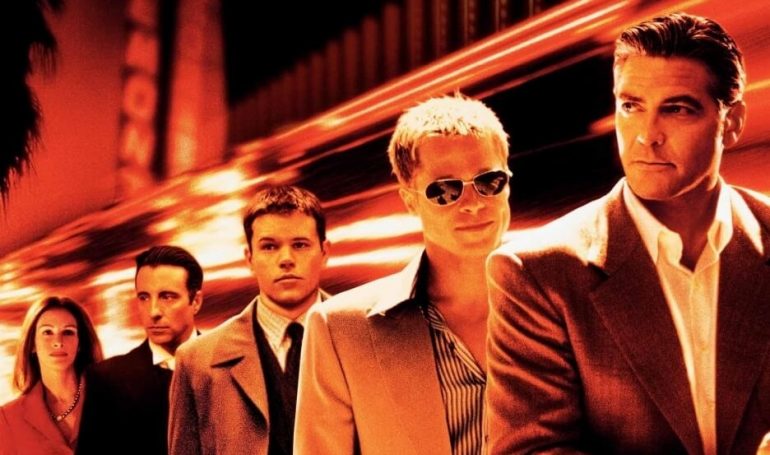
Danny Ocean never sweats. That is the whole trick.
Eleven men rob three casinos in a single night, and Soderbergh spends most of the running time on people talking quietly in rooms. The vault gets cracked almost casually. What the film actually understands is that a location built entirely around people losing money is doing half your dramatic work before anyone loads a weapon.
Action directors have been chasing that ever since, and the reason is simple enough: a table where somebody is about to lose everything comes with a countdown already installed.
Why the Genre Keeps Booking the Same Room
Bond got there first. The character’s introduction in Dr. No in 1962 is a chemin de fer table, not a car chase, and nearly forty years before Ocean’s Eleven the formula was already settled. Put a man in a dinner jacket across from someone who does not blink, and you have tension without a single round fired.
The appetite behind this extends well past the multiplex. Plenty of viewers watch a crew clean out a casino floor and want a version of that feeling they can actually sit down at, without the federal charges.
Minnesota is a useful illustration of how that demand gets served. The state has a substantial tribal casino sector operating under compacts, alongside one of the country’s longest-running charitable gaming traditions, so the appetite is well established and locally supplied. For players who want a table without the drive, guides covering online casinos accepting players from Minnesota set out what the platforms available to the state actually offer and how they differ.
The Bluff Is the Real Star
Here is what separates a good casino scene from a good fight scene.
A fight tells you who wins the moment the choreography starts. You know the hero survives. You knew from the poster. The outcome is essentially contractual, and the pleasure is in the execution rather than the question.
A hand of cards does not work like that. Nobody at the table knows what happens next, including the person holding the cards, and that uncertainty is genuinely difficult to fake. It is why directors reach for the format constantly, even in films with no interest in gambling as a subject. It buys real suspense without a stunt budget.
The performances follow the same logic. The memorable beats in these films are almost never the getaway. They are a face doing arithmetic, deciding whether the other person is lying.
Ensemble Jobs Work Because the Room Demands Specialists
Ocean’s Eleven did not need eleven men to open a vault. It needed eleven because a casino presents eleven separate problems, and no one person solves more than two of them.
The safecracker cannot run the inside job. The acrobat cannot forge the paperwork. The pit boss has to be handled by someone who reads people, and the cameras by someone who reads systems. Strip out any one specialist and the plan collapses in a way audiences can follow without being told.
That structure is why the casino heist keeps outliving other subgenres. It generates ensemble casts naturally rather than assembling them for marketing reasons, and every member has a demonstrable job.
The gap between screen and reality has widened considerably since 2001, incidentally. Modern floors run facial recognition, behavioural analytics and integrated table monitoring that would have made the Ocean crew’s approach look antique. Nobody watches these films for procedural accuracy, and the widening gap is arguably the point. The fantasy of outsmarting an impossible system gets more satisfying as the system gets harder to outsmart.
Why the Fascination Holds
The appeal of heist stories generally is not mysterious. Audiences enjoy watching competent people break rules with precision, which is an experience almost nobody gets access to otherwise. Set it in a casino and you add a second layer: the deliberate thrill of risking money inside a building engineered around probability.
Real thefts feed the same loop. The Isabella Stewart Gardner Museum robbery in 1990 remains the largest unsolved art theft on record, and the empty frames still hang in the gallery where the paintings were cut out. Every high-profile museum theft since gets described in the press using the vocabulary of a film script, because that is the vocabulary available.
Fiction and reality keep borrowing from each other. Directors research actual jobs for plausibility, and there is a bottomless supply of real incidents to draw on.
What the Genre Is Actually Selling
Not the robbery. Nobody is opening a casino cage on a Tuesday night, and the films know their audience knows that.
What they are selling is the specific sensation of sitting across from an unresolved outcome and choosing to stay in the hand. Every ensemble heist ever made, underneath the explosions and the one-liners, is a film about a bet. Who is bluffing, who is not, who leaves with the money. That is the oldest tension in the building, given a nine-figure budget and a soundtrack.
It also explains why the table survives every shift in action-movie fashion. Practical effects come and go. CGI budgets balloon and contract. The card flip has needed no upgrades since 1962, because uncertainty does not date.
Which is the same instinct behind our earlier look at why casinos make perfect backdrops for action movies. The room does the work. The genre just keeps showing up to collect.
Something tells me the next big ensemble job finds its way back to a casino floor before long. They always do.